Philip Putze, Tobias Ritschel, Paul Chekhonin, Jochen Geck, Daniel Wolf, Alexey A. Popov, Bernd Büchner, Peer Schmidt and Silke Hampel
{"title":"Creating chirality in WSe2 through screw dislocations by chemical vapor transport†","authors":"Philip Putze, Tobias Ritschel, Paul Chekhonin, Jochen Geck, Daniel Wolf, Alexey A. Popov, Bernd Büchner, Peer Schmidt and Silke Hampel","doi":"10.1039/D4NH00567H","DOIUrl":null,"url":null,"abstract":"<p >Screw dislocation-driven nanostructures of two-dimensional transition metal dichalcogenides (2D TMDs) can feature chirality that enables prominent asymmetric optical properties. One of the outstanding representatives is WSe<small><sub>2</sub></small> as it can exhibit intriguing new size and shape-dependent chemical and physical properties compared to its bulk counterpart. Crystal growth control in nanostructures with screw dislocation-driven growth is central for exploiting their structure-related properties. However, bottom-up syntheses of 2D TMDs usually contain ‘trial and error’ approaches. Here we report on the rational synthesis planning and realizing for the binary system W:Se to achieve chirality in nano-scale crystals by chemical vapor transport (CVT). For that purpose, key parameters were modelled based on thermodynamic datasets. Thus, crystal growth by CVT under addition of SeCl<small><sub>4</sub></small> succeeds for right-handed spiral nanocrystals from 850 °C to 800 °C with a dwell time of 60 min, while left-handed spirals are obtained from 915 °C to 860 °C. Surface-fused SiO<small><sub>2</sub></small> nanoparticles on an Si(100) substrate served as potential nucleation points. Chirality of screwed WSe<small><sub>2</sub></small> was unprecedentedly investigated by circular-polarized Raman Spectroscopy and showed an intensity increase of the E<small><sup>1</sup></small><small><sub>2g</sub></small> mode of 29% and 15% for right and left-handed spirals, respectively. Pyramid-like WSe<small><sub>2</sub></small> analyzed by atomic force microscopy exhibits step heights of around 10 nm. Electron backscatter diffraction patterns reveal a convex curvature for WSe<small><sub>2</sub></small> with the curvature radii determined as <em>R</em><small><sub><em>x</em></sub></small> = (270 ± 32) μm and <em>R</em><small><sub><em>y</em></sub></small> = (141 ± 9) μm, respectively.</p>","PeriodicalId":93,"journal":{"name":"Nanoscale Horizons","volume":" 5","pages":" 944-956"},"PeriodicalIF":6.6000,"publicationDate":"2025-03-13","publicationTypes":"Journal Article","fieldsOfStudy":null,"isOpenAccess":false,"openAccessPdf":"https://pubs.rsc.org/en/content/articlepdf/2025/nh/d4nh00567h?page=search","citationCount":"0","resultStr":null,"platform":"Semanticscholar","paperid":null,"PeriodicalName":"Nanoscale Horizons","FirstCategoryId":"88","ListUrlMain":"https://pubs.rsc.org/en/content/articlelanding/2025/nh/d4nh00567h","RegionNum":2,"RegionCategory":"材料科学","ArticlePicture":[],"TitleCN":null,"AbstractTextCN":null,"PMCID":null,"EPubDate":"","PubModel":"","JCR":"Q1","JCRName":"CHEMISTRY, PHYSICAL","Score":null,"Total":0}
引用次数: 0
Abstract
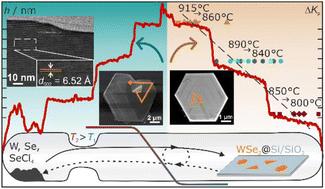
Screw dislocation-driven nanostructures of two-dimensional transition metal dichalcogenides (2D TMDs) can feature chirality that enables prominent asymmetric optical properties. One of the outstanding representatives is WSe2 as it can exhibit intriguing new size and shape-dependent chemical and physical properties compared to its bulk counterpart. Crystal growth control in nanostructures with screw dislocation-driven growth is central for exploiting their structure-related properties. However, bottom-up syntheses of 2D TMDs usually contain ‘trial and error’ approaches. Here we report on the rational synthesis planning and realizing for the binary system W:Se to achieve chirality in nano-scale crystals by chemical vapor transport (CVT). For that purpose, key parameters were modelled based on thermodynamic datasets. Thus, crystal growth by CVT under addition of SeCl4 succeeds for right-handed spiral nanocrystals from 850 °C to 800 °C with a dwell time of 60 min, while left-handed spirals are obtained from 915 °C to 860 °C. Surface-fused SiO2 nanoparticles on an Si(100) substrate served as potential nucleation points. Chirality of screwed WSe2 was unprecedentedly investigated by circular-polarized Raman Spectroscopy and showed an intensity increase of the E12g mode of 29% and 15% for right and left-handed spirals, respectively. Pyramid-like WSe2 analyzed by atomic force microscopy exhibits step heights of around 10 nm. Electron backscatter diffraction patterns reveal a convex curvature for WSe2 with the curvature radii determined as Rx = (270 ± 32) μm and Ry = (141 ± 9) μm, respectively.
期刊介绍:
Nanoscale Horizons stands out as a premier journal for publishing exceptionally high-quality and innovative nanoscience and nanotechnology. The emphasis lies on original research that introduces a new concept or a novel perspective (a conceptual advance), prioritizing this over reporting technological improvements. Nevertheless, outstanding articles showcasing truly groundbreaking developments, including record-breaking performance, may also find a place in the journal. Published work must be of substantial general interest to our broad and diverse readership across the nanoscience and nanotechnology community.



 京公网安备 11010802042870号
京ICP备2023020795号-1
京公网安备 11010802042870号
京ICP备2023020795号-1

 分享
分享
 求助内容:
求助内容: 应助结果提醒方式:
 扫码关注我们
