Heterogeneous Photocatalytic Systems Formed by Compound [Zr6O4(OH)4(C6H5COO)8(H2O)8][SiW12O40] in Combination with Inorganic Cocatalysts for the CO2 Reduction to Alcohols in Water
Jon Napal, Raquel López, Fernando Aguilar-Galindo, Beñat Artetxe, Garikoitz Beobide, Oscar Castillo, Antonio Luque, Sonia Pérez-Yáñez
{"title":"Heterogeneous Photocatalytic Systems Formed by Compound [Zr6O4(OH)4(C6H5COO)8(H2O)8][SiW12O40] in Combination with Inorganic Cocatalysts for the CO2 Reduction to Alcohols in Water","authors":"Jon Napal, Raquel López, Fernando Aguilar-Galindo, Beñat Artetxe, Garikoitz Beobide, Oscar Castillo, Antonio Luque, Sonia Pérez-Yáñez","doi":"10.1002/cssc.202402694","DOIUrl":null,"url":null,"abstract":"<p>The photoreduction of CO<sub>2</sub> to methanol and ethanol is a highly sought-after reaction due to the economic and environmental implications of these products. Both methanol and ethanol are versatile chemical feedstock and renewable fuels. The ionic hybrid compound [Zr<sub>6</sub>O<sub>4</sub>(OH)<sub>4</sub>(C<sub>6</sub>H<sub>5</sub>COO)<sub>8</sub>(H<sub>2</sub>O)<sub>8</sub>][SiW<sub>12</sub>O<sub>40</sub>] (<b>Zr<sub>6</sub>W<sub>12</sub></b>) provides effective separation of the generated electron-hole pair during exposure to UV radiation through a Z-scheme disposition of the HOMO-LUMO levels of each discrete ionic entity. However, this compound does not promote the CO<sub>2</sub> reduction. In contrast, the incorporation of selected inorganic cocatalysts, such as AgI, Bi<sub>2</sub>O<sub>3</sub>, CeO<sub>2</sub>, CuI, CuO, Cu<sub>2</sub>O, In<sub>2</sub>O<sub>3</sub>, PbO, Sb<sub>2</sub>O<sub>3</sub>, SnO, TiO<sub>2</sub> or ZnO, to the photocatalytic system can enable the activation and reduction of CO<sub>2</sub>, leveraging their electronic properties and interactions with <b>Zr<sub>6</sub>W<sub>12</sub></b>. Some of these heterogeneous photocatalytic systems perform well for the photoreduction of CO<sub>2</sub> into methanol and/or ethanol in water and without the need of any sacrificial chemical reagent, achieving maximum production levels of 163 μg g<sup>−1</sup> h<sup>−1</sup> and 144 μg g<sup>−1</sup> h<sup>−1</sup> for methanol and ethanol, respectively, for the Zr<sub>6</sub>W<sub>12</sub>/CuI photocatalytic mixture. Theoretical calculations have been conducted to determine how the relative disposition of the HOMO/LUMO energy levels of <b>Zr<sub>6</sub>W<sub>12</sub></b> and the band structure of the inorganic cocatalysts impact on the CO<sub>2</sub> photocatalytic reduction to alcohols.</p>","PeriodicalId":149,"journal":{"name":"ChemSusChem","volume":"18 12","pages":""},"PeriodicalIF":6.6000,"publicationDate":"2025-03-20","publicationTypes":"Journal Article","fieldsOfStudy":null,"isOpenAccess":false,"openAccessPdf":"https://onlinelibrary.wiley.com/doi/epdf/10.1002/cssc.202402694","citationCount":"0","resultStr":null,"platform":"Semanticscholar","paperid":null,"PeriodicalName":"ChemSusChem","FirstCategoryId":"92","ListUrlMain":"https://chemistry-europe.onlinelibrary.wiley.com/doi/10.1002/cssc.202402694","RegionNum":2,"RegionCategory":"化学","ArticlePicture":[],"TitleCN":null,"AbstractTextCN":null,"PMCID":null,"EPubDate":"","PubModel":"","JCR":"Q1","JCRName":"CHEMISTRY, MULTIDISCIPLINARY","Score":null,"Total":0}
引用次数: 0
Abstract
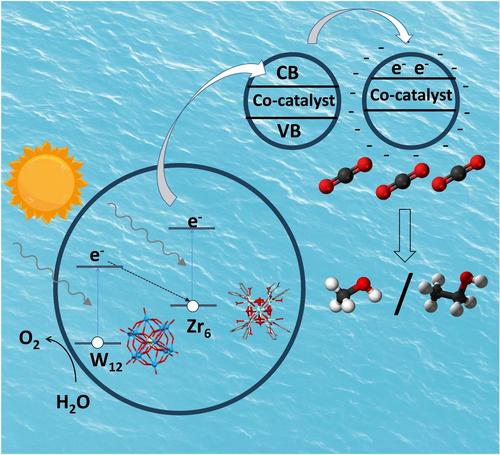
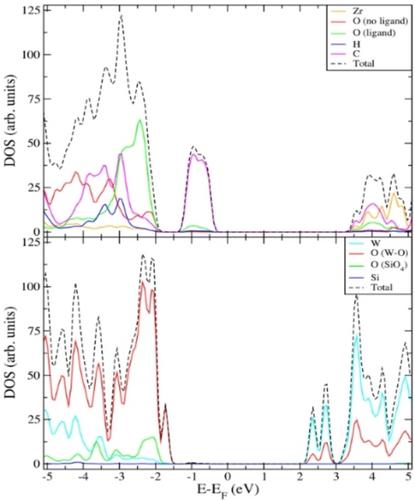
The photoreduction of CO2 to methanol and ethanol is a highly sought-after reaction due to the economic and environmental implications of these products. Both methanol and ethanol are versatile chemical feedstock and renewable fuels. The ionic hybrid compound [Zr6O4(OH)4(C6H5COO)8(H2O)8][SiW12O40] (Zr6W12) provides effective separation of the generated electron-hole pair during exposure to UV radiation through a Z-scheme disposition of the HOMO-LUMO levels of each discrete ionic entity. However, this compound does not promote the CO2 reduction. In contrast, the incorporation of selected inorganic cocatalysts, such as AgI, Bi2O3, CeO2, CuI, CuO, Cu2O, In2O3, PbO, Sb2O3, SnO, TiO2 or ZnO, to the photocatalytic system can enable the activation and reduction of CO2, leveraging their electronic properties and interactions with Zr6W12. Some of these heterogeneous photocatalytic systems perform well for the photoreduction of CO2 into methanol and/or ethanol in water and without the need of any sacrificial chemical reagent, achieving maximum production levels of 163 μg g−1 h−1 and 144 μg g−1 h−1 for methanol and ethanol, respectively, for the Zr6W12/CuI photocatalytic mixture. Theoretical calculations have been conducted to determine how the relative disposition of the HOMO/LUMO energy levels of Zr6W12 and the band structure of the inorganic cocatalysts impact on the CO2 photocatalytic reduction to alcohols.
期刊介绍:
ChemSusChem
Impact Factor (2016): 7.226
Scope:
Interdisciplinary journal
Focuses on research at the interface of chemistry and sustainability
Features the best research on sustainability and energy
Areas Covered:
Chemistry
Materials Science
Chemical Engineering
Biotechnology





 京公网安备 11010802042870号
京ICP备2023020795号-1
京公网安备 11010802042870号
京ICP备2023020795号-1

 分享
分享
 求助内容:
求助内容: 应助结果提醒方式:
 扫码关注我们
