{"title":"A New Strategy to Functionalize Exosomes via Enzymatic Engineering of Surface Glycans and its Application to Profile Exosomal Glycans and Endocytosis","authors":"Sayan Kundu, Jiatong Guo, Md. Shamiul Islam, Rajendra Rohokale, Mohit Jaiswal, Zhongwu Guo","doi":"10.1002/advs.202415942","DOIUrl":null,"url":null,"abstract":"<p>Exosomes are membrane-enclosed nanoparticles secreted by cells to mediate intercellular communication. Hence, functionalized exosomes are powerful tools in biology and medicine, and efficient methods to functionalize exosomes are highly desired. In this work, a novel approach is developed to modify and functionalize exosomes based on enzymatic engineering of their surface glycans. It employs a sialyltransferase and an azide-modified sialyl donor to enzymatically install azido-sialic acids onto exosomal glycans. The azide tags serve as universal molecular handles to attach various probes, e.g., biotin, protein, fluorophore, etc., by simple and biocompatible click chemistry. This approach is easy and effective, and the modified exosomes are readily retrieved from the plate, enabling the production of functional exosomes in practical scales for various studies and applications. The functionalized exosomes obtained are employed to profile exosomal glycans, disclosing the diverse glycosylation patterns of exosomes of different origins. They also facilitated comprehensive investigations on the cellular uptake of exosomes to disclose macropinocytosis as the main and general uptake route, while other endocytosis pathways are also partially involved in specific exosomes. Additionally, the new exosome functionalization approach has been demonstrated to be widely applicable to exosomes of different origins.</p>","PeriodicalId":117,"journal":{"name":"Advanced Science","volume":"12 18","pages":""},"PeriodicalIF":14.1000,"publicationDate":"2025-03-19","publicationTypes":"Journal Article","fieldsOfStudy":null,"isOpenAccess":false,"openAccessPdf":"https://onlinelibrary.wiley.com/doi/epdf/10.1002/advs.202415942","citationCount":"0","resultStr":null,"platform":"Semanticscholar","paperid":null,"PeriodicalName":"Advanced Science","FirstCategoryId":"88","ListUrlMain":"https://advanced.onlinelibrary.wiley.com/doi/10.1002/advs.202415942","RegionNum":1,"RegionCategory":"材料科学","ArticlePicture":[],"TitleCN":null,"AbstractTextCN":null,"PMCID":null,"EPubDate":"","PubModel":"","JCR":"Q1","JCRName":"CHEMISTRY, MULTIDISCIPLINARY","Score":null,"Total":0}
引用次数: 0
Abstract
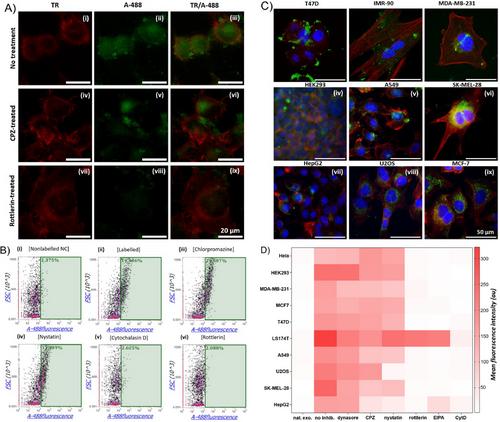
Exosomes are membrane-enclosed nanoparticles secreted by cells to mediate intercellular communication. Hence, functionalized exosomes are powerful tools in biology and medicine, and efficient methods to functionalize exosomes are highly desired. In this work, a novel approach is developed to modify and functionalize exosomes based on enzymatic engineering of their surface glycans. It employs a sialyltransferase and an azide-modified sialyl donor to enzymatically install azido-sialic acids onto exosomal glycans. The azide tags serve as universal molecular handles to attach various probes, e.g., biotin, protein, fluorophore, etc., by simple and biocompatible click chemistry. This approach is easy and effective, and the modified exosomes are readily retrieved from the plate, enabling the production of functional exosomes in practical scales for various studies and applications. The functionalized exosomes obtained are employed to profile exosomal glycans, disclosing the diverse glycosylation patterns of exosomes of different origins. They also facilitated comprehensive investigations on the cellular uptake of exosomes to disclose macropinocytosis as the main and general uptake route, while other endocytosis pathways are also partially involved in specific exosomes. Additionally, the new exosome functionalization approach has been demonstrated to be widely applicable to exosomes of different origins.
期刊介绍:
Advanced Science is a prestigious open access journal that focuses on interdisciplinary research in materials science, physics, chemistry, medical and life sciences, and engineering. The journal aims to promote cutting-edge research by employing a rigorous and impartial review process. It is committed to presenting research articles with the highest quality production standards, ensuring maximum accessibility of top scientific findings. With its vibrant and innovative publication platform, Advanced Science seeks to revolutionize the dissemination and organization of scientific knowledge.





 京公网安备 11010802042870号
京ICP备2023020795号-1
京公网安备 11010802042870号
京ICP备2023020795号-1

 分享
分享
 求助内容:
求助内容: 应助结果提醒方式:
 扫码关注我们
