{"title":"Neutrophil Hitchhiking-Mediated Delivery of ROS-Scavenging Biomimetic Nanoparticles for Enhanced Treatment of Atherosclerosis","authors":"Ming Wu, Mengjuan Chen, Yuzhen Zhao, Xijun Zhang, Xiao Ding, Jianjun Yuan, Jinjin Shi, Wenyan Yu, Haohui Zhu","doi":"10.1002/smtd.202402019","DOIUrl":null,"url":null,"abstract":"<p>Atherosclerosis (AS), a chronic inflammatory disease and a leading cause of cardiovascular morbidity and mortality worldwide, is a significant contributor to disability. Neutrophil extracellular traps (NETs) have been closely associated with the progression of AS and plaque vulnerability. However, developing a treatment strategy that specifically targets neutrophils and effectively reduces NET release at the lesion site remains a major challenge. In this study, a biomimetic nanosystem with neutrophil-targeting properties is engineered. Coating Prussian blue nanoparticles with bacterial biomimetic membranes (MPB NPs) enables specific recognition and internalization by neutrophils. By hitching onto neutrophils, the MPB NPs scavenge intracellular reactive oxygen species (ROS) and suppress NET formation at the lesion site. Importantly, MPB NPs reduce the size of atherosclerotic plaques by 3.29-fold, from 22.53% to 6.85%, stabilize the plaques, and halt their progression in atherosclerotic mouse models. These findings suggest that MPB NPs offer a promising therapeutic strategy for atherosclerosis, and provide a versatile platform for the treatment of NET-associated diseases.</p>","PeriodicalId":229,"journal":{"name":"Small Methods","volume":"9 7","pages":""},"PeriodicalIF":9.1000,"publicationDate":"2025-03-20","publicationTypes":"Journal Article","fieldsOfStudy":null,"isOpenAccess":false,"openAccessPdf":"","citationCount":"0","resultStr":null,"platform":"Semanticscholar","paperid":null,"PeriodicalName":"Small Methods","FirstCategoryId":"88","ListUrlMain":"https://onlinelibrary.wiley.com/doi/10.1002/smtd.202402019","RegionNum":2,"RegionCategory":"材料科学","ArticlePicture":[],"TitleCN":null,"AbstractTextCN":null,"PMCID":null,"EPubDate":"","PubModel":"","JCR":"Q1","JCRName":"CHEMISTRY, PHYSICAL","Score":null,"Total":0}
引用次数: 0
Abstract
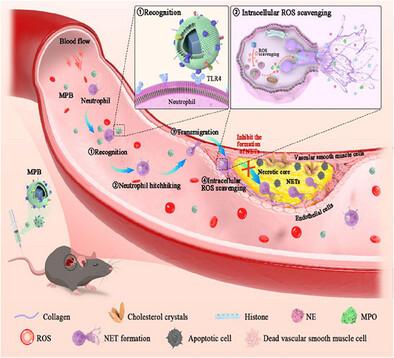
Atherosclerosis (AS), a chronic inflammatory disease and a leading cause of cardiovascular morbidity and mortality worldwide, is a significant contributor to disability. Neutrophil extracellular traps (NETs) have been closely associated with the progression of AS and plaque vulnerability. However, developing a treatment strategy that specifically targets neutrophils and effectively reduces NET release at the lesion site remains a major challenge. In this study, a biomimetic nanosystem with neutrophil-targeting properties is engineered. Coating Prussian blue nanoparticles with bacterial biomimetic membranes (MPB NPs) enables specific recognition and internalization by neutrophils. By hitching onto neutrophils, the MPB NPs scavenge intracellular reactive oxygen species (ROS) and suppress NET formation at the lesion site. Importantly, MPB NPs reduce the size of atherosclerotic plaques by 3.29-fold, from 22.53% to 6.85%, stabilize the plaques, and halt their progression in atherosclerotic mouse models. These findings suggest that MPB NPs offer a promising therapeutic strategy for atherosclerosis, and provide a versatile platform for the treatment of NET-associated diseases.
Small MethodsMaterials Science-General Materials Science
CiteScore
17.40
自引率
1.60%
发文量
347
期刊介绍:
Small Methods is a multidisciplinary journal that publishes groundbreaking research on methods relevant to nano- and microscale research. It welcomes contributions from the fields of materials science, biomedical science, chemistry, and physics, showcasing the latest advancements in experimental techniques.
With a notable 2022 Impact Factor of 12.4 (Journal Citation Reports, Clarivate Analytics, 2023), Small Methods is recognized for its significant impact on the scientific community.
The online ISSN for Small Methods is 2366-9608.



 京公网安备 11010802042870号
京ICP备2023020795号-1
京公网安备 11010802042870号
京ICP备2023020795号-1

 分享
分享
 求助内容:
求助内容: 应助结果提醒方式:
 扫码关注我们
