Mebratu Tila Bacho, Getahun Dendir Wolda, Wondu Reta Demssie, Nefsu Awoke, Ashagrie Sintayehu Temsgen, Elias Habtu Sulieman, Tsegaye Demeke Geberemedin, Ashebir Debalkie Gemechu, Naol Gorde Wosene, Andualem Assefa Endebirku, Wogayehu Abera Negash, Afwork Alemu, Alemu Urmle Kussie, Wondafrsh Kusie, Mohammed Suleiman Obsa
{"title":"Incidence and risk factors of postoperative nausea and vomiting in Africa among patient under gone surgery: a systematic review and meta-analysis.","authors":"Mebratu Tila Bacho, Getahun Dendir Wolda, Wondu Reta Demssie, Nefsu Awoke, Ashagrie Sintayehu Temsgen, Elias Habtu Sulieman, Tsegaye Demeke Geberemedin, Ashebir Debalkie Gemechu, Naol Gorde Wosene, Andualem Assefa Endebirku, Wogayehu Abera Negash, Afwork Alemu, Alemu Urmle Kussie, Wondafrsh Kusie, Mohammed Suleiman Obsa","doi":"10.1097/MS9.0000000000002845","DOIUrl":null,"url":null,"abstract":"<p><strong>Background: </strong>Patients who experience postoperative nausea and vomiting are not happy with their surgical outcomes. Preventing this problem expedites the patients' return to normal activities following surgery and significantly increases their satisfaction. There are no condensed results that show the prevalence and contributing variables of postoperative nausea and vomiting in Africa. Thus, the purpose of this meta-analysis and comprehensive review was to ascertain the prevalence and contributing variables of postoperative nausea and vomiting in Africa.</p><p><strong>Methods: </strong>Studies were retrieved from the PubMed, EMBASE, Cochrane Database, CINAHL, Scopus, Mednar, and Google Scholar databases using combinations of searching terms and Boolean operators. <i>I</i>-squared (<i>I</i> <sup>2</sup>) statistics is used for evaluating study heterogeneity. Every publication is assessed for methodological quality using the Joanna Briggs Institute (JBI) Critical Appraisal criteria. Using a funnel plot, publication bias is visually assessed. Subgroup analyses investigate the source of heterogeneity. To determine whether publication bias exists, the Eggers weighted regression test is employed. STATA software version 14 was used to perform statistical analyses.</p><p><strong>Results: </strong>In Africa, the combined incidences of nausea 24.96 % (95% CI: 17.903-32.018), vomiting 23.655 % (95% CI: 17.542-29.769) and nausea with vomiting 15.27 % (95% CI: 9.118-21.424) . History of motion sickness (odds ratio [OR]: 3.19 (95% CI 1.08-9.42), <i>P</i> < 0.036) and history of postoperative nausea and vomiting (OR: 4.33 (95% CI 2.654-7.07), <i>P</i> < 0.001) were factors linked to postoperative nausea and vomiting. Compared to their counterparts, patients who underwent more risky surgical procedures had a 1.4-fold increased chance of developing postoperative nausea and vomiting. Patients who skipped the use of prophylactic medication for nausea and vomiting had a 59% higher risk of experiencing postoperative nausea and vomiting than those who did [OR: 1.39 (95% CI (1.074-1.769), <i>P</i> < 0.012) and OR: 0.194 (95% CI (0.04-0.935), <i>P</i> < 0.001)], respectively.</p><p><strong>Conclusion: </strong>Postoperative nausea and vomiting were more common in surgically treated African individuals. Clinical interventions are needed to prevent, diagnose, and treat postoperative nausea and vomiting (PONV), with a focus on patients who have experienced motion sickness, high-risk surgery, or PONV in the past. It is advisable to use whole intravenous anesthesia based on Propofol for surgery, if feasible.</p>","PeriodicalId":8025,"journal":{"name":"Annals of Medicine and Surgery","volume":"87 1","pages":"285-298"},"PeriodicalIF":1.6000,"publicationDate":"2025-01-09","publicationTypes":"Journal Article","fieldsOfStudy":null,"isOpenAccess":false,"openAccessPdf":"https://www.ncbi.nlm.nih.gov/pmc/articles/PMC11918660/pdf/","citationCount":"0","resultStr":null,"platform":"Semanticscholar","paperid":null,"PeriodicalName":"Annals of Medicine and Surgery","FirstCategoryId":"1085","ListUrlMain":"https://doi.org/10.1097/MS9.0000000000002845","RegionNum":0,"RegionCategory":null,"ArticlePicture":[],"TitleCN":null,"AbstractTextCN":null,"PMCID":null,"EPubDate":"2025/1/1 0:00:00","PubModel":"eCollection","JCR":"Q2","JCRName":"MEDICINE, GENERAL & INTERNAL","Score":null,"Total":0}
引用次数: 0
Abstract
Background: Patients who experience postoperative nausea and vomiting are not happy with their surgical outcomes. Preventing this problem expedites the patients' return to normal activities following surgery and significantly increases their satisfaction. There are no condensed results that show the prevalence and contributing variables of postoperative nausea and vomiting in Africa. Thus, the purpose of this meta-analysis and comprehensive review was to ascertain the prevalence and contributing variables of postoperative nausea and vomiting in Africa.
Methods: Studies were retrieved from the PubMed, EMBASE, Cochrane Database, CINAHL, Scopus, Mednar, and Google Scholar databases using combinations of searching terms and Boolean operators. I-squared (I2) statistics is used for evaluating study heterogeneity. Every publication is assessed for methodological quality using the Joanna Briggs Institute (JBI) Critical Appraisal criteria. Using a funnel plot, publication bias is visually assessed. Subgroup analyses investigate the source of heterogeneity. To determine whether publication bias exists, the Eggers weighted regression test is employed. STATA software version 14 was used to perform statistical analyses.
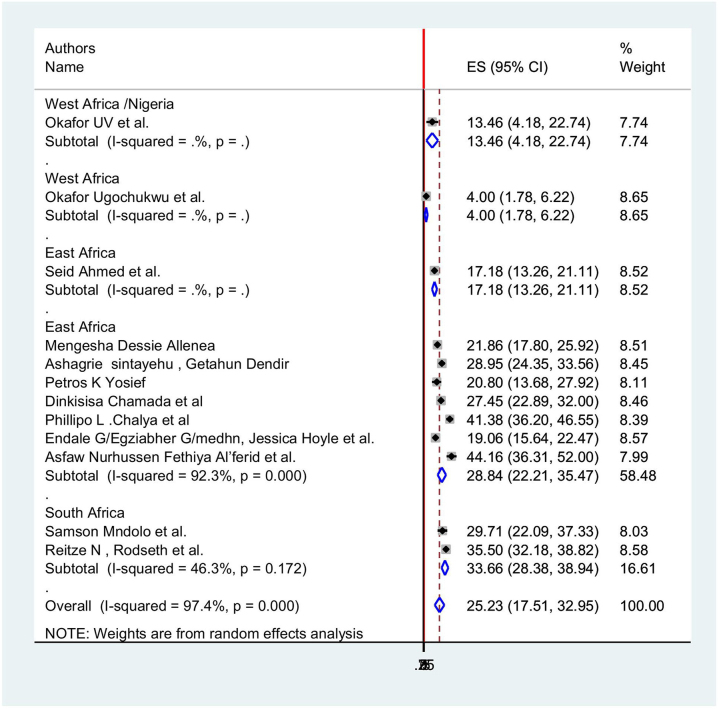
Results: In Africa, the combined incidences of nausea 24.96 % (95% CI: 17.903-32.018), vomiting 23.655 % (95% CI: 17.542-29.769) and nausea with vomiting 15.27 % (95% CI: 9.118-21.424) . History of motion sickness (odds ratio [OR]: 3.19 (95% CI 1.08-9.42), P < 0.036) and history of postoperative nausea and vomiting (OR: 4.33 (95% CI 2.654-7.07), P < 0.001) were factors linked to postoperative nausea and vomiting. Compared to their counterparts, patients who underwent more risky surgical procedures had a 1.4-fold increased chance of developing postoperative nausea and vomiting. Patients who skipped the use of prophylactic medication for nausea and vomiting had a 59% higher risk of experiencing postoperative nausea and vomiting than those who did [OR: 1.39 (95% CI (1.074-1.769), P < 0.012) and OR: 0.194 (95% CI (0.04-0.935), P < 0.001)], respectively.
Conclusion: Postoperative nausea and vomiting were more common in surgically treated African individuals. Clinical interventions are needed to prevent, diagnose, and treat postoperative nausea and vomiting (PONV), with a focus on patients who have experienced motion sickness, high-risk surgery, or PONV in the past. It is advisable to use whole intravenous anesthesia based on Propofol for surgery, if feasible.
背景:术后恶心和呕吐的患者对手术结果并不满意。预防这一问题加快了患者在手术后恢复正常活动,并显著提高了他们的满意度。没有浓缩的结果显示患病率和贡献变量的术后恶心和呕吐在非洲。因此,本荟萃分析和综合综述的目的是确定非洲术后恶心和呕吐的患病率和影响因素。方法:采用组合检索词和布尔运算符从PubMed、EMBASE、Cochrane数据库、CINAHL、Scopus、Mednar和谷歌Scholar数据库中检索研究。I-squared (i2)统计量用于评估研究异质性。每个出版物都使用乔安娜布里格斯研究所(JBI)关键评估标准对方法质量进行评估。使用漏斗图,对发表偏倚进行视觉评估。亚组分析调查异质性的来源。为确定是否存在发表偏倚,采用Eggers加权回归检验。采用STATA软件14进行统计分析。结果:在非洲,恶心合并发生率为24.96% (95% CI: 17.903-32.018),呕吐合并发生率为23.655 % (95% CI: 17.542-29.769),恶心合并呕吐合并发生率为15.27% (95% CI: 9.118-21.424)。晕车史(优势比[OR]: 3.19 (95% CI 1.08-9.42), P P P P结论:术后恶心和呕吐在手术治疗的非洲患者中更为常见。临床干预需要预防、诊断和治疗术后恶心和呕吐(PONV),重点是过去经历过晕动病、高风险手术或PONV的患者。如果可行,手术时建议采用以异丙酚为基础的全静脉麻醉。





 京公网安备 11010802042870号
京ICP备2023020795号-1
京公网安备 11010802042870号
京ICP备2023020795号-1

 分享
分享
 求助内容:
求助内容: 应助结果提醒方式:
 扫码关注我们
