Ayham Qatza, Kenana Tawashi, Ahmed Sheikh Sobeh, Saleh Takkem
{"title":"A case of sustained fetal atrial flutter at 25-week gestation: diagnostic challenges and therapeutic strategies.","authors":"Ayham Qatza, Kenana Tawashi, Ahmed Sheikh Sobeh, Saleh Takkem","doi":"10.1097/MS9.0000000000002905","DOIUrl":null,"url":null,"abstract":"<p><strong>Introduction: </strong>Sustained fetal tachycardia is an uncommon phenomenon in gestations (approximately 0.1%). Atrial flutter (AF) accounts for 10-30% of fetal tachyarrhythmias, which is characterized by a rapid atrial rate estimated at 300-600 beats per minute, associated with variable degrees of atrioventricular conduction.</p><p><strong>Case presentation: </strong>A 29-year-old asymptomatic woman, pregnant for the third time, was diagnosed with a male fetus at 25 weeks gestation exhibiting sustained atrial flutter with rapid ventricular response (2:1 and 1:1 AV block). Maternal digoxin reduced the fetal ventricular rate to 120 bpm, mitigating hydrop risk. The infant was delivered via cesarean at 35 weeks, presenting with low blood pressure (80/50 mmHg) and an irregular pulse (160 bpm). The electrocardiogram showed AF; intravenous amiodarone was administered, and the rhythm successfully converted to a normal sinus rhythm.</p><p><strong>Clinical discussion: </strong>Fetal arrhythmias in pregnant women require detailed assessment and treatment, including maternal history, electrocardiogram, and renal function assessment. The approach to treatment involves the use of transplacental antiarrhythmics, where digoxin is considered the first line of treatment. Other options include sotalol and flecainide. The mother should be monitored for side effects, with follow-up in the postpartum period for the infant.</p><p><strong>Conclusion: </strong>Fetal AF may occur in the second trimester and requires an increased awareness of this life-threatening arrhythmia. Whatever the gestational age, early recognition of fetal tachycardia is important due to the potential for adverse and life-threatening outcomes.</p>","PeriodicalId":8025,"journal":{"name":"Annals of Medicine and Surgery","volume":"87 2","pages":"1038-1042"},"PeriodicalIF":1.6000,"publicationDate":"2025-01-21","publicationTypes":"Journal Article","fieldsOfStudy":null,"isOpenAccess":false,"openAccessPdf":"https://www.ncbi.nlm.nih.gov/pmc/articles/PMC11918542/pdf/","citationCount":"0","resultStr":null,"platform":"Semanticscholar","paperid":null,"PeriodicalName":"Annals of Medicine and Surgery","FirstCategoryId":"1085","ListUrlMain":"https://doi.org/10.1097/MS9.0000000000002905","RegionNum":0,"RegionCategory":null,"ArticlePicture":[],"TitleCN":null,"AbstractTextCN":null,"PMCID":null,"EPubDate":"2025/2/1 0:00:00","PubModel":"eCollection","JCR":"Q2","JCRName":"MEDICINE, GENERAL & INTERNAL","Score":null,"Total":0}
引用次数: 0
Abstract
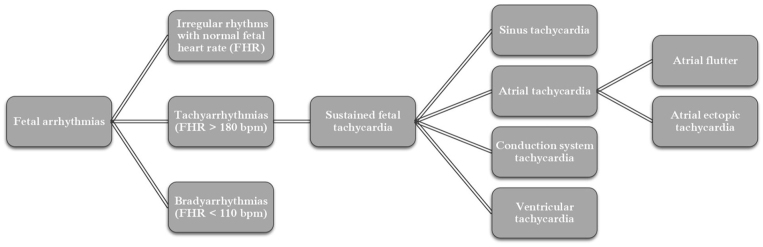
Introduction: Sustained fetal tachycardia is an uncommon phenomenon in gestations (approximately 0.1%). Atrial flutter (AF) accounts for 10-30% of fetal tachyarrhythmias, which is characterized by a rapid atrial rate estimated at 300-600 beats per minute, associated with variable degrees of atrioventricular conduction.
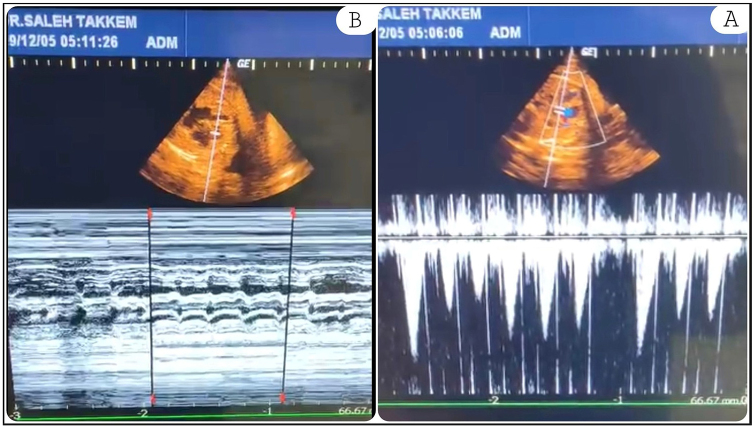
Case presentation: A 29-year-old asymptomatic woman, pregnant for the third time, was diagnosed with a male fetus at 25 weeks gestation exhibiting sustained atrial flutter with rapid ventricular response (2:1 and 1:1 AV block). Maternal digoxin reduced the fetal ventricular rate to 120 bpm, mitigating hydrop risk. The infant was delivered via cesarean at 35 weeks, presenting with low blood pressure (80/50 mmHg) and an irregular pulse (160 bpm). The electrocardiogram showed AF; intravenous amiodarone was administered, and the rhythm successfully converted to a normal sinus rhythm.
Clinical discussion: Fetal arrhythmias in pregnant women require detailed assessment and treatment, including maternal history, electrocardiogram, and renal function assessment. The approach to treatment involves the use of transplacental antiarrhythmics, where digoxin is considered the first line of treatment. Other options include sotalol and flecainide. The mother should be monitored for side effects, with follow-up in the postpartum period for the infant.
Conclusion: Fetal AF may occur in the second trimester and requires an increased awareness of this life-threatening arrhythmia. Whatever the gestational age, early recognition of fetal tachycardia is important due to the potential for adverse and life-threatening outcomes.




 京公网安备 11010802042870号
京ICP备2023020795号-1
京公网安备 11010802042870号
京ICP备2023020795号-1

 分享
分享
 求助内容:
求助内容: 应助结果提醒方式:
 扫码关注我们
