Raquel Vassão-Araujo, Samira Apóstolos, Angela Marie Jansen, Marco A Lana-Peixoto, Antonio Pereira Gomes Neto, Mariana Rico-Restrepo, Soniza Vieira Alves-Leon, Douglas Kazutoshi Sato
{"title":"A roadmap to increasing access to AQP4-Ig testing for NMOSD: expert recommendations.","authors":"Raquel Vassão-Araujo, Samira Apóstolos, Angela Marie Jansen, Marco A Lana-Peixoto, Antonio Pereira Gomes Neto, Mariana Rico-Restrepo, Soniza Vieira Alves-Leon, Douglas Kazutoshi Sato","doi":"10.1055/s-0045-1801845","DOIUrl":null,"url":null,"abstract":"<p><p>The discovery of aquaporin 4 immunoglobulin G (AQP4-IgG) autoantibody, present in ∼80% of patients with neuromyelitis optica spectrum disorder (NMOSD), dramatically improved its diagnosis, treatment, and prognosis. While Brazil has a higher prevalence of NMOSD (up to 4.5 per 100,000 people) compared with global averages, disparities in access to testing in Brazil impede early diagnosis and treatment. To tackle these issues, the Americas Health Foundation convened a three-day virtual conference with six Brazilian NMOSD experts. This paper emphasizes the importance of addressing the gaps in physicians' knowledge about NMOSD. Stakeholders, including government agencies, should develop national programs for continuing medical education. The public healthcare system should ensure the availability and accessibility of AQP4-IgG antibody testing. Clinical practice guidelines for NMOSD diagnosis and treatment must be established. Such guidelines will enable healthcare providers to manage patients promptly after the initial attack, reducing relapses and improving quality of life. Finally, addressing the fragmented healthcare system, including bridging the gap between public and private institutions and improving access to telemedicine, will aid individuals in Brazil with NMOSD in receiving early diagnosis and treatment. NMOSD presents unique challenges in Brazil because of its higher prevalence and limited access to crucial AQP4-IgG tests. Overcoming these challenges requires collaboration among experts, healthcare providers, government agencies, and the public healthcare system to improve diagnosis, treatment, and patient outcomes.</p>","PeriodicalId":8694,"journal":{"name":"Arquivos de neuro-psiquiatria","volume":"83 2","pages":"1-11"},"PeriodicalIF":1.6000,"publicationDate":"2025-02-01","publicationTypes":"Journal Article","fieldsOfStudy":null,"isOpenAccess":false,"openAccessPdf":"https://www.ncbi.nlm.nih.gov/pmc/articles/PMC11922624/pdf/","citationCount":"0","resultStr":null,"platform":"Semanticscholar","paperid":null,"PeriodicalName":"Arquivos de neuro-psiquiatria","FirstCategoryId":"3","ListUrlMain":"https://doi.org/10.1055/s-0045-1801845","RegionNum":4,"RegionCategory":"医学","ArticlePicture":[],"TitleCN":null,"AbstractTextCN":null,"PMCID":null,"EPubDate":"2025/3/19 0:00:00","PubModel":"Epub","JCR":"Q4","JCRName":"NEUROSCIENCES","Score":null,"Total":0}
引用次数: 0
Abstract
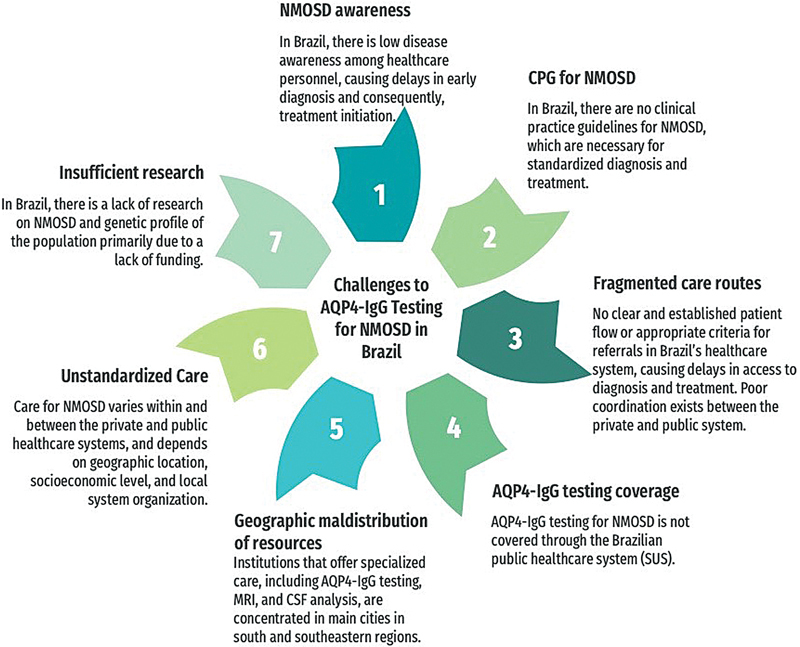
The discovery of aquaporin 4 immunoglobulin G (AQP4-IgG) autoantibody, present in ∼80% of patients with neuromyelitis optica spectrum disorder (NMOSD), dramatically improved its diagnosis, treatment, and prognosis. While Brazil has a higher prevalence of NMOSD (up to 4.5 per 100,000 people) compared with global averages, disparities in access to testing in Brazil impede early diagnosis and treatment. To tackle these issues, the Americas Health Foundation convened a three-day virtual conference with six Brazilian NMOSD experts. This paper emphasizes the importance of addressing the gaps in physicians' knowledge about NMOSD. Stakeholders, including government agencies, should develop national programs for continuing medical education. The public healthcare system should ensure the availability and accessibility of AQP4-IgG antibody testing. Clinical practice guidelines for NMOSD diagnosis and treatment must be established. Such guidelines will enable healthcare providers to manage patients promptly after the initial attack, reducing relapses and improving quality of life. Finally, addressing the fragmented healthcare system, including bridging the gap between public and private institutions and improving access to telemedicine, will aid individuals in Brazil with NMOSD in receiving early diagnosis and treatment. NMOSD presents unique challenges in Brazil because of its higher prevalence and limited access to crucial AQP4-IgG tests. Overcoming these challenges requires collaboration among experts, healthcare providers, government agencies, and the public healthcare system to improve diagnosis, treatment, and patient outcomes.
期刊介绍:
Arquivos de Neuro-Psiquiatria is the official journal of the Brazilian Academy of Neurology. The mission of the journal is to provide neurologists, specialists and researchers in Neurology and related fields with open access to original articles (clinical and translational research), editorials, reviews, historical papers, neuroimages and letters about published manuscripts. It also publishes the consensus and guidelines on Neurology, as well as educational and scientific material from the different scientific departments of the Brazilian Academy of Neurology.
The ultimate goals of the journal are to contribute to advance knowledge in the areas of Neurology and Neuroscience, and to provide valuable material for training and continuing education for neurologists and other health professionals working in the area. These goals might contribute to improving care for patients with neurological diseases. We aim to be the best Neuroscience journal in Latin America within the peer review system.




 京公网安备 11010802042870号
京ICP备2023020795号-1
京公网安备 11010802042870号
京ICP备2023020795号-1

 分享
分享
 求助内容:
求助内容: 应助结果提醒方式:
 扫码关注我们
