Taowu Chen, Yulin Chen, Heng Wang, Xueqing Li, Xin Guo, Hong Tan, Xiaoyan Zhang, Chunhui Li, Rui Shi, Chen Sun
{"title":"Association between trace elements and dental caries in the USA: analysis of data from serial cross-sectional surveys, 2010-2016.","authors":"Taowu Chen, Yulin Chen, Heng Wang, Xueqing Li, Xin Guo, Hong Tan, Xiaoyan Zhang, Chunhui Li, Rui Shi, Chen Sun","doi":"10.1186/s12903-025-05763-3","DOIUrl":null,"url":null,"abstract":"<p><strong>Background: </strong>Dental caries is a localized deterioration of hard tissues caused by acidic by-products of bacterial fermentation of dietary carbohydrates. However, except for fluoride, there were few studies focusing on the direct association between other trace elements. This study aimed to explore how other trace elements affect dental caries.</p><p><strong>Methods: </strong>Data from 10,426 individuals were collected from the National Health and Nutrition Examination Survey (NHANES) during the 2010-2016 cycle. The sample was restricted to individuals aged 20 years or older who had complete clinical oral examination data, and who had also completed blood (N = 10,086), serum (N = 5,152), or urine tests (N = 5,297). These three groups were weighted to represent multi-year data. The effects of 20 trace elements on dental caries experience were investigated using quartiles of continuous variables and weighted multivariate logistic regression models.</p><p><strong>Results: </strong>The analysis revealed significant differences in trace elements (lead, cadmium, mercury, molybdenum, tin, and tungsten) between individuals with no dental caries experience and those with dental caries experience (P < 0.05). Adjusted results from the weighted multivariate logistic regression model showed that the odds ratios (OR) for following trace elements were significantly positively associated with dental caries experience: lead (OR = 1.0105; 95% CI 1.0030-1.0181; P = 0.0077), cobalt (OR = 1.0048; 95% CI 1.001-1.0087; P = 0.0154), cesium (OR = 1.0028; 95% CI 1.0011-1.0046; P = 0.0027), and arsenic (OR = 1.0002; 95% CI 1-1.0004; P = 0.0244), while iron (OR = 0.9974; 95% CI 0.9954-0.9994; P = 0.0116) showed the negative association.</p><p><strong>Conclusion: </strong>The results of this cross-sectional study conducted on the U.S. population identified a statistically significant positive association between dental caries and trace elements, including lead, cobalt, cesium, and arsenic, while a negative association was observed with iron.</p>","PeriodicalId":9072,"journal":{"name":"BMC Oral Health","volume":"25 1","pages":"405"},"PeriodicalIF":3.1000,"publicationDate":"2025-03-19","publicationTypes":"Journal Article","fieldsOfStudy":null,"isOpenAccess":false,"openAccessPdf":"https://www.ncbi.nlm.nih.gov/pmc/articles/PMC11924794/pdf/","citationCount":"0","resultStr":null,"platform":"Semanticscholar","paperid":null,"PeriodicalName":"BMC Oral Health","FirstCategoryId":"3","ListUrlMain":"https://doi.org/10.1186/s12903-025-05763-3","RegionNum":2,"RegionCategory":"医学","ArticlePicture":[],"TitleCN":null,"AbstractTextCN":null,"PMCID":null,"EPubDate":"","PubModel":"","JCR":"Q1","JCRName":"DENTISTRY, ORAL SURGERY & MEDICINE","Score":null,"Total":0}
引用次数: 0
Abstract
Background: Dental caries is a localized deterioration of hard tissues caused by acidic by-products of bacterial fermentation of dietary carbohydrates. However, except for fluoride, there were few studies focusing on the direct association between other trace elements. This study aimed to explore how other trace elements affect dental caries.
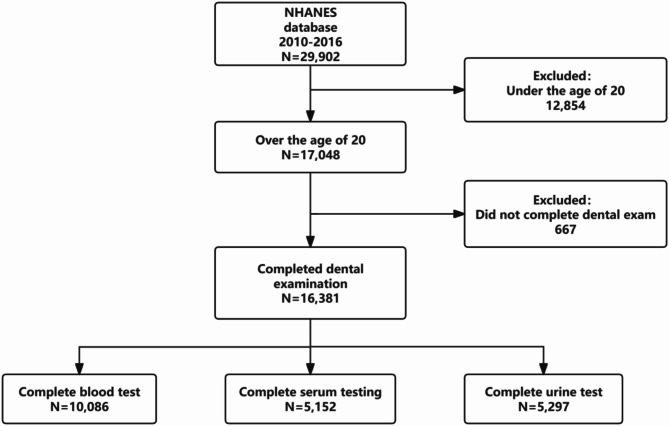
Methods: Data from 10,426 individuals were collected from the National Health and Nutrition Examination Survey (NHANES) during the 2010-2016 cycle. The sample was restricted to individuals aged 20 years or older who had complete clinical oral examination data, and who had also completed blood (N = 10,086), serum (N = 5,152), or urine tests (N = 5,297). These three groups were weighted to represent multi-year data. The effects of 20 trace elements on dental caries experience were investigated using quartiles of continuous variables and weighted multivariate logistic regression models.
Results: The analysis revealed significant differences in trace elements (lead, cadmium, mercury, molybdenum, tin, and tungsten) between individuals with no dental caries experience and those with dental caries experience (P < 0.05). Adjusted results from the weighted multivariate logistic regression model showed that the odds ratios (OR) for following trace elements were significantly positively associated with dental caries experience: lead (OR = 1.0105; 95% CI 1.0030-1.0181; P = 0.0077), cobalt (OR = 1.0048; 95% CI 1.001-1.0087; P = 0.0154), cesium (OR = 1.0028; 95% CI 1.0011-1.0046; P = 0.0027), and arsenic (OR = 1.0002; 95% CI 1-1.0004; P = 0.0244), while iron (OR = 0.9974; 95% CI 0.9954-0.9994; P = 0.0116) showed the negative association.
Conclusion: The results of this cross-sectional study conducted on the U.S. population identified a statistically significant positive association between dental caries and trace elements, including lead, cobalt, cesium, and arsenic, while a negative association was observed with iron.
期刊介绍:
BMC Oral Health is an open access, peer-reviewed journal that considers articles on all aspects of the prevention, diagnosis and management of disorders of the mouth, teeth and gums, as well as related molecular genetics, pathophysiology, and epidemiology.



 京公网安备 11010802042870号
京ICP备2023020795号-1
京公网安备 11010802042870号
京ICP备2023020795号-1

 分享
分享
 求助内容:
求助内容: 应助结果提醒方式:
 扫码关注我们
