{"title":"The role of social determinants of health in woman's intention to pregnancy: a model with the mediation of social support.","authors":"Farzaneh Rashidi, Fereshteh Ghahremani, Zohreh Mahmoodi, Mahbobeh Ahmadi Doulabi","doi":"10.1186/s12889-025-22223-3","DOIUrl":null,"url":null,"abstract":"<p><strong>Background: </strong>Childbearing intention is a complex issue that is influenced by a number of factor. However, childbearing intention does not necessarily lead to actual behavior, and mediating factors are effective in the realization and emergence of reproductive behavior. Since childbearing intention is influenced by several factors, including the social determinants of health, a thorough understanding of the effect of health determinants on this intention will help the reproductive process. Therefore, the present study was conducted using a social support-mediated model to examine the role of social determinants of health in women's intention to pregnant.</p><p><strong>Methods: </strong>This cross-sectional study was conducted on 500 married women of reproductive age (age range 15-49 years old) who were referred to health centers affiliated with Shahid Beheshti University of Medical Sciences during 2022-2023. Sampling was performed in a multi-stage (class-cluster) manner. Data collection tools in this study included the Demographic Information Form, the Childbearing Intention Questionnaire, social determinants of health questionnaires such as the Ghodratnama Socio-Economic Status Questionnaire, the Perceived Social Support Questionnaire, and the Depression Anxiety Stress Scales (DASS-21), and the Dyadic Adjustment Scale (Spinner questionnaire). Data analysis was performed using SPSS21 software with descriptive statistical tests and analytical statistics. Laserl 8.8 software was also used to test the model using the path analysis statistical test.</p><p><strong>Results: </strong>The mean scores of depression, anxiety and stress were 5.03 ± 4.39, 4.49 ± 3.68 and 7.7 ± 4.67, respectively. The mean score of marital adjustment was 103.26 ± 23.49, indicating that the majority of women (60.4%) had marital adjustment. Based on the results of the path analysis, marital adjustment was the only variable that had a direct positive and significant causal relationship with the childbearing intention from only one path (B = 0.74). Moreover, based on the results of the path analysis, perceived social support had the most direct and indirect positive causal relationship with the childbearing intention to have children (B = 0.74). Among the components of DASS21, depression was the only variable that had both a direct and indirect negative causal relationship with childbearing (B=-0.12). Both stress and anxiety had a direct positive causal relationship with the childbearing intention (B = 0.11 and B = 0.15 respectively).</p><p><strong>Conclusion: </strong>Factors such as marital adjustment, perceived social support, depression, stress, and anxiety, as structural social determinants of health, are associated with childbearing intention. Accordingly, changes in social structures depend on population planning and policies.</p>","PeriodicalId":9039,"journal":{"name":"BMC Public Health","volume":"25 1","pages":"1062"},"PeriodicalIF":3.6000,"publicationDate":"2025-03-19","publicationTypes":"Journal Article","fieldsOfStudy":null,"isOpenAccess":false,"openAccessPdf":"https://www.ncbi.nlm.nih.gov/pmc/articles/PMC11921526/pdf/","citationCount":"0","resultStr":null,"platform":"Semanticscholar","paperid":null,"PeriodicalName":"BMC Public Health","FirstCategoryId":"3","ListUrlMain":"https://doi.org/10.1186/s12889-025-22223-3","RegionNum":2,"RegionCategory":"医学","ArticlePicture":[],"TitleCN":null,"AbstractTextCN":null,"PMCID":null,"EPubDate":"","PubModel":"","JCR":"Q1","JCRName":"PUBLIC, ENVIRONMENTAL & OCCUPATIONAL HEALTH","Score":null,"Total":0}
引用次数: 0
Abstract
Background: Childbearing intention is a complex issue that is influenced by a number of factor. However, childbearing intention does not necessarily lead to actual behavior, and mediating factors are effective in the realization and emergence of reproductive behavior. Since childbearing intention is influenced by several factors, including the social determinants of health, a thorough understanding of the effect of health determinants on this intention will help the reproductive process. Therefore, the present study was conducted using a social support-mediated model to examine the role of social determinants of health in women's intention to pregnant.
Methods: This cross-sectional study was conducted on 500 married women of reproductive age (age range 15-49 years old) who were referred to health centers affiliated with Shahid Beheshti University of Medical Sciences during 2022-2023. Sampling was performed in a multi-stage (class-cluster) manner. Data collection tools in this study included the Demographic Information Form, the Childbearing Intention Questionnaire, social determinants of health questionnaires such as the Ghodratnama Socio-Economic Status Questionnaire, the Perceived Social Support Questionnaire, and the Depression Anxiety Stress Scales (DASS-21), and the Dyadic Adjustment Scale (Spinner questionnaire). Data analysis was performed using SPSS21 software with descriptive statistical tests and analytical statistics. Laserl 8.8 software was also used to test the model using the path analysis statistical test.
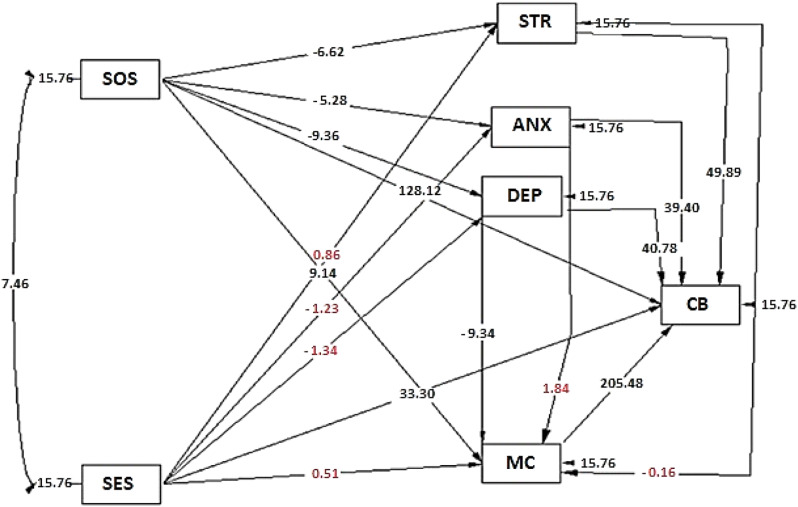
Results: The mean scores of depression, anxiety and stress were 5.03 ± 4.39, 4.49 ± 3.68 and 7.7 ± 4.67, respectively. The mean score of marital adjustment was 103.26 ± 23.49, indicating that the majority of women (60.4%) had marital adjustment. Based on the results of the path analysis, marital adjustment was the only variable that had a direct positive and significant causal relationship with the childbearing intention from only one path (B = 0.74). Moreover, based on the results of the path analysis, perceived social support had the most direct and indirect positive causal relationship with the childbearing intention to have children (B = 0.74). Among the components of DASS21, depression was the only variable that had both a direct and indirect negative causal relationship with childbearing (B=-0.12). Both stress and anxiety had a direct positive causal relationship with the childbearing intention (B = 0.11 and B = 0.15 respectively).
Conclusion: Factors such as marital adjustment, perceived social support, depression, stress, and anxiety, as structural social determinants of health, are associated with childbearing intention. Accordingly, changes in social structures depend on population planning and policies.
期刊介绍:
BMC Public Health is an open access, peer-reviewed journal that considers articles on the epidemiology of disease and the understanding of all aspects of public health. The journal has a special focus on the social determinants of health, the environmental, behavioral, and occupational correlates of health and disease, and the impact of health policies, practices and interventions on the community.





 京公网安备 11010802042870号
京ICP备2023020795号-1
京公网安备 11010802042870号
京ICP备2023020795号-1

 分享
分享
 求助内容:
求助内容: 应助结果提醒方式:
 扫码关注我们
