{"title":"Immune mediators as plasma biomarkers for identifying household contacts and classifying clinical forms and leprosy reactions.","authors":"Jairo Campos Carvalho, Marcelo Antônio Pascoal-Xavier, Marcelo Grossi Araújo, Júlia Pereira Martins, Andrea Teixeira-Carvalho, Matheus de Souza Gomes, Laurence Rodrigues Amaral, Vanessa Peruhype-Magalhães, Jordana Grazziela Alves Coelho-Dos-Reis, Olindo Assis Martins-Filho, Márcio Sobreira Silva Araújo","doi":"10.3389/fimmu.2025.1513060","DOIUrl":null,"url":null,"abstract":"<p><p>The present study aimed to evaluate the performance of plasma immune mediators in classifying leprosy patients [L(PB) and L(MB), paucibacillary and multibacillary leprosy, respectively], leprosy reaction patients (T1LR and T2LR, type 1 and type 2 leprosy reaction, respectively), household contacts (HHC), and non-infected (NI) controls. Quantitative measurements of these immune mediators were carried out using high-throughput multiplex microbead array. The results demonstrated that most of the plasma immune mediators were increased in all clinical groups compared with NI controls. Higher frequencies but lower maximum magnitudes of increase (fold change according to NI) were observed for T1LR (63%, 6.1×) and T2LR (63%, 9.7×) compared with HHC (48%, 68.5×), L(PB) (56%, 8.5×), and L(MB) (48%, 37.9×). The bi-dimensional scattering profiles (magnitude order <i>vs</i>. significance) identified a higher number of immune mediators in T2LR (12/27) compared with HHC (8/27), L(PB) (7/27), L(MB) (5/27), and T1LR (5/27). CXCL8 was selected as the parameter with the highest accuracy and significance [area under the receiver operating characteristic curve (AUC) = 0.98, <i>p</i> = 0.0002] in classifying NI <i>vs</i>. HHC. CCL3 (C-C motif chemokine ligand 3) was the single analyte with moderate accuracy and significance (AUC = 0.74, <i>p</i> = 0.0422) in classifying L(PB) <i>vs.</i> L(MB). IL-9 was selected as an attribute with moderate accuracy and significance (AUC = 0.77, <i>p</i> = 0.0041) in classifying T1LR <i>vs.</i> T2LR. Decision tree algorithms confirmed the high accuracy (96%) of CXCL8 in classifying NI <i>vs</i>. HHC. The use of CCL3 followed by IFN-γ classified L(MB) <i>vs.</i> L(PB) with high accuracy (93%). Moreover, the analysis of IL-9 followed by IL-6 and CXCL10 classified T1RL <i>vs.</i> T2RL with high accuracy (96%). In general, combined stepwise algorithms showed enhanced classification accuracy compared with single-attribute analysis. Together, our findings supported the potential use of plasma immune mediators as complementary laboratory biomarkers for the identification of HHC and the classification of distinct clinical forms of leprosy and leprosy reactions.</p>","PeriodicalId":12622,"journal":{"name":"Frontiers in Immunology","volume":"16 ","pages":"1513060"},"PeriodicalIF":5.9000,"publicationDate":"2025-03-05","publicationTypes":"Journal Article","fieldsOfStudy":null,"isOpenAccess":false,"openAccessPdf":"https://www.ncbi.nlm.nih.gov/pmc/articles/PMC11920121/pdf/","citationCount":"0","resultStr":null,"platform":"Semanticscholar","paperid":null,"PeriodicalName":"Frontiers in Immunology","FirstCategoryId":"3","ListUrlMain":"https://doi.org/10.3389/fimmu.2025.1513060","RegionNum":2,"RegionCategory":"医学","ArticlePicture":[],"TitleCN":null,"AbstractTextCN":null,"PMCID":null,"EPubDate":"2025/1/1 0:00:00","PubModel":"eCollection","JCR":"Q1","JCRName":"IMMUNOLOGY","Score":null,"Total":0}
引用次数: 0
Abstract
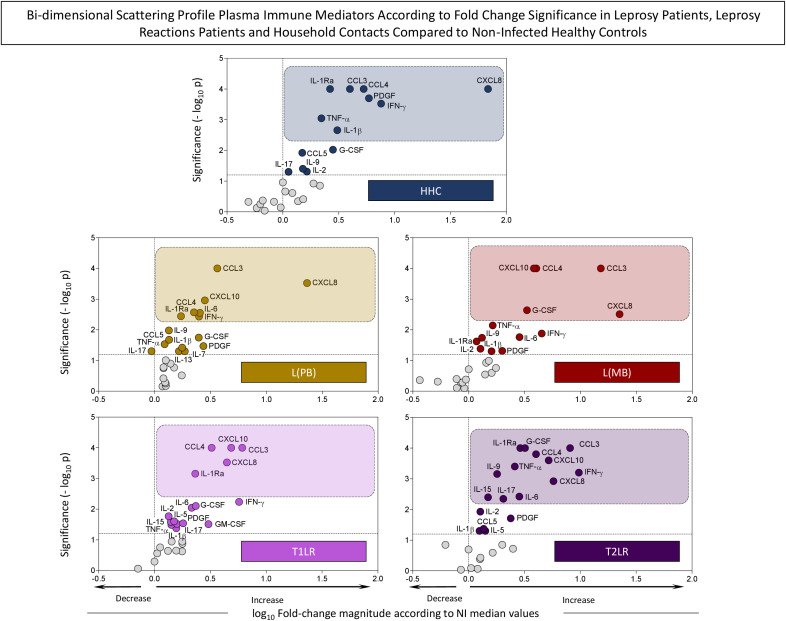
The present study aimed to evaluate the performance of plasma immune mediators in classifying leprosy patients [L(PB) and L(MB), paucibacillary and multibacillary leprosy, respectively], leprosy reaction patients (T1LR and T2LR, type 1 and type 2 leprosy reaction, respectively), household contacts (HHC), and non-infected (NI) controls. Quantitative measurements of these immune mediators were carried out using high-throughput multiplex microbead array. The results demonstrated that most of the plasma immune mediators were increased in all clinical groups compared with NI controls. Higher frequencies but lower maximum magnitudes of increase (fold change according to NI) were observed for T1LR (63%, 6.1×) and T2LR (63%, 9.7×) compared with HHC (48%, 68.5×), L(PB) (56%, 8.5×), and L(MB) (48%, 37.9×). The bi-dimensional scattering profiles (magnitude order vs. significance) identified a higher number of immune mediators in T2LR (12/27) compared with HHC (8/27), L(PB) (7/27), L(MB) (5/27), and T1LR (5/27). CXCL8 was selected as the parameter with the highest accuracy and significance [area under the receiver operating characteristic curve (AUC) = 0.98, p = 0.0002] in classifying NI vs. HHC. CCL3 (C-C motif chemokine ligand 3) was the single analyte with moderate accuracy and significance (AUC = 0.74, p = 0.0422) in classifying L(PB) vs. L(MB). IL-9 was selected as an attribute with moderate accuracy and significance (AUC = 0.77, p = 0.0041) in classifying T1LR vs. T2LR. Decision tree algorithms confirmed the high accuracy (96%) of CXCL8 in classifying NI vs. HHC. The use of CCL3 followed by IFN-γ classified L(MB) vs. L(PB) with high accuracy (93%). Moreover, the analysis of IL-9 followed by IL-6 and CXCL10 classified T1RL vs. T2RL with high accuracy (96%). In general, combined stepwise algorithms showed enhanced classification accuracy compared with single-attribute analysis. Together, our findings supported the potential use of plasma immune mediators as complementary laboratory biomarkers for the identification of HHC and the classification of distinct clinical forms of leprosy and leprosy reactions.
期刊介绍:
Frontiers in Immunology is a leading journal in its field, publishing rigorously peer-reviewed research across basic, translational and clinical immunology. This multidisciplinary open-access journal is at the forefront of disseminating and communicating scientific knowledge and impactful discoveries to researchers, academics, clinicians and the public worldwide.
Frontiers in Immunology is the official Journal of the International Union of Immunological Societies (IUIS). Encompassing the entire field of Immunology, this journal welcomes papers that investigate basic mechanisms of immune system development and function, with a particular emphasis given to the description of the clinical and immunological phenotype of human immune disorders, and on the definition of their molecular basis.







 京公网安备 11010802042870号
京ICP备2023020795号-1
京公网安备 11010802042870号
京ICP备2023020795号-1

 分享
分享
 求助内容:
求助内容: 应助结果提醒方式:
 扫码关注我们
