{"title":"Comparison of the characteristics between machine learning and deep learning algorithms for ablation site classification in a novel cloud-based system","authors":"Masataka Narita MD, Daisuke Kawano MD, PhD, Naomichi Tanaka MD, PhD, Tsukasa Naganuma MD, Wataru Sasaki MD, Kazuhisa Matsumoto MD, PhD, Kazuhiko Kuinose MD, Hitoshi Mori MD, PhD, Yoshifumi Ikeda MD, PhD, Kazuo Matsumoto MD, PhD, Ritsushi Kato MD, PhD","doi":"10.1016/j.hrthm.2025.03.1955","DOIUrl":null,"url":null,"abstract":"<div><h3>Background</h3><div>CARTONET is a cloud-based system for the analysis of ablation procedures using the CARTO system. The current CARTONET R14 model employs deep learning, but its accuracy and positive predictive value (PPV) remain underevaluated.</div></div><div><h3>Objective</h3><div>This study aimed to compare the characteristics of the CARTONET system between the R12.1 and the R14 models.</div></div><div><h3>Methods</h3><div>Data from 396 atrial fibrillation ablation cases were analyzed. Using a CARTONET R14 model, the sensitivity and PPV of the automated anatomic location model were investigated. The distribution of potential reconnection sites and confidence level for each site were investigated. We also compared the difference in the data between the CARTONET R12.1, the previous CARTONET version, and the CARTONET R14 models.</div></div><div><h3>Results</h3><div>We analyzed the overall tags of 39,169 points and the gap prediction of 625 segments using the CARTONET R14 model. The sensitivity and PPV of the R14 model significantly improved compared with the R12.1 model (R12.1 vs R14: sensitivity, 71.2% vs 77.5% [<em>P</em> < .0001]; PPV, 85.6% vs 86.2% [<em>P</em> = .0184]). The incidence of reconnections was highly observed in the posterior area of the right pulmonary veins (98/238 [41.2%]) and left pulmonary veins (190/387 [49.1%]). In contrast, the possibility of reconnection was highest in the roof area for the right pulmonary veins (14% [5.5%–41%]) and left pulmonary veins (16% [8%–22%]).</div></div><div><h3>Conclusion</h3><div>The R14 model significantly improved sensitivity and PPV compared with the R12.1 model. The tendency for predicting potential reconnection sites was similar to that of the previous version, the R12 model.</div></div>","PeriodicalId":12886,"journal":{"name":"Heart rhythm","volume":"22 9","pages":"Pages e572-e577"},"PeriodicalIF":5.7000,"publicationDate":"2025-09-01","publicationTypes":"Journal Article","fieldsOfStudy":null,"isOpenAccess":false,"openAccessPdf":"","citationCount":"0","resultStr":null,"platform":"Semanticscholar","paperid":null,"PeriodicalName":"Heart rhythm","FirstCategoryId":"3","ListUrlMain":"https://www.sciencedirect.com/science/article/pii/S1547527125021927","RegionNum":2,"RegionCategory":"医学","ArticlePicture":[],"TitleCN":null,"AbstractTextCN":null,"PMCID":null,"EPubDate":"","PubModel":"","JCR":"Q1","JCRName":"CARDIAC & CARDIOVASCULAR SYSTEMS","Score":null,"Total":0}
引用次数: 0
Abstract
Background
CARTONET is a cloud-based system for the analysis of ablation procedures using the CARTO system. The current CARTONET R14 model employs deep learning, but its accuracy and positive predictive value (PPV) remain underevaluated.
Objective
This study aimed to compare the characteristics of the CARTONET system between the R12.1 and the R14 models.
Methods
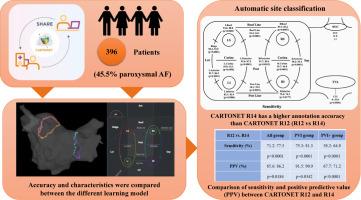
Data from 396 atrial fibrillation ablation cases were analyzed. Using a CARTONET R14 model, the sensitivity and PPV of the automated anatomic location model were investigated. The distribution of potential reconnection sites and confidence level for each site were investigated. We also compared the difference in the data between the CARTONET R12.1, the previous CARTONET version, and the CARTONET R14 models.
Results
We analyzed the overall tags of 39,169 points and the gap prediction of 625 segments using the CARTONET R14 model. The sensitivity and PPV of the R14 model significantly improved compared with the R12.1 model (R12.1 vs R14: sensitivity, 71.2% vs 77.5% [P < .0001]; PPV, 85.6% vs 86.2% [P = .0184]). The incidence of reconnections was highly observed in the posterior area of the right pulmonary veins (98/238 [41.2%]) and left pulmonary veins (190/387 [49.1%]). In contrast, the possibility of reconnection was highest in the roof area for the right pulmonary veins (14% [5.5%–41%]) and left pulmonary veins (16% [8%–22%]).
Conclusion
The R14 model significantly improved sensitivity and PPV compared with the R12.1 model. The tendency for predicting potential reconnection sites was similar to that of the previous version, the R12 model.
期刊介绍:
HeartRhythm, the official Journal of the Heart Rhythm Society and the Cardiac Electrophysiology Society, is a unique journal for fundamental discovery and clinical applicability.
HeartRhythm integrates the entire cardiac electrophysiology (EP) community from basic and clinical academic researchers, private practitioners, engineers, allied professionals, industry, and trainees, all of whom are vital and interdependent members of our EP community.
The Heart Rhythm Society is the international leader in science, education, and advocacy for cardiac arrhythmia professionals and patients, and the primary information resource on heart rhythm disorders. Its mission is to improve the care of patients by promoting research, education, and optimal health care policies and standards.



 京公网安备 11010802042870号
京ICP备2023020795号-1
京公网安备 11010802042870号
京ICP备2023020795号-1

 分享
分享
 求助内容:
求助内容: 应助结果提醒方式:
 扫码关注我们
