{"title":"Dynamic interactions of dimeric hub proteins underlie their diverse functions and structures: A comparative analysis of 14-3-3 and LC8.","authors":"Jesse Howe, Elisar J Barbar","doi":"10.1016/j.jbc.2025.108416","DOIUrl":null,"url":null,"abstract":"<p><p>Hub proteins interact with a host of client proteins and regulate multiple cellular functions. Dynamic hubs have a single binding interface for one client at a time resulting in competition among clients with the highest affinity. Dynamic dimeric hubs with two identical sites bind either two different client proteins or two chains of the same client to form homogenous complexes and could also form heterogeneous mixtures of interconverting complexes. Here, we review the interactions of the dimeric hubs 14-3-3 and LC8. 14-3-3 is a phosphoserine/threonine binding protein involved in structuring client proteins and regulating their phosphorylation. LC8 is involved in promoting the dimerization of client peptides and the rigidification of their disordered regions. Both 14-3-3 and LC8 are essential genes, with 14-3-3 playing a crucial role in apoptosis and cell cycle regulation, while LC8 is critical for the assembly of proteins involved in transport, DNA repair, and transcription. Interestingly, both protein dimers can dissociate by phosphorylation, which results in their interactome-wide changes. Their interactions are also regulated by the phosphorylation of their clients. Both form heterogeneous complexes with various functions including phase separation, signaling, and viral hijacking where they restrict the conformational heterogeneity of their dimeric clients that bind nucleic acids. This comparative analysis highlights the importance of dynamic protein-protein interactions in the diversity of functions of 14-3-3 and LC8 and how small differences in structures of interfaces explain why 14-3-3 is primarily involved in the regulation of phosphorylation states while LC8 is primarily involved in the regulation of assembly of large dynamic complexes.</p>","PeriodicalId":15140,"journal":{"name":"Journal of Biological Chemistry","volume":" ","pages":"108416"},"PeriodicalIF":4.0000,"publicationDate":"2025-04-01","publicationTypes":"Journal Article","fieldsOfStudy":null,"isOpenAccess":false,"openAccessPdf":"https://www.ncbi.nlm.nih.gov/pmc/articles/PMC12017986/pdf/","citationCount":"0","resultStr":null,"platform":"Semanticscholar","paperid":null,"PeriodicalName":"Journal of Biological Chemistry","FirstCategoryId":"99","ListUrlMain":"https://doi.org/10.1016/j.jbc.2025.108416","RegionNum":2,"RegionCategory":"生物学","ArticlePicture":[],"TitleCN":null,"AbstractTextCN":null,"PMCID":null,"EPubDate":"2025/3/17 0:00:00","PubModel":"Epub","JCR":"Q2","JCRName":"BIOCHEMISTRY & MOLECULAR BIOLOGY","Score":null,"Total":0}
引用次数: 0
Abstract
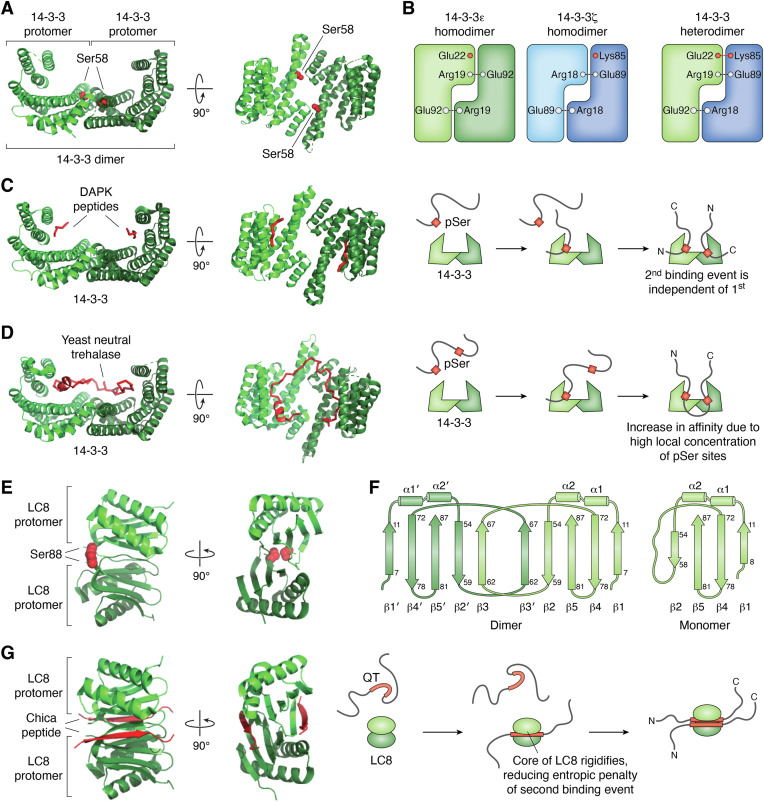
Hub proteins interact with a host of client proteins and regulate multiple cellular functions. Dynamic hubs have a single binding interface for one client at a time resulting in competition among clients with the highest affinity. Dynamic dimeric hubs with two identical sites bind either two different client proteins or two chains of the same client to form homogenous complexes and could also form heterogeneous mixtures of interconverting complexes. Here, we review the interactions of the dimeric hubs 14-3-3 and LC8. 14-3-3 is a phosphoserine/threonine binding protein involved in structuring client proteins and regulating their phosphorylation. LC8 is involved in promoting the dimerization of client peptides and the rigidification of their disordered regions. Both 14-3-3 and LC8 are essential genes, with 14-3-3 playing a crucial role in apoptosis and cell cycle regulation, while LC8 is critical for the assembly of proteins involved in transport, DNA repair, and transcription. Interestingly, both protein dimers can dissociate by phosphorylation, which results in their interactome-wide changes. Their interactions are also regulated by the phosphorylation of their clients. Both form heterogeneous complexes with various functions including phase separation, signaling, and viral hijacking where they restrict the conformational heterogeneity of their dimeric clients that bind nucleic acids. This comparative analysis highlights the importance of dynamic protein-protein interactions in the diversity of functions of 14-3-3 and LC8 and how small differences in structures of interfaces explain why 14-3-3 is primarily involved in the regulation of phosphorylation states while LC8 is primarily involved in the regulation of assembly of large dynamic complexes.
期刊介绍:
The Journal of Biological Chemistry welcomes high-quality science that seeks to elucidate the molecular and cellular basis of biological processes. Papers published in JBC can therefore fall under the umbrellas of not only biological chemistry, chemical biology, or biochemistry, but also allied disciplines such as biophysics, systems biology, RNA biology, immunology, microbiology, neurobiology, epigenetics, computational biology, ’omics, and many more. The outcome of our focus on papers that contribute novel and important mechanistic insights, rather than on a particular topic area, is that JBC is truly a melting pot for scientists across disciplines. In addition, JBC welcomes papers that describe methods that will help scientists push their biochemical inquiries forward and resources that will be of use to the research community.





 京公网安备 11010802042870号
京ICP备2023020795号-1
京公网安备 11010802042870号
京ICP备2023020795号-1

 分享
分享
 求助内容:
求助内容: 应助结果提醒方式:
 扫码关注我们
