Identification of distinct fatigue trajectories in patients with nasopharyngeal carcinoma undergoing radiotherapy: an observational longitudinal study.
Jieling Wu, Xinru Yang, Qiqi He, Zhiying Zhan, Zilan Wu, Litao Zhuo, Li Su, Wenlong Lyu, Jinru Ye, Xiurong Song, Jinsheng Hong, Jihong Song
{"title":"Identification of distinct fatigue trajectories in patients with nasopharyngeal carcinoma undergoing radiotherapy: an observational longitudinal study.","authors":"Jieling Wu, Xinru Yang, Qiqi He, Zhiying Zhan, Zilan Wu, Litao Zhuo, Li Su, Wenlong Lyu, Jinru Ye, Xiurong Song, Jinsheng Hong, Jihong Song","doi":"10.1007/s00520-025-09322-y","DOIUrl":null,"url":null,"abstract":"<p><strong>Purpose: </strong>To investigate the fatigue trajectory types and various influencing factors during intensity-modulated radiotherapy (IMRT) in patients with nasopharyngeal carcinoma (NPC).</p><p><strong>Methods: </strong>Longitudinal data of cancer-related fatigue from 182 participants with NPC were assessed at baseline (T0) and weekly (T1-T7) during radiotherapy via the revised Piper Fatigue Scale. Patient-generated data from the Subjective Global Assessment (PG-SGA) and the Hospital Anxiety and Depression Scale were collected at baseline. Latent growth curve models (LGCM) and latent class growth models (LCGM) were used to explore fatigue trajectories and heterogeneity among fatigue trajectories, respectively. The influencing factors of different trajectories were assessed via multivariate logistic regression analysis.</p><p><strong>Results: </strong>The overall fatigue level during IMRT tended to increase but then decreased, as indicated by the LGCM results (S = 0.985, P < 0.001), and peaked in the fifth week. The LCGM results fit the following three fatigue trajectories: \"mild fatigue persistence\" (n = 54, 29.7%), \"mild fatigue growth\" (n = 95, 52.2%), and \"moderate fatigue persistence\" (n = 33, 18.1%). PG-SGA score and being married were risk factors for the \"mild fatigue growth\" group. The risk factors for the \"moderate fatigue persistence\" group were PG-SGA, anxiety, and being married, whereas a family income < 3000 Y/month was a protective factor.</p><p><strong>Conclusions: </strong>Three types of fatigue trajectories are observed during IMRT in patients with NPC. PG-SGA score, marital status, anxiety, and family income may influence the type of fatigue trajectory in patients, so preventive measures should be taken on the basis of specific circumstances.</p>","PeriodicalId":22046,"journal":{"name":"Supportive Care in Cancer","volume":"33 4","pages":"298"},"PeriodicalIF":3.0000,"publicationDate":"2025-03-19","publicationTypes":"Journal Article","fieldsOfStudy":null,"isOpenAccess":false,"openAccessPdf":"https://www.ncbi.nlm.nih.gov/pmc/articles/PMC11923017/pdf/","citationCount":"0","resultStr":null,"platform":"Semanticscholar","paperid":null,"PeriodicalName":"Supportive Care in Cancer","FirstCategoryId":"3","ListUrlMain":"https://doi.org/10.1007/s00520-025-09322-y","RegionNum":3,"RegionCategory":"医学","ArticlePicture":[],"TitleCN":null,"AbstractTextCN":null,"PMCID":null,"EPubDate":"","PubModel":"","JCR":"Q2","JCRName":"HEALTH CARE SCIENCES & SERVICES","Score":null,"Total":0}
引用次数: 0
Abstract
Purpose: To investigate the fatigue trajectory types and various influencing factors during intensity-modulated radiotherapy (IMRT) in patients with nasopharyngeal carcinoma (NPC).
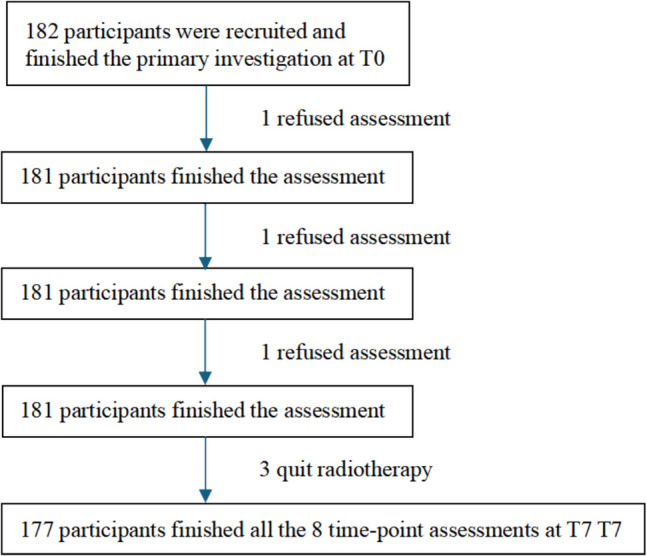
Methods: Longitudinal data of cancer-related fatigue from 182 participants with NPC were assessed at baseline (T0) and weekly (T1-T7) during radiotherapy via the revised Piper Fatigue Scale. Patient-generated data from the Subjective Global Assessment (PG-SGA) and the Hospital Anxiety and Depression Scale were collected at baseline. Latent growth curve models (LGCM) and latent class growth models (LCGM) were used to explore fatigue trajectories and heterogeneity among fatigue trajectories, respectively. The influencing factors of different trajectories were assessed via multivariate logistic regression analysis.
Results: The overall fatigue level during IMRT tended to increase but then decreased, as indicated by the LGCM results (S = 0.985, P < 0.001), and peaked in the fifth week. The LCGM results fit the following three fatigue trajectories: "mild fatigue persistence" (n = 54, 29.7%), "mild fatigue growth" (n = 95, 52.2%), and "moderate fatigue persistence" (n = 33, 18.1%). PG-SGA score and being married were risk factors for the "mild fatigue growth" group. The risk factors for the "moderate fatigue persistence" group were PG-SGA, anxiety, and being married, whereas a family income < 3000 Y/month was a protective factor.
Conclusions: Three types of fatigue trajectories are observed during IMRT in patients with NPC. PG-SGA score, marital status, anxiety, and family income may influence the type of fatigue trajectory in patients, so preventive measures should be taken on the basis of specific circumstances.
期刊介绍:
Supportive Care in Cancer provides members of the Multinational Association of Supportive Care in Cancer (MASCC) and all other interested individuals, groups and institutions with the most recent scientific and social information on all aspects of supportive care in cancer patients. It covers primarily medical, technical and surgical topics concerning supportive therapy and care which may supplement or substitute basic cancer treatment at all stages of the disease.
Nursing, rehabilitative, psychosocial and spiritual issues of support are also included.




 京公网安备 11010802042870号
京ICP备2023020795号-1
京公网安备 11010802042870号
京ICP备2023020795号-1

 分享
分享
 求助内容:
求助内容: 应助结果提醒方式:
 扫码关注我们
