{"title":"The impact of central sensitization on perioperative pain in TKA: a retrospective cohort study.","authors":"Tatsuru Sonobe, Takuya Nikaido, Miho Sekiguchi, Yoichi Kaneuchi, Tadashi Kikuchi, Yoshihiro Matsumoto","doi":"10.1186/s43019-025-00263-8","DOIUrl":null,"url":null,"abstract":"<p><strong>Background: </strong>Total knee arthroplasty (TKA) is an established surgical procedure for severe knee osteoarthritis (KOA) that has provided excellent outcomes. While several studies have reported that patients with preoperative central sensitization (CS) experienced worse pre- and post-operative pain and outcomes, the evidence is limited. We conducted this study to determine the impact of CS on perioperative knee pain in TKA for severe KOA.</p><p><strong>Methods: </strong>A retrospective cohort study of 66 patients who underwent bilateral TKA for bilateral severe KOA was conducted. Multiple linear regression models that included covariates and scaled estimated regression coefficients were used to examine the impact of CS on the patients' pre- and post-operative pain subscale values on the Knee Injury and Osteoarthritis Outcome Score (KOOS) and the improvement of KOOS pain. Postoperative KOOS pain was assessed at 3 months postoperatively, while other evaluation items including preoperative KOOS pain, CS, and pain self-efficacy were assessed on admission.</p><p><strong>Results: </strong>CS had a negative impact on pre- and post-operative KOOS pain (preoperative, β: -0.28, 95% confidence interval [CI] -18.53, -0.92; postoperative, β: -0.26, 95%CI -14.09, -0.44; p < 0.05). High pain self-efficacy had a positive impact on preoperative KOOS pain (β: 0.25, 95%CI 0.32, 18.08; p < 0.05). However, CS did not influence the improvement of KOOS pain.</p><p><strong>Conclusions: </strong>These results demonstrate that CS had a negative impact on pre- and post-TKA knee pain in patients but did not affect the improvement of knee pain. TKA provides sufficient pain relief for severe KOA, with or without CS. Further research is required to improve pre- and post-operative knee pain in KOA patients with CS.</p>","PeriodicalId":36317,"journal":{"name":"Knee Surgery and Related Research","volume":"37 1","pages":"13"},"PeriodicalIF":4.4000,"publicationDate":"2025-03-19","publicationTypes":"Journal Article","fieldsOfStudy":null,"isOpenAccess":false,"openAccessPdf":"https://www.ncbi.nlm.nih.gov/pmc/articles/PMC11921699/pdf/","citationCount":"0","resultStr":null,"platform":"Semanticscholar","paperid":null,"PeriodicalName":"Knee Surgery and Related Research","FirstCategoryId":"1085","ListUrlMain":"https://doi.org/10.1186/s43019-025-00263-8","RegionNum":0,"RegionCategory":null,"ArticlePicture":[],"TitleCN":null,"AbstractTextCN":null,"PMCID":null,"EPubDate":"","PubModel":"","JCR":"Q2","JCRName":"Medicine","Score":null,"Total":0}
引用次数: 0
Abstract
Background: Total knee arthroplasty (TKA) is an established surgical procedure for severe knee osteoarthritis (KOA) that has provided excellent outcomes. While several studies have reported that patients with preoperative central sensitization (CS) experienced worse pre- and post-operative pain and outcomes, the evidence is limited. We conducted this study to determine the impact of CS on perioperative knee pain in TKA for severe KOA.
Methods: A retrospective cohort study of 66 patients who underwent bilateral TKA for bilateral severe KOA was conducted. Multiple linear regression models that included covariates and scaled estimated regression coefficients were used to examine the impact of CS on the patients' pre- and post-operative pain subscale values on the Knee Injury and Osteoarthritis Outcome Score (KOOS) and the improvement of KOOS pain. Postoperative KOOS pain was assessed at 3 months postoperatively, while other evaluation items including preoperative KOOS pain, CS, and pain self-efficacy were assessed on admission.
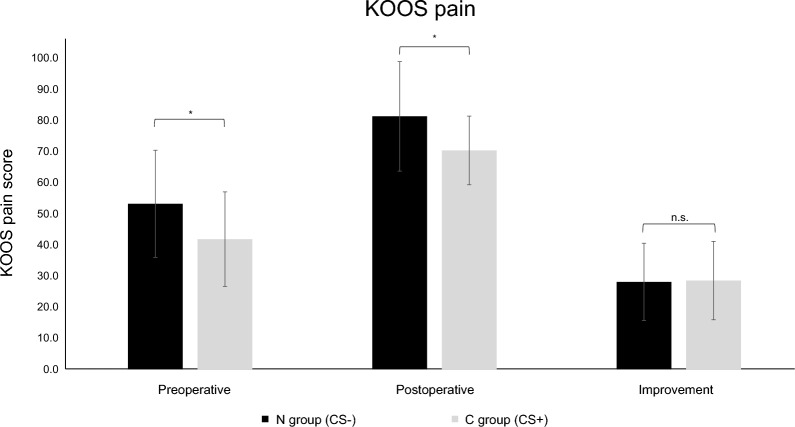
Results: CS had a negative impact on pre- and post-operative KOOS pain (preoperative, β: -0.28, 95% confidence interval [CI] -18.53, -0.92; postoperative, β: -0.26, 95%CI -14.09, -0.44; p < 0.05). High pain self-efficacy had a positive impact on preoperative KOOS pain (β: 0.25, 95%CI 0.32, 18.08; p < 0.05). However, CS did not influence the improvement of KOOS pain.
Conclusions: These results demonstrate that CS had a negative impact on pre- and post-TKA knee pain in patients but did not affect the improvement of knee pain. TKA provides sufficient pain relief for severe KOA, with or without CS. Further research is required to improve pre- and post-operative knee pain in KOA patients with CS.



 京公网安备 11010802042870号
京ICP备2023020795号-1
京公网安备 11010802042870号
京ICP备2023020795号-1

 分享
分享
 求助内容:
求助内容: 应助结果提醒方式:
 扫码关注我们
