{"title":"An ensemble learning model for detection of pulmonary hypertension using electrocardiogram, chest X-ray, and brain natriuretic peptide.","authors":"Risa Kishikawa, Satoshi Kodera, Naoto Setoguchi, Kengo Tanabe, Shunichi Kushida, Mamoru Nanasato, Hisataka Maki, Hideo Fujita, Nahoko Kato, Hiroyuki Watanabe, Masao Takahashi, Naoko Sawada, Jiro Ando, Masataka Sato, Shinnosuke Sawano, Hiroki Shinohara, Koki Nakanishi, Shun Minatsuki, Junichi Ishida, Katsuhito Fujiu, Hiroshi Akazawa, Hiroyuki Morita, Norihiko Takeda","doi":"10.1093/ehjdh/ztae097","DOIUrl":null,"url":null,"abstract":"<p><strong>Aims: </strong>Delayed diagnosis of pulmonary hypertension (PH) is a known cause of poor patient prognosis. We aimed to develop an artificial intelligence (AI) model, using ensemble learning method to detect PH using electrocardiography (ECG), chest X-ray (CXR), and brain natriuretic peptide (BNP), facilitating accurate detection and prompting further examinations.</p><p><strong>Methods and results: </strong>We developed a convolutional neural network model using ECG data to predict PH, labelled by ECG from seven institutions. Logistic regression was used for the BNP prediction model. We referenced a CXR deep learning model using ResNet18. Outputs from each of the three models were integrated into a three-layer fully connected multimodal model. Ten cardiologists participated in an interpretation test, detecting PH from patients' ECG, CXR, and BNP data both with and without the ensemble learning model. The area under the receiver operating characteristic curves of the ECG, CXR, BNP, and ensemble learning model were 0.818 [95% confidence interval (CI), 0.808-0.828], 0.823 (95% CI, 0.780-0.866), 0.724 (95% CI, 0.668-0.780), and 0.872 (95% CI, 0.829-0.915). Cardiologists' average accuracy rates were 65.0 ± 4.7% for test without AI model and 74.0 ± 2.7% for test with AI model, a statistically significant improvement (<i>P</i> < 0.01).</p><p><strong>Conclusion: </strong>Our ensemble learning model improved doctors' accuracy in detecting PH from ECG, CXR, and BNP examinations. This suggests that earlier and more accurate PH diagnosis is possible, potentially improving patient prognosis.</p>","PeriodicalId":72965,"journal":{"name":"European heart journal. Digital health","volume":"6 2","pages":"209-217"},"PeriodicalIF":4.4000,"publicationDate":"2025-01-16","publicationTypes":"Journal Article","fieldsOfStudy":null,"isOpenAccess":false,"openAccessPdf":"https://www.ncbi.nlm.nih.gov/pmc/articles/PMC11914732/pdf/","citationCount":"0","resultStr":null,"platform":"Semanticscholar","paperid":null,"PeriodicalName":"European heart journal. Digital health","FirstCategoryId":"1085","ListUrlMain":"https://doi.org/10.1093/ehjdh/ztae097","RegionNum":0,"RegionCategory":null,"ArticlePicture":[],"TitleCN":null,"AbstractTextCN":null,"PMCID":null,"EPubDate":"2025/3/1 0:00:00","PubModel":"eCollection","JCR":"Q1","JCRName":"CARDIAC & CARDIOVASCULAR SYSTEMS","Score":null,"Total":0}
引用次数: 0
Abstract
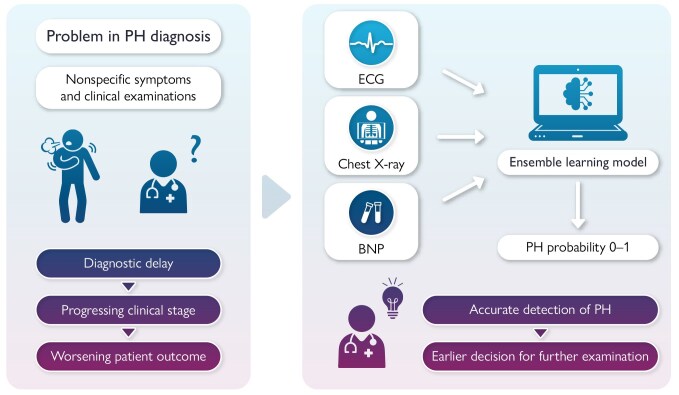
Aims: Delayed diagnosis of pulmonary hypertension (PH) is a known cause of poor patient prognosis. We aimed to develop an artificial intelligence (AI) model, using ensemble learning method to detect PH using electrocardiography (ECG), chest X-ray (CXR), and brain natriuretic peptide (BNP), facilitating accurate detection and prompting further examinations.
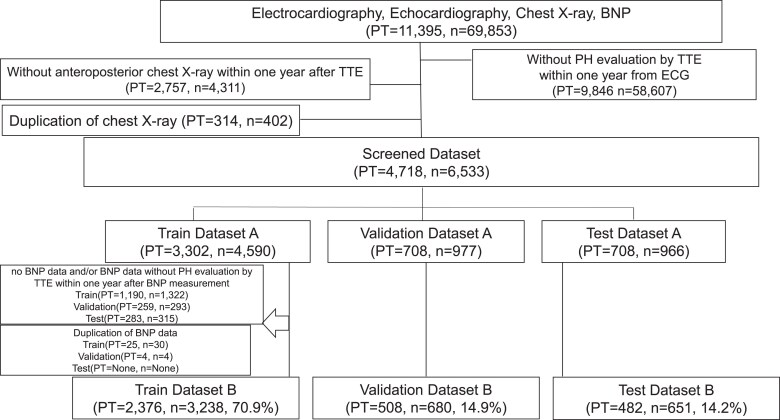
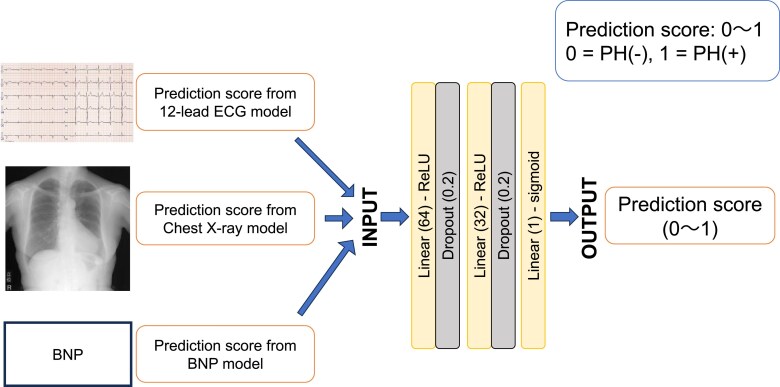
Methods and results: We developed a convolutional neural network model using ECG data to predict PH, labelled by ECG from seven institutions. Logistic regression was used for the BNP prediction model. We referenced a CXR deep learning model using ResNet18. Outputs from each of the three models were integrated into a three-layer fully connected multimodal model. Ten cardiologists participated in an interpretation test, detecting PH from patients' ECG, CXR, and BNP data both with and without the ensemble learning model. The area under the receiver operating characteristic curves of the ECG, CXR, BNP, and ensemble learning model were 0.818 [95% confidence interval (CI), 0.808-0.828], 0.823 (95% CI, 0.780-0.866), 0.724 (95% CI, 0.668-0.780), and 0.872 (95% CI, 0.829-0.915). Cardiologists' average accuracy rates were 65.0 ± 4.7% for test without AI model and 74.0 ± 2.7% for test with AI model, a statistically significant improvement (P < 0.01).
Conclusion: Our ensemble learning model improved doctors' accuracy in detecting PH from ECG, CXR, and BNP examinations. This suggests that earlier and more accurate PH diagnosis is possible, potentially improving patient prognosis.



 京公网安备 11010802042870号
京ICP备2023020795号-1
京公网安备 11010802042870号
京ICP备2023020795号-1

 分享
分享

 求助内容:
求助内容: 应助结果提醒方式:
 扫码关注我们
