{"title":"Evaporation controls contact-dependent bacterial killing during surface-associated growth.","authors":"Miao Han, Chujin Ruan, Gang Wang, David R Johnson","doi":"10.1093/ismeco/ycaf034","DOIUrl":null,"url":null,"abstract":"<p><p>Many bacteria employ contact-dependent killing mechanisms, which require direct physical contact with a target cell, to gain an advantage over competitors. Here, we hypothesize that evaporation-induced fluid flows determine the number of contacts between attacking and target cells, thus controlling killing efficacy. To test this, we experimentally manipulated the strength of the coffee ring effect (CRE) and measured the consequences on killing mediated by the type VI secretion system (T6SS). The CRE is caused by evaporation-induced fluid flows that move water and cells from the center to the periphery of a liquid droplet, consequently concentrating cells at the periphery. We found that the CRE significantly increases the number of contacts between attacking (<i>Vibrio cholerae</i>) and target (<i>Escherichia coli</i>) cells and enhances the ability of <i>V. cholerae</i> to kill and out-compete <i>E. coli</i>. We corroborated our findings with individual-based computational simulations and demonstrated that increased cell densities at the droplet periphery caused by the CRE increase killing. We further found that the T6SS firing rate, lethal hit threshold, and lysis delay significantly affect killing when the CRE is strong. Our results underscore the importance of evaporation-induced fluid flows in shaping bacterial interactions and controlling competitive outcomes.</p>","PeriodicalId":73516,"journal":{"name":"ISME communications","volume":"5 1","pages":"ycaf034"},"PeriodicalIF":6.1000,"publicationDate":"2025-02-21","publicationTypes":"Journal Article","fieldsOfStudy":null,"isOpenAccess":false,"openAccessPdf":"https://www.ncbi.nlm.nih.gov/pmc/articles/PMC11922317/pdf/","citationCount":"0","resultStr":null,"platform":"Semanticscholar","paperid":null,"PeriodicalName":"ISME communications","FirstCategoryId":"1085","ListUrlMain":"https://doi.org/10.1093/ismeco/ycaf034","RegionNum":0,"RegionCategory":null,"ArticlePicture":[],"TitleCN":null,"AbstractTextCN":null,"PMCID":null,"EPubDate":"2025/1/1 0:00:00","PubModel":"eCollection","JCR":"Q1","JCRName":"ECOLOGY","Score":null,"Total":0}
引用次数: 0
Abstract
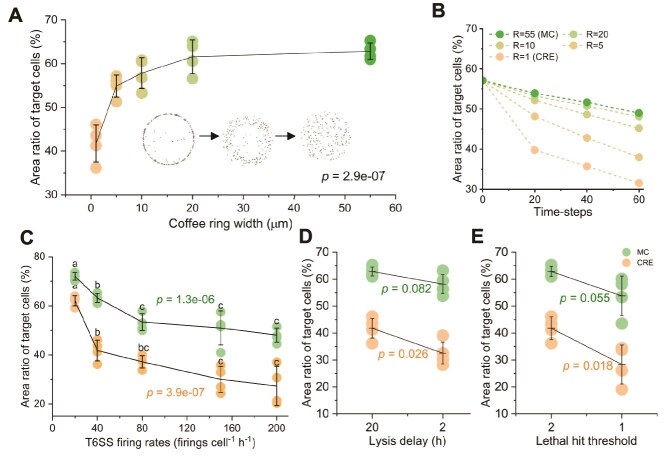
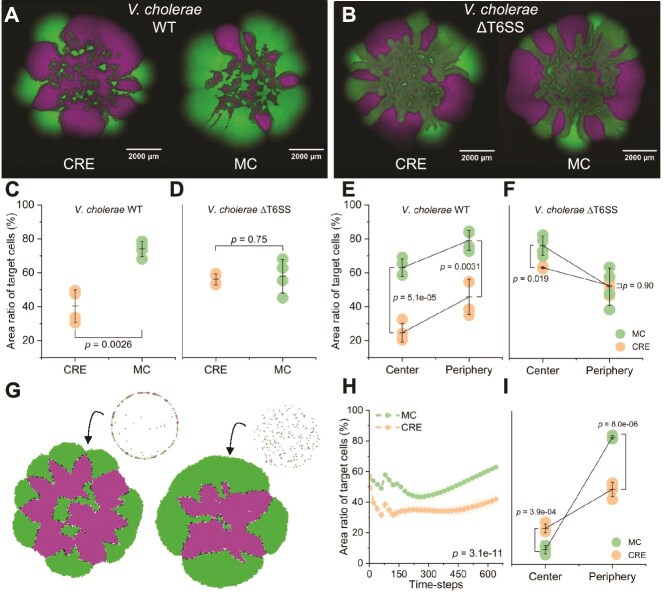
Many bacteria employ contact-dependent killing mechanisms, which require direct physical contact with a target cell, to gain an advantage over competitors. Here, we hypothesize that evaporation-induced fluid flows determine the number of contacts between attacking and target cells, thus controlling killing efficacy. To test this, we experimentally manipulated the strength of the coffee ring effect (CRE) and measured the consequences on killing mediated by the type VI secretion system (T6SS). The CRE is caused by evaporation-induced fluid flows that move water and cells from the center to the periphery of a liquid droplet, consequently concentrating cells at the periphery. We found that the CRE significantly increases the number of contacts between attacking (Vibrio cholerae) and target (Escherichia coli) cells and enhances the ability of V. cholerae to kill and out-compete E. coli. We corroborated our findings with individual-based computational simulations and demonstrated that increased cell densities at the droplet periphery caused by the CRE increase killing. We further found that the T6SS firing rate, lethal hit threshold, and lysis delay significantly affect killing when the CRE is strong. Our results underscore the importance of evaporation-induced fluid flows in shaping bacterial interactions and controlling competitive outcomes.



 京公网安备 11010802042870号
京ICP备2023020795号-1
京公网安备 11010802042870号
京ICP备2023020795号-1

 分享
分享

 求助内容:
求助内容: 应助结果提醒方式:
 扫码关注我们
