Allan Böhm, Amitai Segev, Nikola Jajcay, Konstantin A Krychtiuk, Guido Tavazzi, Michael Spartalis, Marta Kollarova, Imrich Berta, Jana Jankova, Frederico Guerra, Edita Pogran, Andrej Remak, Milana Jarakovic, Viera Sebenova Jerigova, Katarina Petrikova, Shlomi Matetzky, Carsten Skurk, Kurt Huber, Branislav Bezak
{"title":"Machine learning-based scoring system to predict cardiogenic shock in acute coronary syndrome.","authors":"Allan Böhm, Amitai Segev, Nikola Jajcay, Konstantin A Krychtiuk, Guido Tavazzi, Michael Spartalis, Marta Kollarova, Imrich Berta, Jana Jankova, Frederico Guerra, Edita Pogran, Andrej Remak, Milana Jarakovic, Viera Sebenova Jerigova, Katarina Petrikova, Shlomi Matetzky, Carsten Skurk, Kurt Huber, Branislav Bezak","doi":"10.1093/ehjdh/ztaf002","DOIUrl":null,"url":null,"abstract":"<p><strong>Aims: </strong>Cardiogenic shock (CS) is a severe complication of acute coronary syndrome (ACS) with mortality rates approaching 50%. The ability to identify high-risk patients prior to the development of CS may allow for pre-emptive measures to prevent the development of CS. The objective was to derive and externally validate a simple, machine learning (ML)-based scoring system using variables readily available at first medical contact to predict the risk of developing CS during hospitalization in patients with ACS.</p><p><strong>Methods and results: </strong>Observational multicentre study on ACS patients hospitalized at intensive care units. Derivation cohort included over 40 000 patients from Beth Israel Deaconess Medical Center, Boston, USA. Validation cohort included 5123 patients from the Sheba Medical Center, Ramat Gan, Israel. The final derivation cohort consisted of 3228 and the final validation cohort of 4904 ACS patients without CS at hospital admission. Development of CS was adjudicated manually based on the patients' reports. From nine ML models based on 13 variables (heart rate, respiratory rate, oxygen saturation, blood glucose level, systolic blood pressure, age, sex, shock index, heart rhythm, type of ACS, history of hypertension, congestive heart failure, and hypercholesterolaemia), logistic regression with elastic net regularization had the highest externally validated predictive performance (<i>c</i>-statistics: 0.844, 95% CI, 0.841-0.847).</p><p><strong>Conclusion: </strong>STOP SHOCK score is a simple ML-based tool available at first medical contact showing high performance for prediction of developing CS during hospitalization in ACS patients. The web application is available at https://stopshock.org/#calculator.</p>","PeriodicalId":72965,"journal":{"name":"European heart journal. Digital health","volume":"6 2","pages":"240-251"},"PeriodicalIF":4.4000,"publicationDate":"2025-01-06","publicationTypes":"Journal Article","fieldsOfStudy":null,"isOpenAccess":false,"openAccessPdf":"https://www.ncbi.nlm.nih.gov/pmc/articles/PMC11914733/pdf/","citationCount":"0","resultStr":null,"platform":"Semanticscholar","paperid":null,"PeriodicalName":"European heart journal. Digital health","FirstCategoryId":"1085","ListUrlMain":"https://doi.org/10.1093/ehjdh/ztaf002","RegionNum":0,"RegionCategory":null,"ArticlePicture":[],"TitleCN":null,"AbstractTextCN":null,"PMCID":null,"EPubDate":"2025/3/1 0:00:00","PubModel":"eCollection","JCR":"Q1","JCRName":"CARDIAC & CARDIOVASCULAR SYSTEMS","Score":null,"Total":0}
引用次数: 0
Abstract
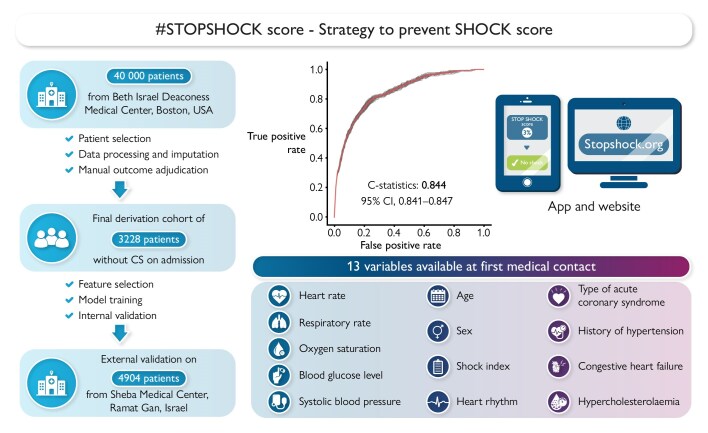
Aims: Cardiogenic shock (CS) is a severe complication of acute coronary syndrome (ACS) with mortality rates approaching 50%. The ability to identify high-risk patients prior to the development of CS may allow for pre-emptive measures to prevent the development of CS. The objective was to derive and externally validate a simple, machine learning (ML)-based scoring system using variables readily available at first medical contact to predict the risk of developing CS during hospitalization in patients with ACS.
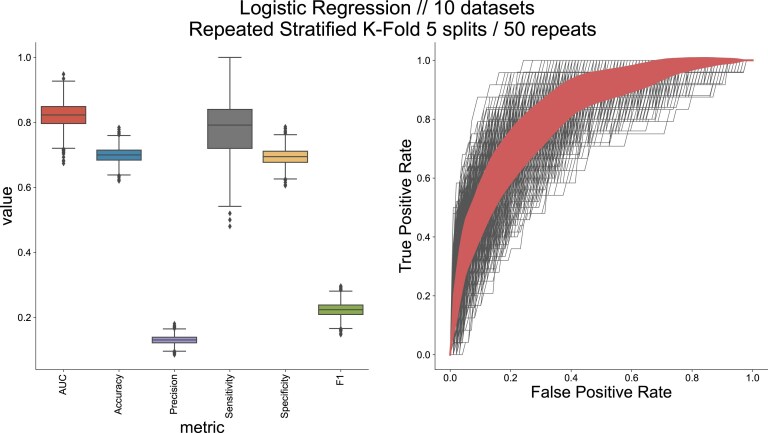
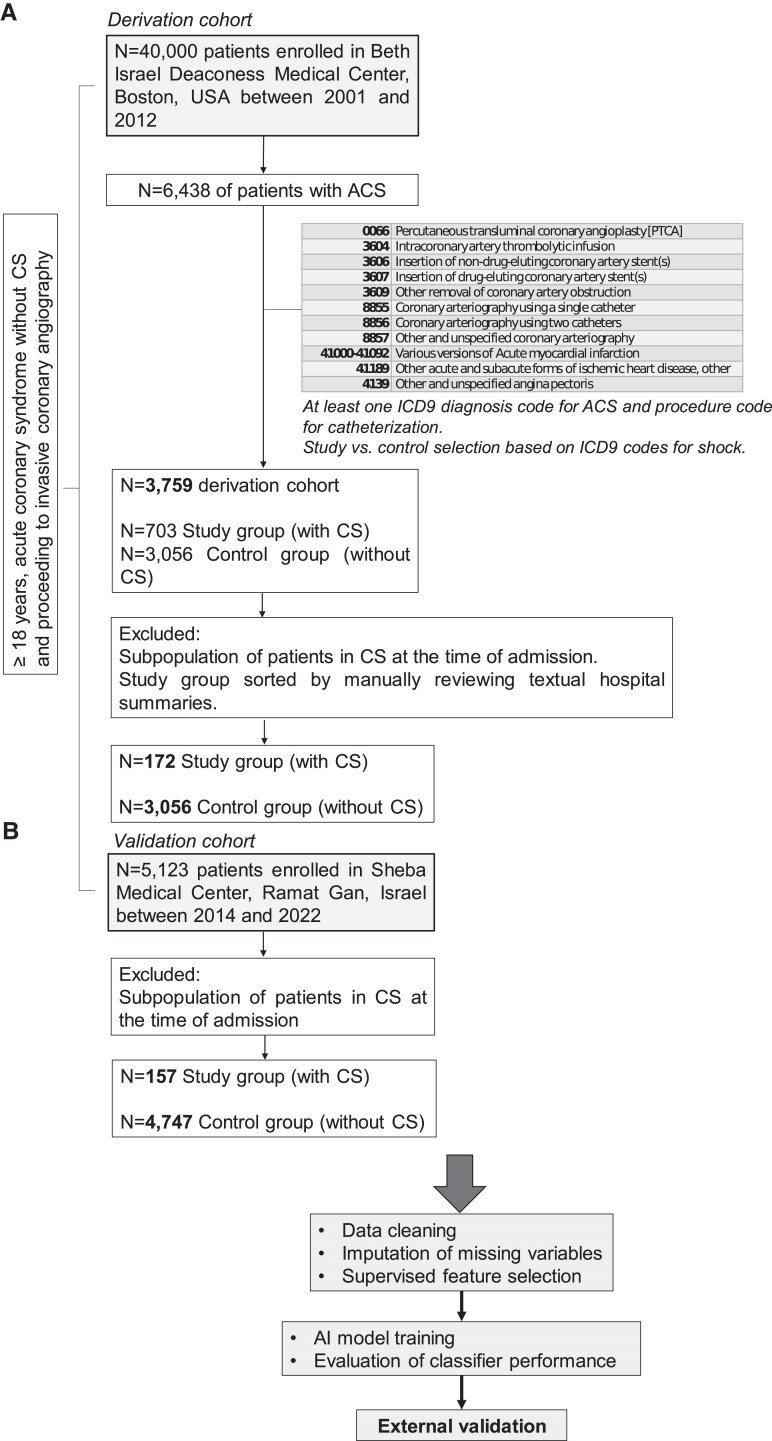
Methods and results: Observational multicentre study on ACS patients hospitalized at intensive care units. Derivation cohort included over 40 000 patients from Beth Israel Deaconess Medical Center, Boston, USA. Validation cohort included 5123 patients from the Sheba Medical Center, Ramat Gan, Israel. The final derivation cohort consisted of 3228 and the final validation cohort of 4904 ACS patients without CS at hospital admission. Development of CS was adjudicated manually based on the patients' reports. From nine ML models based on 13 variables (heart rate, respiratory rate, oxygen saturation, blood glucose level, systolic blood pressure, age, sex, shock index, heart rhythm, type of ACS, history of hypertension, congestive heart failure, and hypercholesterolaemia), logistic regression with elastic net regularization had the highest externally validated predictive performance (c-statistics: 0.844, 95% CI, 0.841-0.847).
Conclusion: STOP SHOCK score is a simple ML-based tool available at first medical contact showing high performance for prediction of developing CS during hospitalization in ACS patients. The web application is available at https://stopshock.org/#calculator.



 京公网安备 11010802042870号
京ICP备2023020795号-1
京公网安备 11010802042870号
京ICP备2023020795号-1

 分享
分享

 求助内容:
求助内容: 应助结果提醒方式:
 扫码关注我们
