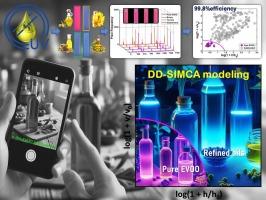
Using UV-induced fluorescence images integrated with a CACHAS-based two-step hierarchical classification approach for rapid detection of extra virgin olive oil adulteration
Wilson Botelho do Nascimento Filho , Francisco dos Santos Panero , Paulo Henrique Gonçalves Dias Diniz , Caroline Mesquita Magalhães da Silva , Mirla Janaína Augusta Cidade
{"title":"Using UV-induced fluorescence images integrated with a CACHAS-based two-step hierarchical classification approach for rapid detection of extra virgin olive oil adulteration","authors":"Wilson Botelho do Nascimento Filho , Francisco dos Santos Panero , Paulo Henrique Gonçalves Dias Diniz , Caroline Mesquita Magalhães da Silva , Mirla Janaína Augusta Cidade","doi":"10.1016/j.foodchem.2025.143951","DOIUrl":null,"url":null,"abstract":"<div><div>This study introduces a novel environmentally-friendly two-step hierarchical classification approach combined with UV-induced fluorescence images for authenticating extra virgin olive oil (EVOO) and detects individual and simultaneous adulteration with refined soybean, canola, and sunflower oils. A Chemometrics-Assisted Color Histogram-based Analytical System (CACHAS) was developed to capture digital fluorescence images and extract analytical fingerprints in the Grayscale, RGB, and HIS channels. Data-Driven Soft Independent Modeling of Class Analogy (DD-SIMCA), optimized for one-class classification, was employed to authenticate pure EVOO with an efficiency of 99.8 % samples, while Partial Least Squares Discriminant Analysis (PLS-DA), designed for multi-class discrimination, was utilized to discriminate the adulterated samples based on the presence of one, two, or three refined vegetable oils with an accuracy of 95.6 %. The complementary application of these methods allows a robust evaluation of the dataset, with DD-SIMCA focusing on validating authentic samples and PLS-DA enhancing the discrimination of adulterated samples across multiple categories.</div></div>","PeriodicalId":318,"journal":{"name":"Food Chemistry","volume":"481 ","pages":"Article 143951"},"PeriodicalIF":9.8000,"publicationDate":"2025-03-20","publicationTypes":"Journal Article","fieldsOfStudy":null,"isOpenAccess":false,"openAccessPdf":"","citationCount":"0","resultStr":null,"platform":"Semanticscholar","paperid":null,"PeriodicalName":"Food Chemistry","FirstCategoryId":"97","ListUrlMain":"https://www.sciencedirect.com/science/article/pii/S0308814625012026","RegionNum":1,"RegionCategory":"农林科学","ArticlePicture":[],"TitleCN":null,"AbstractTextCN":null,"PMCID":null,"EPubDate":"","PubModel":"","JCR":"Q1","JCRName":"CHEMISTRY, APPLIED","Score":null,"Total":0}
引用次数: 0
Abstract
This study introduces a novel environmentally-friendly two-step hierarchical classification approach combined with UV-induced fluorescence images for authenticating extra virgin olive oil (EVOO) and detects individual and simultaneous adulteration with refined soybean, canola, and sunflower oils. A Chemometrics-Assisted Color Histogram-based Analytical System (CACHAS) was developed to capture digital fluorescence images and extract analytical fingerprints in the Grayscale, RGB, and HIS channels. Data-Driven Soft Independent Modeling of Class Analogy (DD-SIMCA), optimized for one-class classification, was employed to authenticate pure EVOO with an efficiency of 99.8 % samples, while Partial Least Squares Discriminant Analysis (PLS-DA), designed for multi-class discrimination, was utilized to discriminate the adulterated samples based on the presence of one, two, or three refined vegetable oils with an accuracy of 95.6 %. The complementary application of these methods allows a robust evaluation of the dataset, with DD-SIMCA focusing on validating authentic samples and PLS-DA enhancing the discrimination of adulterated samples across multiple categories.
本研究介绍了一种新的环境友好的两步分层分类方法,结合紫外线诱导的荧光图像来鉴定特级初榨橄榄油(EVOO),并检测单独和同时掺入精制大豆油、菜籽油和葵花籽油的掺假。开发了一种基于化学计量学辅助颜色直方图的分析系统(CACHAS),用于捕获数字荧光图像并提取灰度、RGB和HIS通道中的分析指纹。采用单类分类优化的Data-Driven Soft Independent Modeling of Class Analogy (DD-SIMCA)对纯EVOO样品进行鉴定,效率为99.8 %;采用多类鉴别设计的偏最小二乘判别分析(PLS-DA)对一种、两种或三种精制植物油的掺假样品进行鉴别,准确率为95.6% %。这些方法的互补应用允许对数据集进行稳健的评估,其中DD-SIMCA侧重于验证真实样本,而PLS-DA增强了跨多个类别的掺假样本的区分。
期刊介绍:
Food Chemistry publishes original research papers dealing with the advancement of the chemistry and biochemistry of foods or the analytical methods/ approach used. All papers should focus on the novelty of the research carried out.




 京公网安备 11010802042870号
京ICP备2023020795号-1
京公网安备 11010802042870号
京ICP备2023020795号-1

 分享
分享
 求助内容:
求助内容: 应助结果提醒方式:
 扫码关注我们
