{"title":"Elucidating the pattern of flavor evolution during the steaming process of fermented sausages in two dimensions: Strain fermentation and steaming time","authors":"Xuefei Shao, Huhu Wang, Xiangyu Song, Na Xu, Linlin Cai, Xinglian Xu","doi":"10.1016/j.foodchem.2025.143945","DOIUrl":null,"url":null,"abstract":"<div><div>This study elucidated the pattern of change in flavor during the steaming of fermented sausages, with a particular focus on the influence of two key factors: Strain fermentation and steaming time. The results indicated that the steaming procedure resulted in a notable loss of water, as well as protein and fat oxidation, in fermented sausages. Additionally, flavor compounds, predominantly aldehydes, esters, and Maillard reaction products, were produced in considerable quantities during the steaming of sausages. Notably, fermented sausages inoculated with LS starter (<em>Lactiplantibacillus plantarum</em> CQ 01107 and <em>Staphylococcus simulans</em> CD 207) exhibited lower levels of oxidation and higher contents of free amino acids and free fatty acids. Furthermore, the textural characteristics of LS sausages during steaming were found to be more favorable, as were the flavor compounds content and sensory scores. For 30-min steaming, LS sausages exhibited lower hardness and chewiness, accompanied by higher levels of esters, ketones and aldehydes, and better sensory scores. These findings demonstrate that starter culture selection (particularly LS strains) and 30-min steaming synergistically optimize flavor profiles, provides a scientific foundation for enhancing the flavor characteristics of fermented sausages throughout their journey from the factory production to the consumer's table.</div></div>","PeriodicalId":318,"journal":{"name":"Food Chemistry","volume":"480 ","pages":"Article 143945"},"PeriodicalIF":9.8000,"publicationDate":"2025-03-20","publicationTypes":"Journal Article","fieldsOfStudy":null,"isOpenAccess":false,"openAccessPdf":"","citationCount":"0","resultStr":null,"platform":"Semanticscholar","paperid":null,"PeriodicalName":"Food Chemistry","FirstCategoryId":"97","ListUrlMain":"https://www.sciencedirect.com/science/article/pii/S0308814625011963","RegionNum":1,"RegionCategory":"农林科学","ArticlePicture":[],"TitleCN":null,"AbstractTextCN":null,"PMCID":null,"EPubDate":"","PubModel":"","JCR":"Q1","JCRName":"CHEMISTRY, APPLIED","Score":null,"Total":0}
引用次数: 0
Abstract
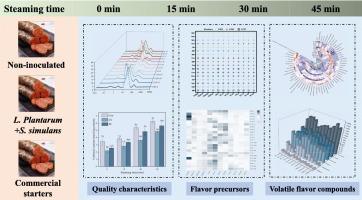
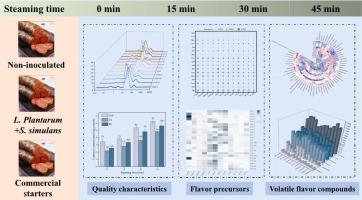
This study elucidated the pattern of change in flavor during the steaming of fermented sausages, with a particular focus on the influence of two key factors: Strain fermentation and steaming time. The results indicated that the steaming procedure resulted in a notable loss of water, as well as protein and fat oxidation, in fermented sausages. Additionally, flavor compounds, predominantly aldehydes, esters, and Maillard reaction products, were produced in considerable quantities during the steaming of sausages. Notably, fermented sausages inoculated with LS starter (Lactiplantibacillus plantarum CQ 01107 and Staphylococcus simulans CD 207) exhibited lower levels of oxidation and higher contents of free amino acids and free fatty acids. Furthermore, the textural characteristics of LS sausages during steaming were found to be more favorable, as were the flavor compounds content and sensory scores. For 30-min steaming, LS sausages exhibited lower hardness and chewiness, accompanied by higher levels of esters, ketones and aldehydes, and better sensory scores. These findings demonstrate that starter culture selection (particularly LS strains) and 30-min steaming synergistically optimize flavor profiles, provides a scientific foundation for enhancing the flavor characteristics of fermented sausages throughout their journey from the factory production to the consumer's table.
期刊介绍:
Food Chemistry publishes original research papers dealing with the advancement of the chemistry and biochemistry of foods or the analytical methods/ approach used. All papers should focus on the novelty of the research carried out.



 京公网安备 11010802042870号
京ICP备2023020795号-1
京公网安备 11010802042870号
京ICP备2023020795号-1

 分享
分享
 求助内容:
求助内容: 应助结果提醒方式:
 扫码关注我们
