{"title":"Development of an electrochemical sensor composed of macaúba biochar for assessing caffeine levels","authors":"Thamiris Carolina Rodrigues de Almeida , Gabriela Françozo Vilela , Juliana Garcia , Matheus Julien Ferreira Bazzana , Sérgio Scherrer Thomasi , Carla Rhaira Teófilo , Zuy Maria Magriotis , Leonardo Luiz Okumura , Adelir Aparecida Saczk","doi":"10.1016/j.foodchem.2025.143925","DOIUrl":null,"url":null,"abstract":"<div><div>This study addresses the development of analytical methods to monitor caffeine concentration levels in stimulant beverages and capsules. For this purpose, an electrochemical sensor modified with macaúba biomass biochar was developed to evaluate caffeine by differential pulse voltammetry. The results indicate that the ideal proportions of the carbon paste components are 50 % graphite, 20 % macaúba biochar and 30 % binder. The voltametric analysis revealed a caffeine oxidation peak at 1.45 V, with linearity in the concentration range from 1.35 × 10<sup>−5</sup> mol·L<sup>−1</sup> to 1.03 × 10<sup>−4</sup> mol·L<sup>−1</sup>. The calculated limits of detection (LOD) for soluble coffee, traditional cola-based soft drinks and central nervous system stimulant capsules were 3.52 μmol·L<sup>-1,</sup> 0.65 μmol·L<sup>−1</sup> and 0.82 μmol·L<sup>−1</sup>, respectively, and the limits of quantification (LOQ) were 11.7 μmol·L<sup>-1,</sup> 2.15 μmol·L<sup>−1</sup> and 2.74 μmol·L<sup>−1</sup>, respectively. Thus, this method is effective for evaluating caffeine, representing a promising alternative to traditional methods, being a low-cost method that proposes an environmentally friendly analysis.</div></div>","PeriodicalId":318,"journal":{"name":"Food Chemistry","volume":"480 ","pages":"Article 143925"},"PeriodicalIF":9.8000,"publicationDate":"2025-03-20","publicationTypes":"Journal Article","fieldsOfStudy":null,"isOpenAccess":false,"openAccessPdf":"","citationCount":"0","resultStr":null,"platform":"Semanticscholar","paperid":null,"PeriodicalName":"Food Chemistry","FirstCategoryId":"97","ListUrlMain":"https://www.sciencedirect.com/science/article/pii/S0308814625011768","RegionNum":1,"RegionCategory":"农林科学","ArticlePicture":[],"TitleCN":null,"AbstractTextCN":null,"PMCID":null,"EPubDate":"","PubModel":"","JCR":"Q1","JCRName":"CHEMISTRY, APPLIED","Score":null,"Total":0}
引用次数: 0
Abstract
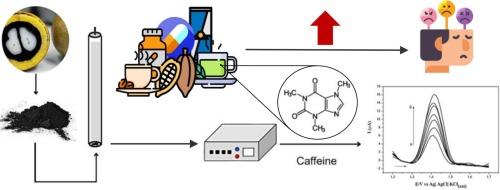
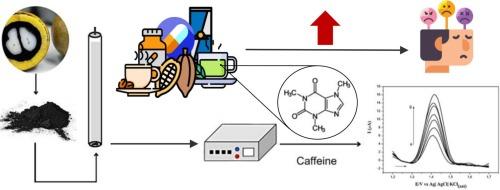
This study addresses the development of analytical methods to monitor caffeine concentration levels in stimulant beverages and capsules. For this purpose, an electrochemical sensor modified with macaúba biomass biochar was developed to evaluate caffeine by differential pulse voltammetry. The results indicate that the ideal proportions of the carbon paste components are 50 % graphite, 20 % macaúba biochar and 30 % binder. The voltametric analysis revealed a caffeine oxidation peak at 1.45 V, with linearity in the concentration range from 1.35 × 10⁻⁵ mol·L−1 to 1.03 × 10⁻⁴ mol·L−1. The calculated limits of detection (LOD) for soluble coffee, traditional cola-based soft drinks and central nervous system stimulant capsules were 3.52 μmol·L-1, 0.65 μmol·L−1 and 0.82 μmol·L−1, respectively, and the limits of quantification (LOQ) were 11.7 μmol·L-1, 2.15 μmol·L−1 and 2.74 μmol·L−1, respectively. Thus, this method is effective for evaluating caffeine, representing a promising alternative to traditional methods, being a low-cost method that proposes an environmentally friendly analysis.
期刊介绍:
Food Chemistry publishes original research papers dealing with the advancement of the chemistry and biochemistry of foods or the analytical methods/ approach used. All papers should focus on the novelty of the research carried out.




 京公网安备 11010802042870号
京ICP备2023020795号-1
京公网安备 11010802042870号
京ICP备2023020795号-1

 分享
分享
 求助内容:
求助内容: 应助结果提醒方式:
 扫码关注我们
