Lu-Ning Wang, Shuang-Zhu Li, Wei-Wei Liu, Niu Jiang, Yu-Yang Song, Lu Bai, Yu Wang, Bo Yin, Jie Yang and Wei Yang
{"title":"Thermally conductive phase change electrodes for in situ thermal management of lithium-ion batteries†","authors":"Lu-Ning Wang, Shuang-Zhu Li, Wei-Wei Liu, Niu Jiang, Yu-Yang Song, Lu Bai, Yu Wang, Bo Yin, Jie Yang and Wei Yang","doi":"10.1039/D4TA08893J","DOIUrl":null,"url":null,"abstract":"<p >With the implementation of diverse application scenarios, the safety issue mainly stemming from the accumulation of generated heat and the formation of internal hot spots has become a major obstacle to the development of lithium-ion batteries (LIBs). Although external thermal management strategies for LIBs have been developed to avoid the thermal runaway, they are incapable of eliminating the temperature gradient (TG) inside an individual cell due to the difference in thermal diffusion between inside and outside the cell, which in turn affects their cycling life and operational safety. In addition, the thermal resistance contribution from the electrode is larger than that from the separator inside the battery. Herein, the effective thermal management of LIBs is achieved by <em>in situ</em> coating thermally conductive boron nitride (BN) and phase change microcapsules on the phosphate cathode surface, promoting uniform heat distribution and absorbing excess heat production. The batteries containing the thermal management electrode exhibit superior ion transport and rate performance, especially in high-temperature environments. The <em>in situ</em> modified coating on the electrode surface endows the LIBs with a positive thermal management effect and a negligible increase in the internal resistance. This work provides a viable solution to the development of internal thermal management for next-generation LIBs.</p>","PeriodicalId":82,"journal":{"name":"Journal of Materials Chemistry A","volume":" 17","pages":" 12650-12660"},"PeriodicalIF":9.5000,"publicationDate":"2025-03-20","publicationTypes":"Journal Article","fieldsOfStudy":null,"isOpenAccess":false,"openAccessPdf":"","citationCount":"0","resultStr":null,"platform":"Semanticscholar","paperid":null,"PeriodicalName":"Journal of Materials Chemistry A","FirstCategoryId":"88","ListUrlMain":"https://pubs.rsc.org/en/content/articlelanding/2025/ta/d4ta08893j","RegionNum":2,"RegionCategory":"材料科学","ArticlePicture":[],"TitleCN":null,"AbstractTextCN":null,"PMCID":null,"EPubDate":"","PubModel":"","JCR":"Q1","JCRName":"CHEMISTRY, PHYSICAL","Score":null,"Total":0}
引用次数: 0
Abstract
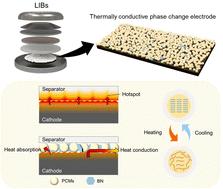
With the implementation of diverse application scenarios, the safety issue mainly stemming from the accumulation of generated heat and the formation of internal hot spots has become a major obstacle to the development of lithium-ion batteries (LIBs). Although external thermal management strategies for LIBs have been developed to avoid the thermal runaway, they are incapable of eliminating the temperature gradient (TG) inside an individual cell due to the difference in thermal diffusion between inside and outside the cell, which in turn affects their cycling life and operational safety. In addition, the thermal resistance contribution from the electrode is larger than that from the separator inside the battery. Herein, the effective thermal management of LIBs is achieved by in situ coating thermally conductive boron nitride (BN) and phase change microcapsules on the phosphate cathode surface, promoting uniform heat distribution and absorbing excess heat production. The batteries containing the thermal management electrode exhibit superior ion transport and rate performance, especially in high-temperature environments. The in situ modified coating on the electrode surface endows the LIBs with a positive thermal management effect and a negligible increase in the internal resistance. This work provides a viable solution to the development of internal thermal management for next-generation LIBs.
期刊介绍:
The Journal of Materials Chemistry A, B & C covers a wide range of high-quality studies in the field of materials chemistry, with each section focusing on specific applications of the materials studied. Journal of Materials Chemistry A emphasizes applications in energy and sustainability, including topics such as artificial photosynthesis, batteries, and fuel cells. Journal of Materials Chemistry B focuses on applications in biology and medicine, while Journal of Materials Chemistry C covers applications in optical, magnetic, and electronic devices. Example topic areas within the scope of Journal of Materials Chemistry A include catalysis, green/sustainable materials, sensors, and water treatment, among others.



 京公网安备 11010802042870号
京ICP备2023020795号-1
京公网安备 11010802042870号
京ICP备2023020795号-1

 分享
分享
 求助内容:
求助内容: 应助结果提醒方式:
 扫码关注我们
