Junya Wang, Zhengdong Jiang, Shikun Wen, Yaling Wei, Ping Ning and Yu Zhang
{"title":"Application of MOF-808 and its derivatives in carbon capture and CO2 catalytic conversion","authors":"Junya Wang, Zhengdong Jiang, Shikun Wen, Yaling Wei, Ping Ning and Yu Zhang","doi":"10.1039/D5TA00011D","DOIUrl":null,"url":null,"abstract":"<p >Excessive emissions of CO<small><sub>2</sub></small>, the main component of greenhouse gases, have led to frequent natural disasters worldwide and a global movement towards carbon neutrality. Carbon Capture, utilisation and storage (CCUS) has attracted research interest as a sustainable emission reduction technology. Metal–organic frameworks (MOFs) stand out as a new class of high-performance adsorbents with significant advantages for CO<small><sub>2</sub></small> capture. Their extraordinarily high specific surface area and well-developed pore structure make them ideal for this application. In recent years, significant progress has been made in the research of MOF-808 and its derivatives for CO<small><sub>2</sub></small> capture, separation, and catalytic utilization. Several important findings have been published, substantially advancing the practical applications of MOF-808 materials in carbon capture technology. However, a comprehensive summary of these developments is still lacking. Therefore, this paper reviews recent research progress on MOF-808 and its derivatives for CO<small><sub>2</sub></small> applications. It provides an in-depth analysis of advanced synthesis methods and optimization strategies for MOF-808 and its derived materials in CO<small><sub>2</sub></small> selective adsorption, separation and catalysis while exploring the mechanisms underlying CO<small><sub>2</sub></small> capture, separation and catalytic processes. Moreover, this paper systematically summarises the key issues that have attracted much attention regarding MOF-808 materials in carbon capture and practical applications. Finally, the challenges and opportunities of MOF-808 materials in the context of CO<small><sub>2</sub></small> adsorption, separation and catalytic utilization are described.</p>","PeriodicalId":82,"journal":{"name":"Journal of Materials Chemistry A","volume":" 16","pages":" 11185-11209"},"PeriodicalIF":9.5000,"publicationDate":"2025-03-20","publicationTypes":"Journal Article","fieldsOfStudy":null,"isOpenAccess":false,"openAccessPdf":"","citationCount":"0","resultStr":null,"platform":"Semanticscholar","paperid":null,"PeriodicalName":"Journal of Materials Chemistry A","FirstCategoryId":"88","ListUrlMain":"https://pubs.rsc.org/en/content/articlelanding/2025/ta/d5ta00011d","RegionNum":2,"RegionCategory":"材料科学","ArticlePicture":[],"TitleCN":null,"AbstractTextCN":null,"PMCID":null,"EPubDate":"","PubModel":"","JCR":"Q1","JCRName":"CHEMISTRY, PHYSICAL","Score":null,"Total":0}
引用次数: 0
Abstract
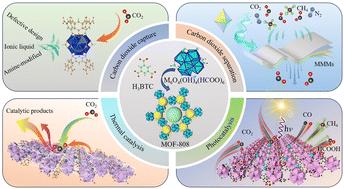
Excessive emissions of CO2, the main component of greenhouse gases, have led to frequent natural disasters worldwide and a global movement towards carbon neutrality. Carbon Capture, utilisation and storage (CCUS) has attracted research interest as a sustainable emission reduction technology. Metal–organic frameworks (MOFs) stand out as a new class of high-performance adsorbents with significant advantages for CO2 capture. Their extraordinarily high specific surface area and well-developed pore structure make them ideal for this application. In recent years, significant progress has been made in the research of MOF-808 and its derivatives for CO2 capture, separation, and catalytic utilization. Several important findings have been published, substantially advancing the practical applications of MOF-808 materials in carbon capture technology. However, a comprehensive summary of these developments is still lacking. Therefore, this paper reviews recent research progress on MOF-808 and its derivatives for CO2 applications. It provides an in-depth analysis of advanced synthesis methods and optimization strategies for MOF-808 and its derived materials in CO2 selective adsorption, separation and catalysis while exploring the mechanisms underlying CO2 capture, separation and catalytic processes. Moreover, this paper systematically summarises the key issues that have attracted much attention regarding MOF-808 materials in carbon capture and practical applications. Finally, the challenges and opportunities of MOF-808 materials in the context of CO2 adsorption, separation and catalytic utilization are described.
期刊介绍:
The Journal of Materials Chemistry A, B & C covers a wide range of high-quality studies in the field of materials chemistry, with each section focusing on specific applications of the materials studied. Journal of Materials Chemistry A emphasizes applications in energy and sustainability, including topics such as artificial photosynthesis, batteries, and fuel cells. Journal of Materials Chemistry B focuses on applications in biology and medicine, while Journal of Materials Chemistry C covers applications in optical, magnetic, and electronic devices. Example topic areas within the scope of Journal of Materials Chemistry A include catalysis, green/sustainable materials, sensors, and water treatment, among others.




 京公网安备 11010802042870号
京ICP备2023020795号-1
京公网安备 11010802042870号
京ICP备2023020795号-1

 分享
分享
 求助内容:
求助内容: 应助结果提醒方式:
 扫码关注我们
