{"title":"Monodisperse and size-regulable nanoparticles by polymerization-induced self-assembly for printable colloidal photonic crystals†","authors":"Nankai An , Xushuai Chen , Xi Chen , Jinying Yuan","doi":"10.1039/d5py00077g","DOIUrl":null,"url":null,"abstract":"<div><div>Colloidal photonic crystals (CPCs) have attracted much attention due to their distinctive and vibrant structural colors. Precise control over the size and dispersity of nanoparticles is vital for high quality CPC patterns by bottom-up colloidal self-assembly. The polymerization-induced self-assembly (PISA) method has emerged as a promising strategy for preparing nanoparticles of specific morphology and size with good adaptability to a wide range of monomers and solvents. Nevertheless, achieving monodisperse particles with a specific particle size to fabricate structural color patterns by PISA remains a challenge. In this study, we present a novel aqueous PISA approach that enables the large-scale preparation of monodisperse nanospheres (diameter polydispersity <1.001) and the fabrication of printable CPCs. The method allows for the large-scale preparation of uniform polymeric nanoparticles with precise size control, thus enabling accurate manipulation of structural colors. The aqueous dispersions were used as inks to print structural color patterns on paper substrates, achieving photonic patterns with characteristic angle-dependent and water-responsive color variations. This study highlights the significant potential of the PISA method in advancing the fabrication of functional colloidal materials and expanding the application of CPCs.</div></div>","PeriodicalId":100,"journal":{"name":"Polymer Chemistry","volume":"16 17","pages":"Pages 1981-1989"},"PeriodicalIF":3.9000,"publicationDate":"2025-03-19","publicationTypes":"Journal Article","fieldsOfStudy":null,"isOpenAccess":false,"openAccessPdf":"","citationCount":"0","resultStr":null,"platform":"Semanticscholar","paperid":null,"PeriodicalName":"Polymer Chemistry","FirstCategoryId":"92","ListUrlMain":"https://www.sciencedirect.com/org/science/article/pii/S1759995425001159","RegionNum":2,"RegionCategory":"化学","ArticlePicture":[],"TitleCN":null,"AbstractTextCN":null,"PMCID":null,"EPubDate":"2025/3/21 0:00:00","PubModel":"Epub","JCR":"Q2","JCRName":"POLYMER SCIENCE","Score":null,"Total":0}
引用次数: 0
Abstract
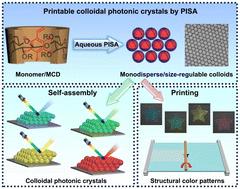
Colloidal photonic crystals (CPCs) have attracted much attention due to their distinctive and vibrant structural colors. Precise control over the size and dispersity of nanoparticles is vital for high quality CPC patterns by bottom-up colloidal self-assembly. The polymerization-induced self-assembly (PISA) method has emerged as a promising strategy for preparing nanoparticles of specific morphology and size with good adaptability to a wide range of monomers and solvents. Nevertheless, achieving monodisperse particles with a specific particle size to fabricate structural color patterns by PISA remains a challenge. In this study, we present a novel aqueous PISA approach that enables the large-scale preparation of monodisperse nanospheres (diameter polydispersity <1.001) and the fabrication of printable CPCs. The method allows for the large-scale preparation of uniform polymeric nanoparticles with precise size control, thus enabling accurate manipulation of structural colors. The aqueous dispersions were used as inks to print structural color patterns on paper substrates, achieving photonic patterns with characteristic angle-dependent and water-responsive color variations. This study highlights the significant potential of the PISA method in advancing the fabrication of functional colloidal materials and expanding the application of CPCs.
期刊介绍:
Polymer Chemistry welcomes submissions in all areas of polymer science that have a strong focus on macromolecular chemistry. Manuscripts may cover a broad range of fields, yet no direct application focus is required.



 京公网安备 11010802042870号
京ICP备2023020795号-1
京公网安备 11010802042870号
京ICP备2023020795号-1

 分享
分享
 求助内容:
求助内容: 应助结果提醒方式:
 扫码关注我们
