{"title":"Constructing Stable and Wavelength-Extended Heptamethine Cyanines via Donor Ectopic Substitution for NIR-IIa/b Bioimaging","authors":"Yi-Feng Ou, Hong-Ya Xiang, Xu Yang, Ren-Xuan Wang, Shuang-Yan Huan, Lin Yuan, Tian-Bing Ren, Xiao-Bing Zhang","doi":"10.1002/anie.202423978","DOIUrl":null,"url":null,"abstract":"<p>Organic NIR-II dyes, particularly cyanine fluorophores, offer high molar extinction coefficients, biocompatibility, and structural tunability and are popular for noninvasive, high-resolution, and -contrast in vivo imaging. However, achieving stable, long-wavelength, and large Stokes shift NIR-II cyanine suitable for NIR-IIa/IIb bioimaging is still a formidable challenge. Herein, we introduce a novel strategy that extends the emission wavelength by the enhanced Highest occupied molecular orbital (HOMO)–Lowest occupied molecular orbital (LUMO) separation through simple donor ectopic substitution at the terminal structure of NIR-II cyanine. Compared to the original NIR-II cyanine Flav7, these novel dyes (NIR-ACs) exhibited a significant emission redshift and larger Stokes shift, with the maximum emission wavelength exceeding 1300 nm (NIR-IIa) and a tail emission exceeding 1500 nm (NIR-IIb). Notably, they also demonstrate excellent stability and deeper tissue imaging ability in vivo imaging. Finally, through surface modification of nanoparticles, NIR-ACs nanoparticles (NPs) have successfully achieved high-contrast tumor and bone-targeted detecting as well as multicolor imaging, providing robust tools for in vivo diagnostics and biomedical research.</p>","PeriodicalId":125,"journal":{"name":"Angewandte Chemie International Edition","volume":"64 22","pages":""},"PeriodicalIF":16.9000,"publicationDate":"2025-03-21","publicationTypes":"Journal Article","fieldsOfStudy":null,"isOpenAccess":false,"openAccessPdf":"","citationCount":"0","resultStr":null,"platform":"Semanticscholar","paperid":null,"PeriodicalName":"Angewandte Chemie International Edition","FirstCategoryId":"92","ListUrlMain":"https://onlinelibrary.wiley.com/doi/10.1002/anie.202423978","RegionNum":1,"RegionCategory":"化学","ArticlePicture":[],"TitleCN":null,"AbstractTextCN":null,"PMCID":null,"EPubDate":"","PubModel":"","JCR":"Q1","JCRName":"CHEMISTRY, MULTIDISCIPLINARY","Score":null,"Total":0}
引用次数: 0
Abstract
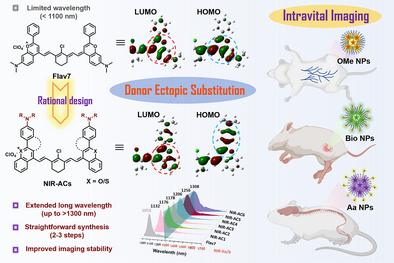
Organic NIR-II dyes, particularly cyanine fluorophores, offer high molar extinction coefficients, biocompatibility, and structural tunability and are popular for noninvasive, high-resolution, and -contrast in vivo imaging. However, achieving stable, long-wavelength, and large Stokes shift NIR-II cyanine suitable for NIR-IIa/IIb bioimaging is still a formidable challenge. Herein, we introduce a novel strategy that extends the emission wavelength by the enhanced Highest occupied molecular orbital (HOMO)–Lowest occupied molecular orbital (LUMO) separation through simple donor ectopic substitution at the terminal structure of NIR-II cyanine. Compared to the original NIR-II cyanine Flav7, these novel dyes (NIR-ACs) exhibited a significant emission redshift and larger Stokes shift, with the maximum emission wavelength exceeding 1300 nm (NIR-IIa) and a tail emission exceeding 1500 nm (NIR-IIb). Notably, they also demonstrate excellent stability and deeper tissue imaging ability in vivo imaging. Finally, through surface modification of nanoparticles, NIR-ACs nanoparticles (NPs) have successfully achieved high-contrast tumor and bone-targeted detecting as well as multicolor imaging, providing robust tools for in vivo diagnostics and biomedical research.
期刊介绍:
Angewandte Chemie, a journal of the German Chemical Society (GDCh), maintains a leading position among scholarly journals in general chemistry with an impressive Impact Factor of 16.6 (2022 Journal Citation Reports, Clarivate, 2023). Published weekly in a reader-friendly format, it features new articles almost every day. Established in 1887, Angewandte Chemie is a prominent chemistry journal, offering a dynamic blend of Review-type articles, Highlights, Communications, and Research Articles on a weekly basis, making it unique in the field.



 京公网安备 11010802042870号
京ICP备2023020795号-1
京公网安备 11010802042870号
京ICP备2023020795号-1

 分享
分享
 求助内容:
求助内容: 应助结果提醒方式:
 扫码关注我们
