Dr. Yuanjie Liu, Dr. Yunpeng Fan, Prof. Xiaoqiang Li, Prof. Gang Tian, Prof. Bo Shen, Dr. Menghan Li, Dr. Kai Su, Dr. Xuhuai Fu, Dr. Mengxuan Zhang, Prof. Yonghong Wang, Prof. Xinyu Li, Prof. Xinmin Li, Prof. Shijia Ding
{"title":"Simple and Rapid Tumor EV Enrichment Enabled by Long DNA Probe-Guided Entanglement","authors":"Dr. Yuanjie Liu, Dr. Yunpeng Fan, Prof. Xiaoqiang Li, Prof. Gang Tian, Prof. Bo Shen, Dr. Menghan Li, Dr. Kai Su, Dr. Xuhuai Fu, Dr. Mengxuan Zhang, Prof. Yonghong Wang, Prof. Xinyu Li, Prof. Xinmin Li, Prof. Shijia Ding","doi":"10.1002/anie.202501804","DOIUrl":null,"url":null,"abstract":"<p>Specific subpopulations of extracellular vesicles (EVs) hold significant clinical potential for biomarker discovery, disease diagnosis, and therapeutic agents. However, this field remains underutilized due to the lack of straightforward and versatile techniques for isolating EV subpopulations from biofluids. Here, we present LODGE, a <span>lo</span>ng <span>D</span>NA probe-<span>g</span>uided EV <span>e</span>ntanglement strategy for the simple, rapid, and selective enrichment of tumor-derived EVs (tEVs) from clinical specimens. LODGE uses two long DNA affinity probes to recognize specific subpopulations, causing them to aggregate with the assistance of splint strands, thereby achieving nondestructive, high-yield, and high-purity separation of tEVs within a short period. Proteomic analysis revealed that the isolated tEVs contributed to the identification of tumor-associated biomarkers compared to total EVs. Additionally, by incorporating a split G-quadruplex-containing molecular trap domain, a novel structure that significantly improves the fluorescence emission of thioflavin T (ThT), into DNA affinity probes, we developed an innovative LODGE-ThT sensing strategy for the highly sensitive profiling of multiple tEV subpopulations. Using data from the tEVs alongside clinical indicators processed with machine learning algorithms, we effectively classified five tumor types. Our results show that LODGE is a promising tool for identifying specific EV subpopulations, and fostering their biomedical applications.</p>","PeriodicalId":125,"journal":{"name":"Angewandte Chemie International Edition","volume":"64 31","pages":""},"PeriodicalIF":16.9000,"publicationDate":"2025-03-21","publicationTypes":"Journal Article","fieldsOfStudy":null,"isOpenAccess":false,"openAccessPdf":"","citationCount":"0","resultStr":null,"platform":"Semanticscholar","paperid":null,"PeriodicalName":"Angewandte Chemie International Edition","FirstCategoryId":"92","ListUrlMain":"https://onlinelibrary.wiley.com/doi/10.1002/anie.202501804","RegionNum":1,"RegionCategory":"化学","ArticlePicture":[],"TitleCN":null,"AbstractTextCN":null,"PMCID":null,"EPubDate":"","PubModel":"","JCR":"Q1","JCRName":"CHEMISTRY, MULTIDISCIPLINARY","Score":null,"Total":0}
引用次数: 0
Abstract
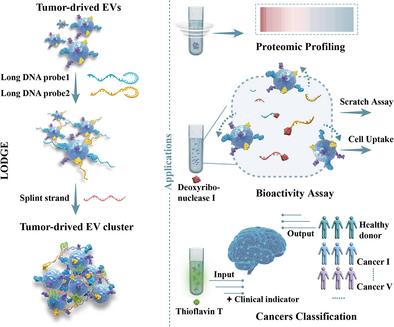
Specific subpopulations of extracellular vesicles (EVs) hold significant clinical potential for biomarker discovery, disease diagnosis, and therapeutic agents. However, this field remains underutilized due to the lack of straightforward and versatile techniques for isolating EV subpopulations from biofluids. Here, we present LODGE, a long DNA probe-guided EV entanglement strategy for the simple, rapid, and selective enrichment of tumor-derived EVs (tEVs) from clinical specimens. LODGE uses two long DNA affinity probes to recognize specific subpopulations, causing them to aggregate with the assistance of splint strands, thereby achieving nondestructive, high-yield, and high-purity separation of tEVs within a short period. Proteomic analysis revealed that the isolated tEVs contributed to the identification of tumor-associated biomarkers compared to total EVs. Additionally, by incorporating a split G-quadruplex-containing molecular trap domain, a novel structure that significantly improves the fluorescence emission of thioflavin T (ThT), into DNA affinity probes, we developed an innovative LODGE-ThT sensing strategy for the highly sensitive profiling of multiple tEV subpopulations. Using data from the tEVs alongside clinical indicators processed with machine learning algorithms, we effectively classified five tumor types. Our results show that LODGE is a promising tool for identifying specific EV subpopulations, and fostering their biomedical applications.
细胞外囊泡(EVs)的特定亚群在生物标记物发现、疾病诊断和治疗药物方面具有巨大的临床潜力。然而,由于缺乏从生物流体中分离细胞外囊泡亚群的直接而通用的技术,这一领域仍然没有得到充分利用。在此,我们介绍一种长 DNA 探针引导的 EV 缠绕策略 LODGE,该策略可从临床样本中简单、快速、选择性地富集肿瘤衍生 EV(tEV)。LODGE 使用两个长 DNA 亲和探针识别特定亚群,使其在夹板链的辅助下聚集,从而在短时间内实现无损、高产、高纯度的 tEVs 分离。蛋白质组分析表明,与总 EVs 相比,分离出的 tEVs 有助于鉴定肿瘤相关生物标记物。此外,我们还在DNA亲和探针中加入了含分裂G-四联分子陷阱结构域,这种新型结构能显著提高硫黄素T(ThT)的荧光发射,因此我们开发出了一种创新的LODGE-ThT传感策略,可对多个tEV亚群进行高灵敏度分析。利用来自 tEV 的数据以及经机器学习算法处理的临床指标,我们有效地对五种肿瘤类型进行了分类。我们的研究结果表明,LODGE 是一种很有前途的工具,可用于识别特定的 EV 亚群,促进其生物医学应用。
期刊介绍:
Angewandte Chemie, a journal of the German Chemical Society (GDCh), maintains a leading position among scholarly journals in general chemistry with an impressive Impact Factor of 16.6 (2022 Journal Citation Reports, Clarivate, 2023). Published weekly in a reader-friendly format, it features new articles almost every day. Established in 1887, Angewandte Chemie is a prominent chemistry journal, offering a dynamic blend of Review-type articles, Highlights, Communications, and Research Articles on a weekly basis, making it unique in the field.



 京公网安备 11010802042870号
京ICP备2023020795号-1
京公网安备 11010802042870号
京ICP备2023020795号-1

 分享
分享
 求助内容:
求助内容: 应助结果提醒方式:
 扫码关注我们
