Qiang Huang, Xiaoyan Gan, Linfei Yang, JianHua Liao, Liling Guo and Hanxing Liu
{"title":"Effect of halogen substitution in spacer cations on two-dimensional Ruddlesden–Popper perovskites†","authors":"Qiang Huang, Xiaoyan Gan, Linfei Yang, JianHua Liao, Liling Guo and Hanxing Liu","doi":"10.1039/D5CP00707K","DOIUrl":null,"url":null,"abstract":"<p >This research investigated how halogen substitution in spacer cations influenced the crystal and electronic structures of two-dimensional Ruddlesden–Popper perovskites (X–(CH<small><sub>2</sub></small>)<small><sub>2</sub></small>–NH<small><sub>3</sub></small>)<small><sub>2</sub></small>PbI<small><sub>4</sub></small> (where X can be I, Br, or Cl) through first-principle calculations. In contrast to (I–(CH<small><sub>2</sub></small>)<small><sub>2</sub></small>–NH<small><sub>3</sub></small>)<small><sub>2</sub></small>PbI<small><sub>4</sub></small>, the [PbI<small><sub>6</sub></small>]<small><sup>4−</sup></small> octahedra in (Br–(CH<small><sub>2</sub></small>)<small><sub>2</sub></small>–NH<small><sub>3</sub></small>)<small><sub>2</sub></small>PbI<small><sub>4</sub></small> and (Cl–(CH<small><sub>2</sub></small>)<small><sub>2</sub></small>–NH<small><sub>3</sub></small>)<small><sub>2</sub></small>PbI<small><sub>4</sub></small> exhibited a greater degree of deviation from ideal octahedral geometry. Moreover, the Pb–I–Pb bond angles in (Br–(CH<small><sub>2</sub></small>)<small><sub>2</sub></small>–NH<small><sub>3</sub></small>)<small><sub>2</sub></small>PbI<small><sub>4</sub></small> and (Cl–(CH<small><sub>2</sub></small>)<small><sub>2</sub></small>–NH<small><sub>3</sub></small>)<small><sub>2</sub></small>PbI<small><sub>4</sub></small> were approximately 180°, indicating that the distortions of the adjacent [PbI<small><sub>6</sub></small>]<small><sup>4−</sup></small> octahedra were relatively minor. In comparison, (I–(CH<small><sub>2</sub></small>)<small><sub>2</sub></small>–NH<small><sub>3</sub></small>)<small><sub>2</sub></small>PbI<small><sub>4</sub></small> demonstrated more significant adjacent [PbI<small><sub>6</sub></small>]<small><sup>4−</sup></small> octahedral distortions and therefore a larger band gap. The significant distortion of adjacent [PbI<small><sub>6</sub></small>]<small><sup>4−</sup></small> octahedra in (I–(CH<small><sub>2</sub></small>)<small><sub>2</sub></small>–NH<small><sub>3</sub></small>)<small><sub>2</sub></small>PbI<small><sub>4</sub></small> was found to be predominantly induced by hydrogen-bonding interactions between the organic and inorganic components, along with the I–I interactions. In (Br–(CH<small><sub>2</sub></small>)<small><sub>2</sub></small>–NH<small><sub>3</sub></small>)<small><sub>2</sub></small>PbI<small><sub>4</sub></small> and (Cl–(CH<small><sub>2</sub></small>)<small><sub>2</sub></small>–NH<small><sub>3</sub></small>)<small><sub>2</sub></small>PbI<small><sub>4</sub></small>, the hydrogen-bonding interactions between the spacer cations facilitated the insertion of two carbon atoms into the pocket of the inorganic layer, leading to significant distortion of the individual [PbI<small><sub>6</sub></small>]<small><sup>4−</sup></small> octahedra. Additionally, these hydrogen-bonding interactions significantly contributed to their increased thermal stability. Moreover, the symmetrical positioning of the spacer cations in relation to the inorganic layer led to symmetrical hydrogen-bonding interactions between the organic and inorganic components, which helped prevent the deformation of adjacent [PbI<small><sub>6</sub></small>]<small><sup>4−</sup></small> octahedra. This research provided valuable theoretical insights for the selection of organic cations of two-dimensional organic–inorganic hybrid materials.</p>","PeriodicalId":99,"journal":{"name":"Physical Chemistry Chemical Physics","volume":" 16","pages":" 8238-8247"},"PeriodicalIF":2.9000,"publicationDate":"2025-03-21","publicationTypes":"Journal Article","fieldsOfStudy":null,"isOpenAccess":false,"openAccessPdf":"","citationCount":"0","resultStr":null,"platform":"Semanticscholar","paperid":null,"PeriodicalName":"Physical Chemistry Chemical Physics","FirstCategoryId":"92","ListUrlMain":"https://pubs.rsc.org/en/content/articlelanding/2025/cp/d5cp00707k","RegionNum":3,"RegionCategory":"化学","ArticlePicture":[],"TitleCN":null,"AbstractTextCN":null,"PMCID":null,"EPubDate":"","PubModel":"","JCR":"Q3","JCRName":"CHEMISTRY, PHYSICAL","Score":null,"Total":0}
引用次数: 0
Abstract
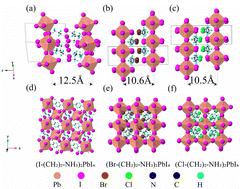
This research investigated how halogen substitution in spacer cations influenced the crystal and electronic structures of two-dimensional Ruddlesden–Popper perovskites (X–(CH2)2–NH3)2PbI4 (where X can be I, Br, or Cl) through first-principle calculations. In contrast to (I–(CH2)2–NH3)2PbI4, the [PbI6]4− octahedra in (Br–(CH2)2–NH3)2PbI4 and (Cl–(CH2)2–NH3)2PbI4 exhibited a greater degree of deviation from ideal octahedral geometry. Moreover, the Pb–I–Pb bond angles in (Br–(CH2)2–NH3)2PbI4 and (Cl–(CH2)2–NH3)2PbI4 were approximately 180°, indicating that the distortions of the adjacent [PbI6]4− octahedra were relatively minor. In comparison, (I–(CH2)2–NH3)2PbI4 demonstrated more significant adjacent [PbI6]4− octahedral distortions and therefore a larger band gap. The significant distortion of adjacent [PbI6]4− octahedra in (I–(CH2)2–NH3)2PbI4 was found to be predominantly induced by hydrogen-bonding interactions between the organic and inorganic components, along with the I–I interactions. In (Br–(CH2)2–NH3)2PbI4 and (Cl–(CH2)2–NH3)2PbI4, the hydrogen-bonding interactions between the spacer cations facilitated the insertion of two carbon atoms into the pocket of the inorganic layer, leading to significant distortion of the individual [PbI6]4− octahedra. Additionally, these hydrogen-bonding interactions significantly contributed to their increased thermal stability. Moreover, the symmetrical positioning of the spacer cations in relation to the inorganic layer led to symmetrical hydrogen-bonding interactions between the organic and inorganic components, which helped prevent the deformation of adjacent [PbI6]4− octahedra. This research provided valuable theoretical insights for the selection of organic cations of two-dimensional organic–inorganic hybrid materials.
期刊介绍:
Physical Chemistry Chemical Physics (PCCP) is an international journal co-owned by 19 physical chemistry and physics societies from around the world. This journal publishes original, cutting-edge research in physical chemistry, chemical physics and biophysical chemistry. To be suitable for publication in PCCP, articles must include significant innovation and/or insight into physical chemistry; this is the most important criterion that reviewers and Editors will judge against when evaluating submissions.
The journal has a broad scope and welcomes contributions spanning experiment, theory, computation and data science. Topical coverage includes spectroscopy, dynamics, kinetics, statistical mechanics, thermodynamics, electrochemistry, catalysis, surface science, quantum mechanics, quantum computing and machine learning. Interdisciplinary research areas such as polymers and soft matter, materials, nanoscience, energy, surfaces/interfaces, and biophysical chemistry are welcomed if they demonstrate significant innovation and/or insight into physical chemistry. Joined experimental/theoretical studies are particularly appreciated when complementary and based on up-to-date approaches.




 京公网安备 11010802042870号
京ICP备2023020795号-1
京公网安备 11010802042870号
京ICP备2023020795号-1

 分享
分享
 求助内容:
求助内容: 应助结果提醒方式:
 扫码关注我们
