Panagiotis Dallas, Vasileios K. Tzitzios, Lida Givalou, Polychronis Tsipas, Georgia Basina, Elias Sakellis, Nikos Boukos and Thomas Stergiopoulos
{"title":"Effects of ligand coordination on Ag8SnS6 as a photoabsorber for thin film solar cells†","authors":"Panagiotis Dallas, Vasileios K. Tzitzios, Lida Givalou, Polychronis Tsipas, Georgia Basina, Elias Sakellis, Nikos Boukos and Thomas Stergiopoulos","doi":"10.1039/D5TC00397K","DOIUrl":null,"url":null,"abstract":"<p >Ag<small><sub>8</sub></small>SnS<small><sub>6</sub></small> (ATS) nanoparticles, with a band gap of 1.35 eV, which is located exactly at the Schockley–Queisser optimal value for a single-junction solar cell, were utilized as a photoabsorber component in solid state photovoltaic devices. The as-made particles were capped with long aliphatic chains of oleic acid and oleylamine. After surface functionalization of the shorter and extremely basic formamidinium cations, an increase of the absorption coefficient throughout the visible spectrum range was observed. The ligand exchange led also to a slight increase of the band gap, by a value of 0.05 eV. XRD, XPS, UPS, diffuse reflectance, TEM and EDX characterization studies revealed the structure of the nanoparticles and finally proof-of-concept thin film solar cells were fabricated. A maximum photoconversion efficiency of 0.22% was achieved for the as-made particles.</p>","PeriodicalId":84,"journal":{"name":"Journal of Materials Chemistry C","volume":" 16","pages":" 7996-8005"},"PeriodicalIF":5.1000,"publicationDate":"2025-03-12","publicationTypes":"Journal Article","fieldsOfStudy":null,"isOpenAccess":false,"openAccessPdf":"https://www.ncbi.nlm.nih.gov/pmc/articles/PMC11915202/pdf/","citationCount":"0","resultStr":null,"platform":"Semanticscholar","paperid":null,"PeriodicalName":"Journal of Materials Chemistry C","FirstCategoryId":"1","ListUrlMain":"https://pubs.rsc.org/en/content/articlelanding/2025/tc/d5tc00397k","RegionNum":2,"RegionCategory":"材料科学","ArticlePicture":[],"TitleCN":null,"AbstractTextCN":null,"PMCID":null,"EPubDate":"","PubModel":"","JCR":"Q2","JCRName":"MATERIALS SCIENCE, MULTIDISCIPLINARY","Score":null,"Total":0}
引用次数: 0
Abstract
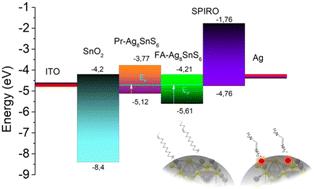
Ag8SnS6 (ATS) nanoparticles, with a band gap of 1.35 eV, which is located exactly at the Schockley–Queisser optimal value for a single-junction solar cell, were utilized as a photoabsorber component in solid state photovoltaic devices. The as-made particles were capped with long aliphatic chains of oleic acid and oleylamine. After surface functionalization of the shorter and extremely basic formamidinium cations, an increase of the absorption coefficient throughout the visible spectrum range was observed. The ligand exchange led also to a slight increase of the band gap, by a value of 0.05 eV. XRD, XPS, UPS, diffuse reflectance, TEM and EDX characterization studies revealed the structure of the nanoparticles and finally proof-of-concept thin film solar cells were fabricated. A maximum photoconversion efficiency of 0.22% was achieved for the as-made particles.
期刊介绍:
The Journal of Materials Chemistry is divided into three distinct sections, A, B, and C, each catering to specific applications of the materials under study:
Journal of Materials Chemistry A focuses primarily on materials intended for applications in energy and sustainability.
Journal of Materials Chemistry B specializes in materials designed for applications in biology and medicine.
Journal of Materials Chemistry C is dedicated to materials suitable for applications in optical, magnetic, and electronic devices.
Example topic areas within the scope of Journal of Materials Chemistry C are listed below. This list is neither exhaustive nor exclusive.
Bioelectronics
Conductors
Detectors
Dielectrics
Displays
Ferroelectrics
Lasers
LEDs
Lighting
Liquid crystals
Memory
Metamaterials
Multiferroics
Photonics
Photovoltaics
Semiconductors
Sensors
Single molecule conductors
Spintronics
Superconductors
Thermoelectrics
Topological insulators
Transistors



 京公网安备 11010802042870号
京ICP备2023020795号-1
京公网安备 11010802042870号
京ICP备2023020795号-1

 分享
分享
 求助内容:
求助内容: 应助结果提醒方式:
 扫码关注我们
