Tara Anderson, Gary Mitchell, Gillian Prue, Susan McLaughlin, Lisa Graham-Wisener
{"title":"The psychosocial impact of pancreatic cancer on caregivers: a scoping review.","authors":"Tara Anderson, Gary Mitchell, Gillian Prue, Susan McLaughlin, Lisa Graham-Wisener","doi":"10.1186/s12885-025-13891-w","DOIUrl":null,"url":null,"abstract":"<p><strong>Background: </strong>Family caregivers are essential members of the care team of someone with pancreatic cancer, supporting their physical and psychological needs. Caregivers are often unprepared for this which may cause substantial psychosocial impact. This may be exacerbated by the short life-expectancy and rapid deterioration associated with pancreatic cancer. A scoping review was conducted to identify, from the existing literature, what is currently known about the psychosocial impact of pancreatic cancer on caregivers across the disease trajectory.</p><p><strong>Methods: </strong>A Joanna Briggs Institute (JBI) mixed methods scoping review was conducted across four databases (CINAHL, EMBASE, MEDLINE, PsycINFO). All identified citations were uploaded to Covidence, and were screened independently by two reviewers. Data were extracted and synthesised following a deductive approach guided by 'The Cancer Family Caregiving Experience' model (Fletcher et al., 2012).</p><p><strong>Results: </strong>42 studies were included: 22 qualitative, 15 quantitative, 5 mixed methods. Results of the included studies were collated into the proposed constructs of Fletcher et al.'s (2012) model: primary stressors, secondary stressors, appraisal, cognitive-behavioural responses, health and wellbeing outcomes, as well as the influence of disease trajectory and contextual factors. The literature highlighted pancreatic cancer caregivers experienced stress related to caregiving activities, disruptions in their daily life and family relationships, high levels of unmet need, and poorer quality of life compared to other cancer caregivers. They were also at increased risk for various psychiatric disorders and reported a persistent lack of support which exacerbated the psychosocial impact.</p><p><strong>Conclusions: </strong>Pancreatic cancer caregivers experience negative psychosocial impacts, exacerbated by the disease's trajectory. Feelings of a lack of support were reflected throughout the included literature and emphasise the need for future research into how pancreatic cancer caregivers may be best supported, and sign-posted to existing support, to minimise the substantial psychosocial impact they may experience.</p>","PeriodicalId":9131,"journal":{"name":"BMC Cancer","volume":"25 1","pages":"511"},"PeriodicalIF":3.4000,"publicationDate":"2025-03-20","publicationTypes":"Journal Article","fieldsOfStudy":null,"isOpenAccess":false,"openAccessPdf":"https://www.ncbi.nlm.nih.gov/pmc/articles/PMC11924831/pdf/","citationCount":"0","resultStr":null,"platform":"Semanticscholar","paperid":null,"PeriodicalName":"BMC Cancer","FirstCategoryId":"3","ListUrlMain":"https://doi.org/10.1186/s12885-025-13891-w","RegionNum":2,"RegionCategory":"医学","ArticlePicture":[],"TitleCN":null,"AbstractTextCN":null,"PMCID":null,"EPubDate":"","PubModel":"","JCR":"Q2","JCRName":"ONCOLOGY","Score":null,"Total":0}
引用次数: 0
Abstract
Background: Family caregivers are essential members of the care team of someone with pancreatic cancer, supporting their physical and psychological needs. Caregivers are often unprepared for this which may cause substantial psychosocial impact. This may be exacerbated by the short life-expectancy and rapid deterioration associated with pancreatic cancer. A scoping review was conducted to identify, from the existing literature, what is currently known about the psychosocial impact of pancreatic cancer on caregivers across the disease trajectory.
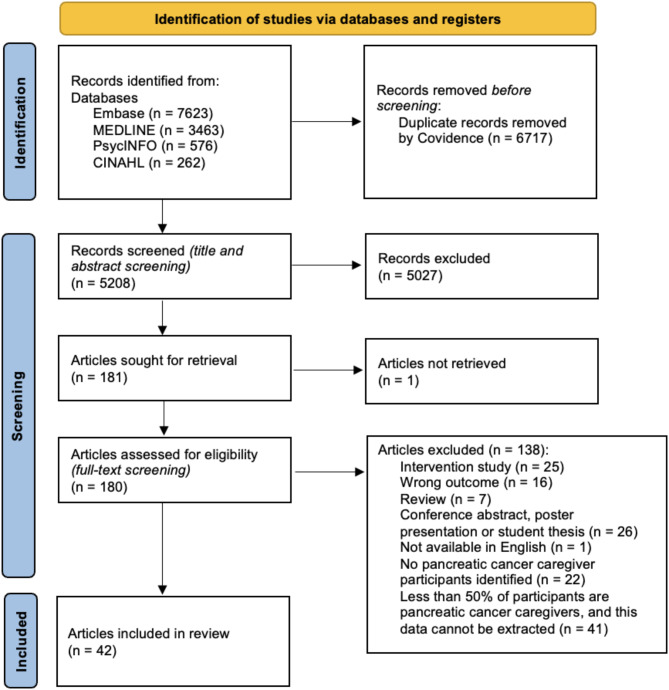
Methods: A Joanna Briggs Institute (JBI) mixed methods scoping review was conducted across four databases (CINAHL, EMBASE, MEDLINE, PsycINFO). All identified citations were uploaded to Covidence, and were screened independently by two reviewers. Data were extracted and synthesised following a deductive approach guided by 'The Cancer Family Caregiving Experience' model (Fletcher et al., 2012).
Results: 42 studies were included: 22 qualitative, 15 quantitative, 5 mixed methods. Results of the included studies were collated into the proposed constructs of Fletcher et al.'s (2012) model: primary stressors, secondary stressors, appraisal, cognitive-behavioural responses, health and wellbeing outcomes, as well as the influence of disease trajectory and contextual factors. The literature highlighted pancreatic cancer caregivers experienced stress related to caregiving activities, disruptions in their daily life and family relationships, high levels of unmet need, and poorer quality of life compared to other cancer caregivers. They were also at increased risk for various psychiatric disorders and reported a persistent lack of support which exacerbated the psychosocial impact.
Conclusions: Pancreatic cancer caregivers experience negative psychosocial impacts, exacerbated by the disease's trajectory. Feelings of a lack of support were reflected throughout the included literature and emphasise the need for future research into how pancreatic cancer caregivers may be best supported, and sign-posted to existing support, to minimise the substantial psychosocial impact they may experience.
背景:家庭照顾者是胰腺癌患者护理团队的重要成员,支持他们的生理和心理需求。照料者往往对此毫无准备,这可能造成重大的社会心理影响。胰腺癌患者的预期寿命短,病情迅速恶化,这可能会加剧这种情况。进行了一项范围审查,从现有文献中确定目前已知的胰腺癌对整个疾病轨迹的护理人员的社会心理影响。方法:采用乔安娜布里格斯研究所(JBI)的混合方法对四个数据库(CINAHL、EMBASE、MEDLINE、PsycINFO)进行范围评估。所有确定的引文都被上传到covid,并由两名审稿人独立筛选。根据“癌症家庭护理经验”模型(Fletcher et al., 2012)指导的演绎方法提取和综合数据。结果:共纳入42项研究:定性法22项,定量法15项,混合法5项。纳入的研究结果被整理成Fletcher等人(2012)模型的提议结构:主要压力源,次要压力源,评估,认知行为反应,健康和福祉结果,以及疾病轨迹和环境因素的影响。文献强调,与其他癌症护理人员相比,胰腺癌护理人员经历了与护理活动、日常生活和家庭关系中断、高水平未满足需求以及较差的生活质量相关的压力。他们患各种精神疾病的风险也在增加,据报持续缺乏支持,这加剧了心理社会影响。结论:胰腺癌护理人员经历了负面的社会心理影响,并因疾病的发展轨迹而加剧。在所有纳入的文献中都反映了缺乏支持的感觉,并强调需要进一步研究如何最好地支持胰腺癌护理人员,并将现有支持的标志张贴出来,以尽量减少他们可能经历的重大心理社会影响。
期刊介绍:
BMC Cancer is an open access, peer-reviewed journal that considers articles on all aspects of cancer research, including the pathophysiology, prevention, diagnosis and treatment of cancers. The journal welcomes submissions concerning molecular and cellular biology, genetics, epidemiology, and clinical trials.





 京公网安备 11010802042870号
京ICP备2023020795号-1
京公网安备 11010802042870号
京ICP备2023020795号-1

 分享
分享
 求助内容:
求助内容: 应助结果提醒方式:
 扫码关注我们
