Liping Zhang , Zhiliang Cheng , Liuwei Zhang , Lanlan Gao , Siqi Li , Zhaoqiang Liu , Lingqiao Wang , Ziyuan Zhou
{"title":"MIP/WS2-AC@Cu-MOF(199)/GCE composite: A robust solution for rapid and selective on-site electrochemical detection of perfluorooctane in real samples","authors":"Liping Zhang , Zhiliang Cheng , Liuwei Zhang , Lanlan Gao , Siqi Li , Zhaoqiang Liu , Lingqiao Wang , Ziyuan Zhou","doi":"10.1016/j.talanta.2025.127958","DOIUrl":null,"url":null,"abstract":"<div><div>Perfluorinated compounds (PFCs), recognized as emerging environmental pollutants of global concern due to their persistence and bioaccumulation, have posed serious threats to human health. This underscores the critical need for developing rapid and accurate detection methods for PFCs. In this study, we proposed a novel electrochemical detection approach for perfluorooctanoic (PFO), a representative PFC, employing a WS<sub>2</sub>-AC-modified Cu-MOF(199) electrode integrated with molecularly imprinted polymer (MIP) technology. The MIP, tailored for PFO recognition, was synthesized through electropolymerization of o-phenylenediamine (o-PD) on WS<sub>2</sub>-AC@Cu-MOF(199) composites. Selective adsorption of PFO was enabled by hydrogen bonding interactions between the MIP and target molecules, and achieved effective detection after template elution. The method demonstrated high sensitivity with a broad linear detection range from 34 ng/L to 10.20 μg/L and an ultralow detection limit of 15.15 ng/L. Beyond its sensitivity, this technique exhibited advantages including low fabrication costs, strong anti-interference capabilities, and exceptional selectivity and reproducibility. Notably, this method demonstrated a higher spike recovery compared to GC-MS in PFO detection. These combined features position it as a promising solution for monitoring PFO contamination in aquatic environments.</div></div>","PeriodicalId":435,"journal":{"name":"Talanta","volume":"292 ","pages":"Article 127958"},"PeriodicalIF":6.1000,"publicationDate":"2025-09-01","publicationTypes":"Journal Article","fieldsOfStudy":null,"isOpenAccess":false,"openAccessPdf":"","citationCount":"0","resultStr":null,"platform":"Semanticscholar","paperid":null,"PeriodicalName":"Talanta","FirstCategoryId":"92","ListUrlMain":"https://www.sciencedirect.com/science/article/pii/S0039914025004485","RegionNum":1,"RegionCategory":"化学","ArticlePicture":[],"TitleCN":null,"AbstractTextCN":null,"PMCID":null,"EPubDate":"2025/3/16 0:00:00","PubModel":"Epub","JCR":"Q1","JCRName":"CHEMISTRY, ANALYTICAL","Score":null,"Total":0}
引用次数: 0
Abstract
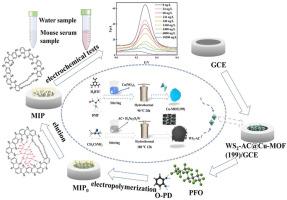
Perfluorinated compounds (PFCs), recognized as emerging environmental pollutants of global concern due to their persistence and bioaccumulation, have posed serious threats to human health. This underscores the critical need for developing rapid and accurate detection methods for PFCs. In this study, we proposed a novel electrochemical detection approach for perfluorooctanoic (PFO), a representative PFC, employing a WS2-AC-modified Cu-MOF(199) electrode integrated with molecularly imprinted polymer (MIP) technology. The MIP, tailored for PFO recognition, was synthesized through electropolymerization of o-phenylenediamine (o-PD) on WS2-AC@Cu-MOF(199) composites. Selective adsorption of PFO was enabled by hydrogen bonding interactions between the MIP and target molecules, and achieved effective detection after template elution. The method demonstrated high sensitivity with a broad linear detection range from 34 ng/L to 10.20 μg/L and an ultralow detection limit of 15.15 ng/L. Beyond its sensitivity, this technique exhibited advantages including low fabrication costs, strong anti-interference capabilities, and exceptional selectivity and reproducibility. Notably, this method demonstrated a higher spike recovery compared to GC-MS in PFO detection. These combined features position it as a promising solution for monitoring PFO contamination in aquatic environments.
期刊介绍:
Talanta provides a forum for the publication of original research papers, short communications, and critical reviews in all branches of pure and applied analytical chemistry. Papers are evaluated based on established guidelines, including the fundamental nature of the study, scientific novelty, substantial improvement or advantage over existing technology or methods, and demonstrated analytical applicability. Original research papers on fundamental studies, and on novel sensor and instrumentation developments, are encouraged. Novel or improved applications in areas such as clinical and biological chemistry, environmental analysis, geochemistry, materials science and engineering, and analytical platforms for omics development are welcome.
Analytical performance of methods should be determined, including interference and matrix effects, and methods should be validated by comparison with a standard method, or analysis of a certified reference material. Simple spiking recoveries may not be sufficient. The developed method should especially comprise information on selectivity, sensitivity, detection limits, accuracy, and reliability. However, applying official validation or robustness studies to a routine method or technique does not necessarily constitute novelty. Proper statistical treatment of the data should be provided. Relevant literature should be cited, including related publications by the authors, and authors should discuss how their proposed methodology compares with previously reported methods.




 京公网安备 11010802042870号
京ICP备2023020795号-1
京公网安备 11010802042870号
京ICP备2023020795号-1

 分享
分享
 求助内容:
求助内容: 应助结果提醒方式:
 扫码关注我们
