Manman Li , Guohua Xu , Zhou Gong , Qiong Wu , Ling Jiang , Conggang Li
{"title":"Simultaneous measurement of multiple fluorine labelling effect on GB1 stability by 19F NMR","authors":"Manman Li , Guohua Xu , Zhou Gong , Qiong Wu , Ling Jiang , Conggang Li","doi":"10.1016/j.talanta.2025.127959","DOIUrl":null,"url":null,"abstract":"<div><div>The incorporation of fluorinated amino acids into proteins through natural biosynthesis in <em>E. coli</em> often leads to the production of heterogeneous fluorinated proteins. The stabilities of proteins with different <sup>19</sup>F labelling states can vary, but these differences are challenging to measure due to the difficulty in separating the fluorinated protein mixtures that differ by only a few <sup>19</sup>F atoms. Here, we simultaneously incorporated both fluoro-phenylalanines (3-fluoro-phenylalanine, 3FF; or 4-fluoro-phenylalanine, 4FF) and 5-fluoro-tryptophan (5FW) into GB1 protein. We are able to measure the stability of GB1 protein with different <sup>19</sup>F labelling states without the need for sample separation by taking the advantage of <sup>19</sup>F NMR. The results showed that 4FF-5FW-GB1 with varying <sup>19</sup>F labelling states exhibited significantly different protein stability, with higher 4FF labeling efficiency correlating with decreased stability. Furthermore, residues F<sub>30</sub> and F<sub>52</sub> show synergistic effects on GB1 stability. In contrast, the 3FF and 5FW substitution exhibits a slightly stabilizing effect on GB1 stability. The present research provides a convenient <sup>19</sup>F NMR method to simultaneously measure fluorine labelling effects on protein stability, favouring precise understanding and analysis of fluorine labelling effects.</div></div>","PeriodicalId":435,"journal":{"name":"Talanta","volume":"292 ","pages":"Article 127959"},"PeriodicalIF":6.1000,"publicationDate":"2025-09-01","publicationTypes":"Journal Article","fieldsOfStudy":null,"isOpenAccess":false,"openAccessPdf":"","citationCount":"0","resultStr":null,"platform":"Semanticscholar","paperid":null,"PeriodicalName":"Talanta","FirstCategoryId":"92","ListUrlMain":"https://www.sciencedirect.com/science/article/pii/S0039914025004497","RegionNum":1,"RegionCategory":"化学","ArticlePicture":[],"TitleCN":null,"AbstractTextCN":null,"PMCID":null,"EPubDate":"2025/3/17 0:00:00","PubModel":"Epub","JCR":"Q1","JCRName":"CHEMISTRY, ANALYTICAL","Score":null,"Total":0}
引用次数: 0
Abstract
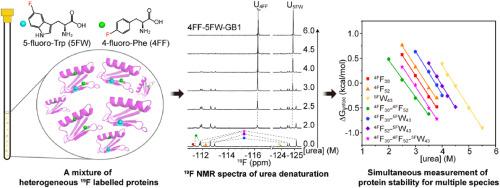
The incorporation of fluorinated amino acids into proteins through natural biosynthesis in E. coli often leads to the production of heterogeneous fluorinated proteins. The stabilities of proteins with different 19F labelling states can vary, but these differences are challenging to measure due to the difficulty in separating the fluorinated protein mixtures that differ by only a few 19F atoms. Here, we simultaneously incorporated both fluoro-phenylalanines (3-fluoro-phenylalanine, 3FF; or 4-fluoro-phenylalanine, 4FF) and 5-fluoro-tryptophan (5FW) into GB1 protein. We are able to measure the stability of GB1 protein with different 19F labelling states without the need for sample separation by taking the advantage of 19F NMR. The results showed that 4FF-5FW-GB1 with varying 19F labelling states exhibited significantly different protein stability, with higher 4FF labeling efficiency correlating with decreased stability. Furthermore, residues F30 and F52 show synergistic effects on GB1 stability. In contrast, the 3FF and 5FW substitution exhibits a slightly stabilizing effect on GB1 stability. The present research provides a convenient 19F NMR method to simultaneously measure fluorine labelling effects on protein stability, favouring precise understanding and analysis of fluorine labelling effects.
期刊介绍:
Talanta provides a forum for the publication of original research papers, short communications, and critical reviews in all branches of pure and applied analytical chemistry. Papers are evaluated based on established guidelines, including the fundamental nature of the study, scientific novelty, substantial improvement or advantage over existing technology or methods, and demonstrated analytical applicability. Original research papers on fundamental studies, and on novel sensor and instrumentation developments, are encouraged. Novel or improved applications in areas such as clinical and biological chemistry, environmental analysis, geochemistry, materials science and engineering, and analytical platforms for omics development are welcome.
Analytical performance of methods should be determined, including interference and matrix effects, and methods should be validated by comparison with a standard method, or analysis of a certified reference material. Simple spiking recoveries may not be sufficient. The developed method should especially comprise information on selectivity, sensitivity, detection limits, accuracy, and reliability. However, applying official validation or robustness studies to a routine method or technique does not necessarily constitute novelty. Proper statistical treatment of the data should be provided. Relevant literature should be cited, including related publications by the authors, and authors should discuss how their proposed methodology compares with previously reported methods.




 京公网安备 11010802042870号
京ICP备2023020795号-1
京公网安备 11010802042870号
京ICP备2023020795号-1

 分享
分享
 求助内容:
求助内容: 应助结果提醒方式:
 扫码关注我们
