{"title":"An electrochemical fluorescence dual-mode strategy for HER2-positive breast cancer cell detection","authors":"Qiao-Bin Liang, Zhi-Ling Zhang","doi":"10.1016/j.talanta.2025.127974","DOIUrl":null,"url":null,"abstract":"<div><div>Breast cancer is one of the most prevalent malignancies worldwide, with HER2-overexpressing subtypes exhibiting increased aggressiveness and poorer prognosis. Accurate identification of HER2-positive subtypes is essential for the effective implementation of HER2-targeted therapy. In this study, an electrochemical fluorescence dual-mode strategy was developed for the high sensitive detection of HER2-positive breast cancer cells. Immunofluorescent quantum dot probes (IFQDs) with both fluorescence and enzyme catalysis were constructed. It labelled HER2 sites on the cell membrane to enable fluorescent imaging and cell counting. Furthermore, alkaline phosphatase (ALP) on the probe surface catalyzed the reduction of silver on the surface of the Au NPs@ITO electrode through enzyme-induced metallization, thereby enabling quantitative detection of the cells via stripping voltammetry. The application of two methods, namely enzyme-induced metallization and enrichment of signal species on the electrode surface, significantly enhanced the sensitivity of this analytical strategy. The self-monitoring of dual signals achieved more accurate analytical performance. The dual-mode strategy demonstrated satisfactory results in identifying breast cancer cells with varying HER2 expression levels and even in complex samples. It indicated that the electrochemical fluorescence dual-mode strategy had potential for typing and quantitative detection of cells with varying HER2 expression levels.</div></div>","PeriodicalId":435,"journal":{"name":"Talanta","volume":"292 ","pages":"Article 127974"},"PeriodicalIF":6.1000,"publicationDate":"2025-03-19","publicationTypes":"Journal Article","fieldsOfStudy":null,"isOpenAccess":false,"openAccessPdf":"","citationCount":"0","resultStr":null,"platform":"Semanticscholar","paperid":null,"PeriodicalName":"Talanta","FirstCategoryId":"92","ListUrlMain":"https://www.sciencedirect.com/science/article/pii/S0039914025004643","RegionNum":1,"RegionCategory":"化学","ArticlePicture":[],"TitleCN":null,"AbstractTextCN":null,"PMCID":null,"EPubDate":"","PubModel":"","JCR":"Q1","JCRName":"CHEMISTRY, ANALYTICAL","Score":null,"Total":0}
引用次数: 0
Abstract
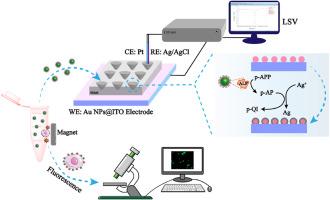
Breast cancer is one of the most prevalent malignancies worldwide, with HER2-overexpressing subtypes exhibiting increased aggressiveness and poorer prognosis. Accurate identification of HER2-positive subtypes is essential for the effective implementation of HER2-targeted therapy. In this study, an electrochemical fluorescence dual-mode strategy was developed for the high sensitive detection of HER2-positive breast cancer cells. Immunofluorescent quantum dot probes (IFQDs) with both fluorescence and enzyme catalysis were constructed. It labelled HER2 sites on the cell membrane to enable fluorescent imaging and cell counting. Furthermore, alkaline phosphatase (ALP) on the probe surface catalyzed the reduction of silver on the surface of the Au NPs@ITO electrode through enzyme-induced metallization, thereby enabling quantitative detection of the cells via stripping voltammetry. The application of two methods, namely enzyme-induced metallization and enrichment of signal species on the electrode surface, significantly enhanced the sensitivity of this analytical strategy. The self-monitoring of dual signals achieved more accurate analytical performance. The dual-mode strategy demonstrated satisfactory results in identifying breast cancer cells with varying HER2 expression levels and even in complex samples. It indicated that the electrochemical fluorescence dual-mode strategy had potential for typing and quantitative detection of cells with varying HER2 expression levels.
期刊介绍:
Talanta provides a forum for the publication of original research papers, short communications, and critical reviews in all branches of pure and applied analytical chemistry. Papers are evaluated based on established guidelines, including the fundamental nature of the study, scientific novelty, substantial improvement or advantage over existing technology or methods, and demonstrated analytical applicability. Original research papers on fundamental studies, and on novel sensor and instrumentation developments, are encouraged. Novel or improved applications in areas such as clinical and biological chemistry, environmental analysis, geochemistry, materials science and engineering, and analytical platforms for omics development are welcome.
Analytical performance of methods should be determined, including interference and matrix effects, and methods should be validated by comparison with a standard method, or analysis of a certified reference material. Simple spiking recoveries may not be sufficient. The developed method should especially comprise information on selectivity, sensitivity, detection limits, accuracy, and reliability. However, applying official validation or robustness studies to a routine method or technique does not necessarily constitute novelty. Proper statistical treatment of the data should be provided. Relevant literature should be cited, including related publications by the authors, and authors should discuss how their proposed methodology compares with previously reported methods.



 京公网安备 11010802042870号
京ICP备2023020795号-1
京公网安备 11010802042870号
京ICP备2023020795号-1

 分享
分享
 求助内容:
求助内容: 应助结果提醒方式:
 扫码关注我们
