{"title":"Diffusion Model-Based Path Follower for a Salamander-Like Robot","authors":"Zhiang Liu;Yang Liu;Yongchun Fang","doi":"10.1109/TNNLS.2025.3549307","DOIUrl":null,"url":null,"abstract":"Salamander-like robots, renowned for their versatile locomotion, present unique challenges in the development of effective path-following controllers due to their distinctive movement patterns and complex body structures. Conventional path-following controllers, while effective for various bionic robots, struggle with the intricate modeling for salamander-like robots and often require laborious manual tuning. Conversely, learning-based methods offer promising alternatives but face issues such as reliance on environmental interactions, short-sighted prediction, and irrational design of state space and reward function. To overcome these limitations, this article proposes a diffusion model-based hierarchical control framework that treats path tracking as a sequence generation problem. The diffusion model’s capability to model joint distributions of state, action, and reward sequences enables it to outperform other learning-based approaches in efficient data utilization, stable training, and long-horizon dependency modeling. Our framework integrates a high-level policy driven by guided diffusion with a low-level controller for parsing commands into executable movements via inverse kinematics, reducing the action space and improving learning efficiency. In addition, we design a more reasonable state space and reward function tailored to the path-following task, addressing shortcomings in prior learning-based controllers. Furthermore, we optimize the diffusion model (DM) by developing lightweight network architectures and incorporating advanced attention mechanisms, to ensure its practical deployment on physical robots with limited computational resources, without compromising performance. Extensive simulations and real-world experiments demonstrate the framework’s effectiveness, efficiency, and robustness in diverse path-following tasks for salamander-like robots, marking a significant advancement in the control of biomimetic robots.","PeriodicalId":13303,"journal":{"name":"IEEE transactions on neural networks and learning systems","volume":"36 8","pages":"14399-14413"},"PeriodicalIF":8.9000,"publicationDate":"2025-03-20","publicationTypes":"Journal Article","fieldsOfStudy":null,"isOpenAccess":false,"openAccessPdf":"","citationCount":"0","resultStr":null,"platform":"Semanticscholar","paperid":null,"PeriodicalName":"IEEE transactions on neural networks and learning systems","FirstCategoryId":"94","ListUrlMain":"https://ieeexplore.ieee.org/document/10934035/","RegionNum":1,"RegionCategory":"计算机科学","ArticlePicture":[],"TitleCN":null,"AbstractTextCN":null,"PMCID":null,"EPubDate":"","PubModel":"","JCR":"Q1","JCRName":"COMPUTER SCIENCE, ARTIFICIAL INTELLIGENCE","Score":null,"Total":0}
引用次数: 0
Abstract
Salamander-like robots, renowned for their versatile locomotion, present unique challenges in the development of effective path-following controllers due to their distinctive movement patterns and complex body structures. Conventional path-following controllers, while effective for various bionic robots, struggle with the intricate modeling for salamander-like robots and often require laborious manual tuning. Conversely, learning-based methods offer promising alternatives but face issues such as reliance on environmental interactions, short-sighted prediction, and irrational design of state space and reward function. To overcome these limitations, this article proposes a diffusion model-based hierarchical control framework that treats path tracking as a sequence generation problem. The diffusion model’s capability to model joint distributions of state, action, and reward sequences enables it to outperform other learning-based approaches in efficient data utilization, stable training, and long-horizon dependency modeling. Our framework integrates a high-level policy driven by guided diffusion with a low-level controller for parsing commands into executable movements via inverse kinematics, reducing the action space and improving learning efficiency. In addition, we design a more reasonable state space and reward function tailored to the path-following task, addressing shortcomings in prior learning-based controllers. Furthermore, we optimize the diffusion model (DM) by developing lightweight network architectures and incorporating advanced attention mechanisms, to ensure its practical deployment on physical robots with limited computational resources, without compromising performance. Extensive simulations and real-world experiments demonstrate the framework’s effectiveness, efficiency, and robustness in diverse path-following tasks for salamander-like robots, marking a significant advancement in the control of biomimetic robots.
期刊介绍:
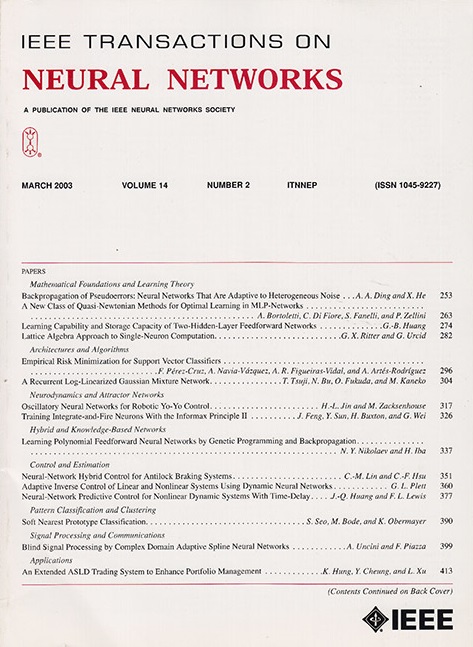
The focus of IEEE Transactions on Neural Networks and Learning Systems is to present scholarly articles discussing the theory, design, and applications of neural networks as well as other learning systems. The journal primarily highlights technical and scientific research in this domain.



 京公网安备 11010802042870号
京ICP备2023020795号-1
京公网安备 11010802042870号
京ICP备2023020795号-1

 分享
分享
 求助内容:
求助内容: 应助结果提醒方式:
 扫码关注我们
