Zhihao Lin, Donghui Xu, Yiming Zhao, Bin Sheng, Zhijian Wu, Xiaobin Wen, Jie Zhou, Ge Chen, Jun Lv, Jing Wang, Guangyang Liu
{"title":"Micro/Nanoplastics in plantation agricultural products: behavior process, phytotoxicity under biotic and abiotic stresses, and controlling strategies.","authors":"Zhihao Lin, Donghui Xu, Yiming Zhao, Bin Sheng, Zhijian Wu, Xiaobin Wen, Jie Zhou, Ge Chen, Jun Lv, Jing Wang, Guangyang Liu","doi":"10.1186/s12951-025-03314-0","DOIUrl":null,"url":null,"abstract":"<p><p>With the extensive utilization of plastic products, microplastics/nanoplastics (MPs/NPs) contamination not only poses a global hazard to the environment, but also induces a new threat to the growth development and nutritional quality of plantation agricultural products. This study thoroughly examines the behavior of MPs/NPs, including their sources, entry routes into plants, phytotoxicity under various biotic and abiotic stresses (e.g., salinity, polycyclic aromatic hydrocarbons, heavy metals, antibiotics, plasticizers, nano oxide, naturally occurring organic macromolecular compounds, invasive plants, Botrytis cinerea mycorrhizal fungi.) and controlling strategies. MPs/NPs in agricultural systems mainly originate from mulch, sewage, compost fertilizer, municipal solid waste, pesticide packaging materials, etc. They enter plants through endocytosis, apoplast pathways, crack-entry modes, and leaf stomata, affecting phenotypic, metabolic, enzymatic, and genetic processes such as seed germination, growth metabolism, photosynthesis, oxidative stress and antioxidant defenses, fruit yield and nutrient quality, cytotoxicity and genotoxicity. MPs/NPs can also interact with other environmental stressors, resulting in synergistic, antagonistic, or neutral effects on phytotoxicity. To address these challenges, this review highlights strategies to mitigate MPs/NPs toxicity, including the development of novel green biodegradable plastics, plant extraction and immobilization, exogenous plant growth regulator interventions, porous nanomaterial modulation, biocatalysis and enzymatic degradation. Finally, the study identifies current limitations and future research directions in this critical field.</p>","PeriodicalId":16383,"journal":{"name":"Journal of Nanobiotechnology","volume":"23 1","pages":"231"},"PeriodicalIF":12.6000,"publicationDate":"2025-03-21","publicationTypes":"Journal Article","fieldsOfStudy":null,"isOpenAccess":false,"openAccessPdf":"https://www.ncbi.nlm.nih.gov/pmc/articles/PMC11927206/pdf/","citationCount":"0","resultStr":null,"platform":"Semanticscholar","paperid":null,"PeriodicalName":"Journal of Nanobiotechnology","FirstCategoryId":"5","ListUrlMain":"https://doi.org/10.1186/s12951-025-03314-0","RegionNum":1,"RegionCategory":"生物学","ArticlePicture":[],"TitleCN":null,"AbstractTextCN":null,"PMCID":null,"EPubDate":"","PubModel":"","JCR":"Q1","JCRName":"BIOTECHNOLOGY & APPLIED MICROBIOLOGY","Score":null,"Total":0}
引用次数: 0
Abstract
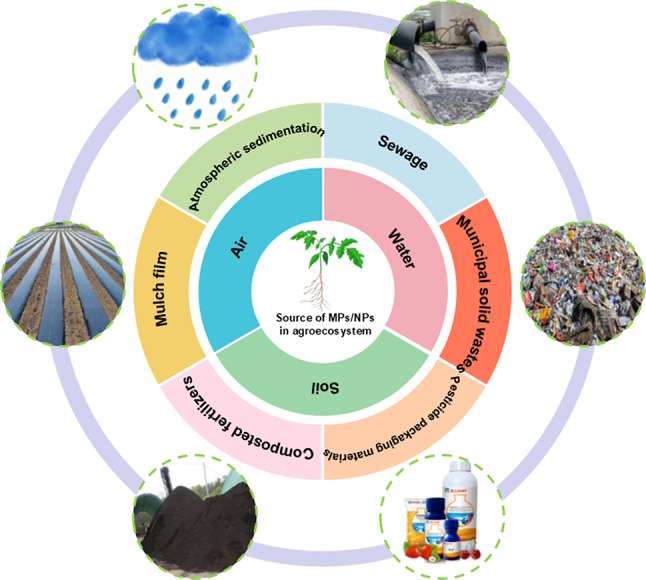
With the extensive utilization of plastic products, microplastics/nanoplastics (MPs/NPs) contamination not only poses a global hazard to the environment, but also induces a new threat to the growth development and nutritional quality of plantation agricultural products. This study thoroughly examines the behavior of MPs/NPs, including their sources, entry routes into plants, phytotoxicity under various biotic and abiotic stresses (e.g., salinity, polycyclic aromatic hydrocarbons, heavy metals, antibiotics, plasticizers, nano oxide, naturally occurring organic macromolecular compounds, invasive plants, Botrytis cinerea mycorrhizal fungi.) and controlling strategies. MPs/NPs in agricultural systems mainly originate from mulch, sewage, compost fertilizer, municipal solid waste, pesticide packaging materials, etc. They enter plants through endocytosis, apoplast pathways, crack-entry modes, and leaf stomata, affecting phenotypic, metabolic, enzymatic, and genetic processes such as seed germination, growth metabolism, photosynthesis, oxidative stress and antioxidant defenses, fruit yield and nutrient quality, cytotoxicity and genotoxicity. MPs/NPs can also interact with other environmental stressors, resulting in synergistic, antagonistic, or neutral effects on phytotoxicity. To address these challenges, this review highlights strategies to mitigate MPs/NPs toxicity, including the development of novel green biodegradable plastics, plant extraction and immobilization, exogenous plant growth regulator interventions, porous nanomaterial modulation, biocatalysis and enzymatic degradation. Finally, the study identifies current limitations and future research directions in this critical field.
期刊介绍:
Journal of Nanobiotechnology is an open access peer-reviewed journal communicating scientific and technological advances in the fields of medicine and biology, with an emphasis in their interface with nanoscale sciences. The journal provides biomedical scientists and the international biotechnology business community with the latest developments in the growing field of Nanobiotechnology.




 京公网安备 11010802042870号
京ICP备2023020795号-1
京公网安备 11010802042870号
京ICP备2023020795号-1

 分享
分享
 求助内容:
求助内容: 应助结果提醒方式:
 扫码关注我们
