Timothy R O'Meara, Brad A Palanski, Maggie Chen, Yingfeng Qiao, Philip A Cole
{"title":"Mutant protein chemical rescue: From mechanisms to therapeutics.","authors":"Timothy R O'Meara, Brad A Palanski, Maggie Chen, Yingfeng Qiao, Philip A Cole","doi":"10.1016/j.jbc.2025.108417","DOIUrl":null,"url":null,"abstract":"<p><p>Chemical rescue is a technique for restoring the activity and/or structure of an engineered or naturally occurring (e.g., disease-associated) mutant protein by the introduction of a \"molecular crutch\" that abrogates the mutation's effect. This method was developed about 4 decades ago to facilitate mechanistic analysis of enzymes. Since then, a variety of purified proteins inactivated by site-directed mutagenesis have been successfully rescued by substrate moieties or exogenous small molecules, an approach that has continued to serve as an important tool for mechanistic enzymologists. More recently, chemical rescue has been applied to activate engineered proteins in intact biological systems for phenotypic and pathway-level analyses. There is growing interest in therapeutic applications of chemical rescue to correct protein mutations that give rise to human diseases. In this review, we first contextualize chemical rescue and discuss its utility in protein mechanistic analysis. Second, we review the advantages and caveats associated with using this approach to study protein function within biological settings. Third, we provide an overview of efforts to develop folding correctors that restore the proper function of disease-associated protein mutants. To conclude, future directions and challenges for the chemical rescue field are discussed.</p>","PeriodicalId":15140,"journal":{"name":"Journal of Biological Chemistry","volume":" ","pages":"108417"},"PeriodicalIF":4.0000,"publicationDate":"2025-04-01","publicationTypes":"Journal Article","fieldsOfStudy":null,"isOpenAccess":false,"openAccessPdf":"https://www.ncbi.nlm.nih.gov/pmc/articles/PMC12018205/pdf/","citationCount":"0","resultStr":null,"platform":"Semanticscholar","paperid":null,"PeriodicalName":"Journal of Biological Chemistry","FirstCategoryId":"99","ListUrlMain":"https://doi.org/10.1016/j.jbc.2025.108417","RegionNum":2,"RegionCategory":"生物学","ArticlePicture":[],"TitleCN":null,"AbstractTextCN":null,"PMCID":null,"EPubDate":"2025/3/18 0:00:00","PubModel":"Epub","JCR":"Q2","JCRName":"BIOCHEMISTRY & MOLECULAR BIOLOGY","Score":null,"Total":0}
引用次数: 0
Abstract
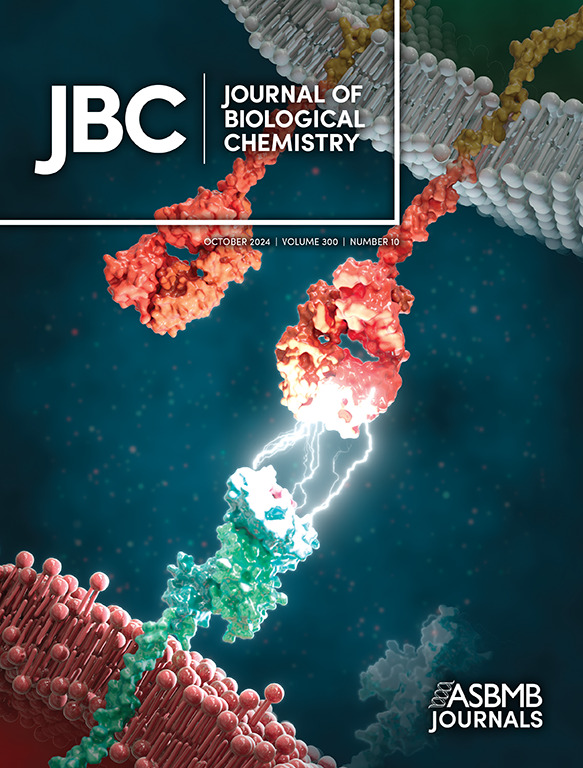
Chemical rescue is a technique for restoring the activity and/or structure of an engineered or naturally occurring (e.g., disease-associated) mutant protein by the introduction of a "molecular crutch" that abrogates the mutation's effect. This method was developed about 4 decades ago to facilitate mechanistic analysis of enzymes. Since then, a variety of purified proteins inactivated by site-directed mutagenesis have been successfully rescued by substrate moieties or exogenous small molecules, an approach that has continued to serve as an important tool for mechanistic enzymologists. More recently, chemical rescue has been applied to activate engineered proteins in intact biological systems for phenotypic and pathway-level analyses. There is growing interest in therapeutic applications of chemical rescue to correct protein mutations that give rise to human diseases. In this review, we first contextualize chemical rescue and discuss its utility in protein mechanistic analysis. Second, we review the advantages and caveats associated with using this approach to study protein function within biological settings. Third, we provide an overview of efforts to develop folding correctors that restore the proper function of disease-associated protein mutants. To conclude, future directions and challenges for the chemical rescue field are discussed.
期刊介绍:
The Journal of Biological Chemistry welcomes high-quality science that seeks to elucidate the molecular and cellular basis of biological processes. Papers published in JBC can therefore fall under the umbrellas of not only biological chemistry, chemical biology, or biochemistry, but also allied disciplines such as biophysics, systems biology, RNA biology, immunology, microbiology, neurobiology, epigenetics, computational biology, ’omics, and many more. The outcome of our focus on papers that contribute novel and important mechanistic insights, rather than on a particular topic area, is that JBC is truly a melting pot for scientists across disciplines. In addition, JBC welcomes papers that describe methods that will help scientists push their biochemical inquiries forward and resources that will be of use to the research community.





 京公网安备 11010802042870号
京ICP备2023020795号-1
京公网安备 11010802042870号
京ICP备2023020795号-1

 分享
分享
 求助内容:
求助内容: 应助结果提醒方式:
 扫码关注我们
