Artificial intelligence algorithm was used to establish and verify the prediction model of portal hypertension in hepatocellular carcinoma based on clinical parameters and imaging features.
{"title":"Artificial intelligence algorithm was used to establish and verify the prediction model of portal hypertension in hepatocellular carcinoma based on clinical parameters and imaging features.","authors":"Yongfei He, Qiang Gao, Shutian Mo, Ketuan Huang, Yuan Liao, Tianyi Liang, Meifeng Chen, Jicai Wang, Qiang Tao, Guangquan Zhang, Fenfang Wu, Chuangye Han, Xianjie Shi, Tao Peng","doi":"10.21037/jgo-2024-931","DOIUrl":null,"url":null,"abstract":"<p><strong>Background: </strong>Portal hypertension (PHT) is an important factor leading to a poor prognosis in patients with hepatocellular carcinoma (HCC). Identifying patients with PHT for individualized treatment is of great clinical significance. The prediction model of HCC combined PHT is in urgent need of clinical practice. Combining clinical parameters and imaging features can improve prediction accuracy. The application of artificial intelligence algorithms can further tap the potential of data, optimize the prediction model, and provide strong support for early intervention and personalized treatment of PHT. This study aimed to establish a prediction model of PHT based on the clinicopathological features of PHT and computed tomography scanning features of the non-tumor liver area in the portal vein stage.</p><p><strong>Methods: </strong>A total of 884 patients were enrolled in this study, and randomly divided into a training set of 707 patients (of whom 89 had PHT) and a validation set of 177 patients (of whom 23 had PHT) at a ratio of 8:2. Univariate and multivariate logistic regression analyses were performed to screen the clinical features. Radiomics and deep-learning features were extracted from the non-tumorous liver regions. Feature selection was conducted using <i>t</i>-tests, correlation analyses, and least absolute shrinkage and selection operator regression models. Finally, a predictive model for PHT in HCC patients was constructed by combining clinical features with the selected radiomics and deep-learning features.</p><p><strong>Results: </strong>Portal vein diameter (PVD), Child-Pugh score, and fibrosis 4 (FIB-4) score were identified as independent risk factors for PHT. The predictive model that incorporated clinical features, radiomics features from non-tumorous liver regions, and deep-learning features had an area under the curve (AUC) of 0.966 [95% confidence interval (CI): 0.954-0.979] and a sensitivity of 0.966 in the training set, and an AUC of 0.698 (95% CI: 0.565-0.831) and a sensitivity of 0.609 in the validation set.</p><p><strong>Conclusions: </strong>The preoperative evaluation showed that increased PVD, higher Child-Pugh score, and increased FIB-4 score were independent risk factors for PHT in patients with HCC. To predict the occurrence of PHT more effectively, we construct a comprehensive prediction model. The model incorporates clinical parameters, radiomic features, and deep learning features. This fusion of multi-modal features enables the model to capture complex information related to PHT more comprehensively, thus achieving high prediction accuracy and practicability.</p>","PeriodicalId":15841,"journal":{"name":"Journal of gastrointestinal oncology","volume":"16 1","pages":"159-175"},"PeriodicalIF":2.0000,"publicationDate":"2025-02-28","publicationTypes":"Journal Article","fieldsOfStudy":null,"isOpenAccess":false,"openAccessPdf":"https://www.ncbi.nlm.nih.gov/pmc/articles/PMC11921233/pdf/","citationCount":"0","resultStr":null,"platform":"Semanticscholar","paperid":null,"PeriodicalName":"Journal of gastrointestinal oncology","FirstCategoryId":"3","ListUrlMain":"https://doi.org/10.21037/jgo-2024-931","RegionNum":4,"RegionCategory":"医学","ArticlePicture":[],"TitleCN":null,"AbstractTextCN":null,"PMCID":null,"EPubDate":"2025/2/26 0:00:00","PubModel":"Epub","JCR":"Q3","JCRName":"GASTROENTEROLOGY & HEPATOLOGY","Score":null,"Total":0}
引用次数: 0
Abstract
Background: Portal hypertension (PHT) is an important factor leading to a poor prognosis in patients with hepatocellular carcinoma (HCC). Identifying patients with PHT for individualized treatment is of great clinical significance. The prediction model of HCC combined PHT is in urgent need of clinical practice. Combining clinical parameters and imaging features can improve prediction accuracy. The application of artificial intelligence algorithms can further tap the potential of data, optimize the prediction model, and provide strong support for early intervention and personalized treatment of PHT. This study aimed to establish a prediction model of PHT based on the clinicopathological features of PHT and computed tomography scanning features of the non-tumor liver area in the portal vein stage.
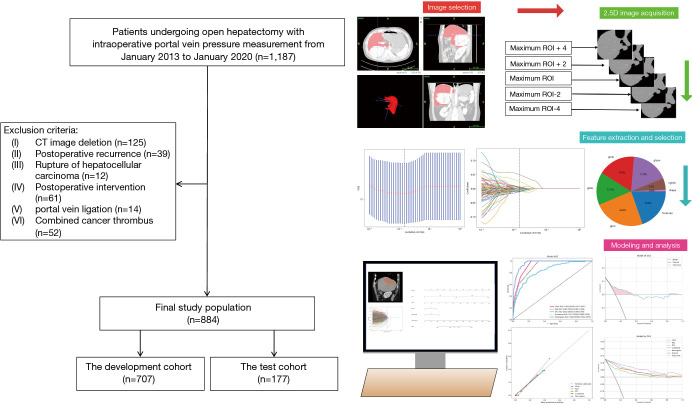
Methods: A total of 884 patients were enrolled in this study, and randomly divided into a training set of 707 patients (of whom 89 had PHT) and a validation set of 177 patients (of whom 23 had PHT) at a ratio of 8:2. Univariate and multivariate logistic regression analyses were performed to screen the clinical features. Radiomics and deep-learning features were extracted from the non-tumorous liver regions. Feature selection was conducted using t-tests, correlation analyses, and least absolute shrinkage and selection operator regression models. Finally, a predictive model for PHT in HCC patients was constructed by combining clinical features with the selected radiomics and deep-learning features.
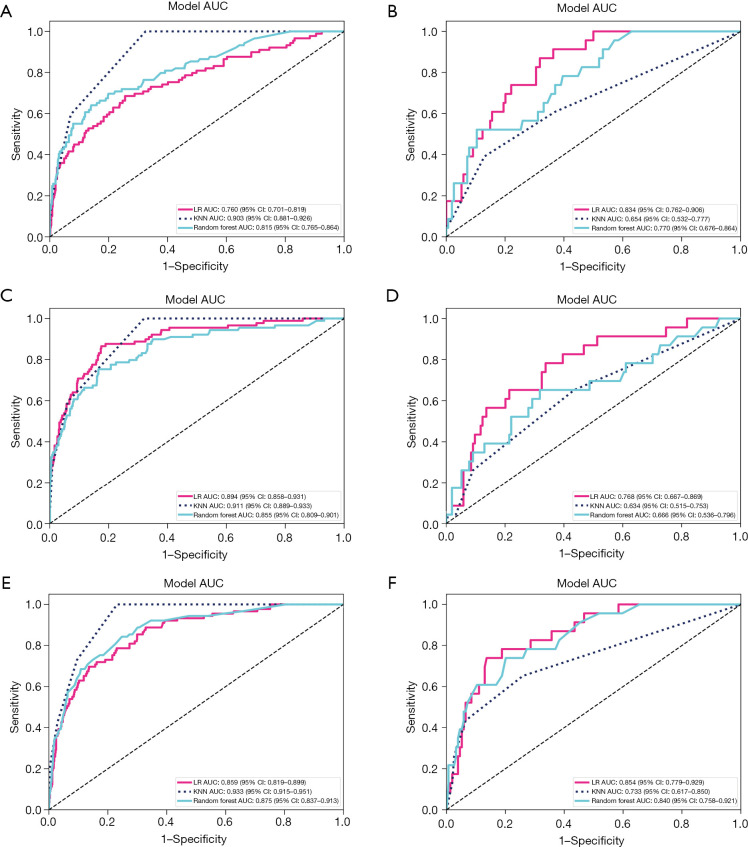
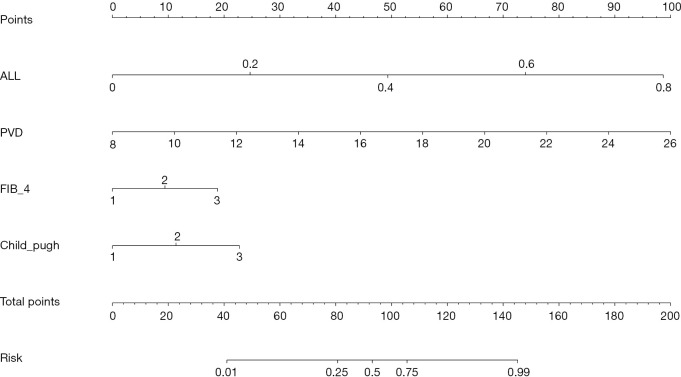
Results: Portal vein diameter (PVD), Child-Pugh score, and fibrosis 4 (FIB-4) score were identified as independent risk factors for PHT. The predictive model that incorporated clinical features, radiomics features from non-tumorous liver regions, and deep-learning features had an area under the curve (AUC) of 0.966 [95% confidence interval (CI): 0.954-0.979] and a sensitivity of 0.966 in the training set, and an AUC of 0.698 (95% CI: 0.565-0.831) and a sensitivity of 0.609 in the validation set.
Conclusions: The preoperative evaluation showed that increased PVD, higher Child-Pugh score, and increased FIB-4 score were independent risk factors for PHT in patients with HCC. To predict the occurrence of PHT more effectively, we construct a comprehensive prediction model. The model incorporates clinical parameters, radiomic features, and deep learning features. This fusion of multi-modal features enables the model to capture complex information related to PHT more comprehensively, thus achieving high prediction accuracy and practicability.
期刊介绍:
ournal of Gastrointestinal Oncology (Print ISSN 2078-6891; Online ISSN 2219-679X; J Gastrointest Oncol; JGO), the official journal of Society for Gastrointestinal Oncology (SGO), is an open-access, international peer-reviewed journal. It is published quarterly (Sep. 2010- Dec. 2013), bimonthly (Feb. 2014 -) and openly distributed worldwide.
JGO publishes manuscripts that focus on updated and practical information about diagnosis, prevention and clinical investigations of gastrointestinal cancer treatment. Specific areas of interest include, but not limited to, multimodality therapy, markers, imaging and tumor biology.



 京公网安备 11010802042870号
京ICP备2023020795号-1
京公网安备 11010802042870号
京ICP备2023020795号-1

 分享
分享
 求助内容:
求助内容: 应助结果提醒方式:
 扫码关注我们
