Jacinta Brinsley, Edward J O'Connor, Ben Singh, Grace McKeon, Rachel Curtis, Ty Ferguson, Georgia Gosse, Iris Willems, Pieter-Jan Marent, Kimberley Szeto, Joseph Firth, Carol Maher
{"title":"Effectiveness of Digital Lifestyle Interventions on Depression, Anxiety, Stress, and Well-Being: Systematic Review and Meta-Analysis.","authors":"Jacinta Brinsley, Edward J O'Connor, Ben Singh, Grace McKeon, Rachel Curtis, Ty Ferguson, Georgia Gosse, Iris Willems, Pieter-Jan Marent, Kimberley Szeto, Joseph Firth, Carol Maher","doi":"10.2196/56975","DOIUrl":null,"url":null,"abstract":"<p><strong>Background: </strong>There is a growing body of robust evidence to show that lifestyle behaviors influence mental health outcomes. Technology offers an accessible and cost-effective implementation method for interventions, yet the study of the effectiveness of interventions to date has been specific to the mode of delivery, population, or behavior.</p><p><strong>Objective: </strong>The primary aim of this review was to comprehensively evaluate the effectiveness of digital lifestyle interventions for improving symptoms of depression, anxiety, stress, and well-being as coprimary outcomes in adults. The secondary aim was to explore the technological, methodological, intervention-specific, and population-specific characteristics that were associated with major changes in mental health outcomes.</p><p><strong>Methods: </strong>A systematic search was conducted across the MEDLINE, CINAHL, Embase, Emcare, PsycINFO, and Scopus databases to identify studies published between January 2013 and January 2023. Randomized controlled trials of lifestyle interventions (physical activity, sleep, and diet) that were delivered digitally; reported changes in symptoms of depression, anxiety, stress, or well-being in adults (aged ≥18 years); and were published in English were included. Multiple authors independently extracted data, which was evaluated using the 2011 Levels of Evidence from the Oxford Centre for Evidence-Based Medicine. Inverse-variance random-effects meta-analyses were used for data analysis. The primary outcome was the change in symptoms of depression, anxiety, stress, and well-being as measured by validated self-report of clinician-administered outcomes from pre- to postintervention. Subgroup analyses were conducted to determine whether results differed based on the target lifestyle behavior, delivery method, digital features, design features, or population characteristics.</p><p><strong>Results: </strong>Of the 14,356 studies identified, 61 (0.42%) were included. Digital lifestyle interventions had a significant small-to-medium effect on depression (standardized mean difference [SMD] -0.37; P<.001), a small effect on anxiety (SMD -0.29; P<.001) and stress (SMD -0.17; P=.04), and no effect on well-being (SMD 0.14; P=.15). Subgroup analyses generally suggested that effects were similar regardless of the delivery method or features used, the duration and frequency of the intervention, the population, or the lifestyle behavior targeted.</p><p><strong>Conclusions: </strong>Overall, these results indicate that delivering lifestyle interventions via a range of digital methods can have significant positive effects on depression (P<.001), anxiety (P<.001), and stress (P=.04) for a broad range of populations, while effects on well-being are inconclusive. Future research should explore how these interventions can be effectively implemented and embedded within health care with a concerted focus on addressing digital health equity.</p><p><strong>Trial registration: </strong>PROSPERO CRD42023428908; https://www.crd.york.ac.uk/PROSPERO/view/CRD42023428908.</p>","PeriodicalId":16337,"journal":{"name":"Journal of Medical Internet Research","volume":"27 ","pages":"e56975"},"PeriodicalIF":6.0000,"publicationDate":"2025-03-20","publicationTypes":"Journal Article","fieldsOfStudy":null,"isOpenAccess":false,"openAccessPdf":"https://www.ncbi.nlm.nih.gov/pmc/articles/PMC11969127/pdf/","citationCount":"0","resultStr":null,"platform":"Semanticscholar","paperid":null,"PeriodicalName":"Journal of Medical Internet Research","FirstCategoryId":"3","ListUrlMain":"https://doi.org/10.2196/56975","RegionNum":2,"RegionCategory":"医学","ArticlePicture":[],"TitleCN":null,"AbstractTextCN":null,"PMCID":null,"EPubDate":"","PubModel":"","JCR":"Q1","JCRName":"HEALTH CARE SCIENCES & SERVICES","Score":null,"Total":0}
引用次数: 0
Abstract
Background: There is a growing body of robust evidence to show that lifestyle behaviors influence mental health outcomes. Technology offers an accessible and cost-effective implementation method for interventions, yet the study of the effectiveness of interventions to date has been specific to the mode of delivery, population, or behavior.
Objective: The primary aim of this review was to comprehensively evaluate the effectiveness of digital lifestyle interventions for improving symptoms of depression, anxiety, stress, and well-being as coprimary outcomes in adults. The secondary aim was to explore the technological, methodological, intervention-specific, and population-specific characteristics that were associated with major changes in mental health outcomes.
Methods: A systematic search was conducted across the MEDLINE, CINAHL, Embase, Emcare, PsycINFO, and Scopus databases to identify studies published between January 2013 and January 2023. Randomized controlled trials of lifestyle interventions (physical activity, sleep, and diet) that were delivered digitally; reported changes in symptoms of depression, anxiety, stress, or well-being in adults (aged ≥18 years); and were published in English were included. Multiple authors independently extracted data, which was evaluated using the 2011 Levels of Evidence from the Oxford Centre for Evidence-Based Medicine. Inverse-variance random-effects meta-analyses were used for data analysis. The primary outcome was the change in symptoms of depression, anxiety, stress, and well-being as measured by validated self-report of clinician-administered outcomes from pre- to postintervention. Subgroup analyses were conducted to determine whether results differed based on the target lifestyle behavior, delivery method, digital features, design features, or population characteristics.
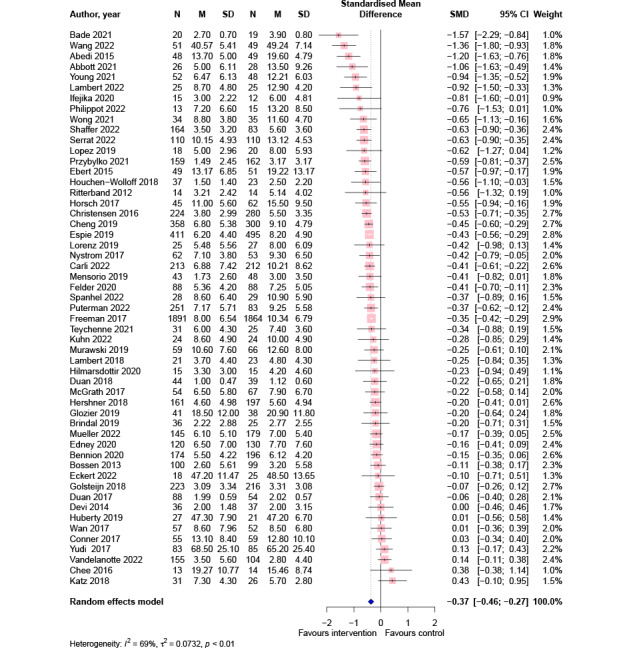
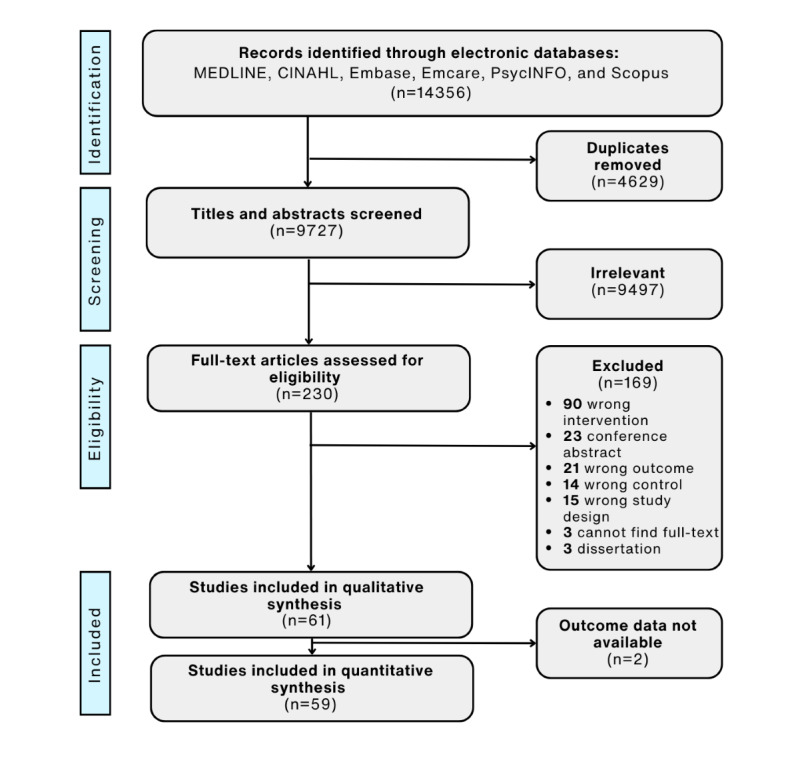
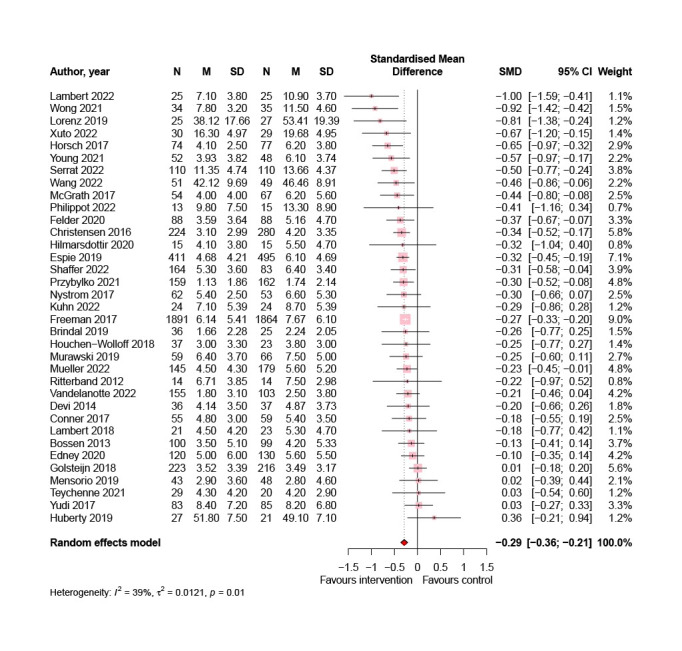
Results: Of the 14,356 studies identified, 61 (0.42%) were included. Digital lifestyle interventions had a significant small-to-medium effect on depression (standardized mean difference [SMD] -0.37; P<.001), a small effect on anxiety (SMD -0.29; P<.001) and stress (SMD -0.17; P=.04), and no effect on well-being (SMD 0.14; P=.15). Subgroup analyses generally suggested that effects were similar regardless of the delivery method or features used, the duration and frequency of the intervention, the population, or the lifestyle behavior targeted.
Conclusions: Overall, these results indicate that delivering lifestyle interventions via a range of digital methods can have significant positive effects on depression (P<.001), anxiety (P<.001), and stress (P=.04) for a broad range of populations, while effects on well-being are inconclusive. Future research should explore how these interventions can be effectively implemented and embedded within health care with a concerted focus on addressing digital health equity.
期刊介绍:
The Journal of Medical Internet Research (JMIR) is a highly respected publication in the field of health informatics and health services. With a founding date in 1999, JMIR has been a pioneer in the field for over two decades.
As a leader in the industry, the journal focuses on digital health, data science, health informatics, and emerging technologies for health, medicine, and biomedical research. It is recognized as a top publication in these disciplines, ranking in the first quartile (Q1) by Impact Factor.
Notably, JMIR holds the prestigious position of being ranked #1 on Google Scholar within the "Medical Informatics" discipline.



 京公网安备 11010802042870号
京ICP备2023020795号-1
京公网安备 11010802042870号
京ICP备2023020795号-1

 分享
分享

 求助内容:
求助内容: 应助结果提醒方式:
 扫码关注我们
