{"title":"Profiling Generalized Anxiety Disorder on Social Networks: Content and Behavior Analysis.","authors":"Linah Alhazzaa, Vasa Curcin","doi":"10.2196/53399","DOIUrl":null,"url":null,"abstract":"<p><strong>Background: </strong>Despite a dramatic increase in the number of people with generalized anxiety disorder (GAD), a substantial number still do not seek help from health professionals, resulting in reduced quality of life. With the growth in popularity of social media platforms, individuals have become more willing to express their emotions through these channels. Therefore, social media data have become valuable for identifying mental health status.</p><p><strong>Objective: </strong>This study investigated the social media posts and behavioral patterns of people with GAD, focusing on language use, emotional expression, topics discussed, and engagement to identify digital markers of GAD, such as anxious patterns and behaviors. These insights could help reveal mental health indicators, aiding in digital intervention development.</p><p><strong>Methods: </strong>Data were first collected from Twitter (subsequently rebranded as X) for the GAD and control groups. Several preprocessing steps were performed. Three measurements were defined based on Linguistic Inquiry and Word Count for linguistic analysis. GuidedLDA was also used to identify the themes present in the tweets. Additionally, users' behaviors were analyzed using Twitter metadata. Finally, we studied the correlation between the GuidedLDA-based themes and users' behaviors.</p><p><strong>Results: </strong>The linguistic analysis indicated differences in cognitive style, personal needs, and emotional expressiveness between people with and without GAD. Regarding cognitive style, there were significant differences (P<.001) for all features, such as insight (Cohen d=1.13), causation (Cohen d=1.03), and discrepancy (Cohen d=1.16). Regarding personal needs, there were significant differences (P<.001) in most personal needs categories, such as curiosity (Cohen d=1.05) and communication (Cohen d=0.64). Regarding emotional expressiveness, there were significant differences (P<.001) for most features, including anxiety (Cohen d=0.62), anger (Cohen d=0.72), sadness (Cohen d=0.48), and swear words (Cohen d=2.61). Additionally, topic modeling identified 4 primary themes (ie, symptoms, relationships, life problems, and feelings). We found that all themes were significantly more prevalent for people with GAD than for those without GAD (P<.001), along with significant effect sizes (Cohen d>0.50; P<.001) for most themes. Moreover, studying users' behaviors, including hashtag participation, volume, interaction pattern, social engagement, and reactive behaviors, revealed some digital markers of GAD, with most behavior-based features, such as the hashtag (Cohen d=0.49) and retweet (Cohen d=0.69) ratios, being statistically significant (P<.001). Furthermore, correlations between the GuidedLDA-based themes and users' behaviors were also identified.</p><p><strong>Conclusions: </strong>Our findings revealed several digital markers of GAD on social media. These findings are significant and could contribute to developing an assessment tool that clinicians could use for the initial diagnosis of GAD or the detection of an early signal of worsening in people with GAD via social media posts. This tool could provide ongoing support and personalized coping strategies. However, one limitation of using social media for mental health assessment is the lack of a demographic representativeness analysis.</p>","PeriodicalId":16337,"journal":{"name":"Journal of Medical Internet Research","volume":"27 ","pages":"e53399"},"PeriodicalIF":6.0000,"publicationDate":"2025-03-20","publicationTypes":"Journal Article","fieldsOfStudy":null,"isOpenAccess":false,"openAccessPdf":"https://www.ncbi.nlm.nih.gov/pmc/articles/PMC11969129/pdf/","citationCount":"0","resultStr":null,"platform":"Semanticscholar","paperid":null,"PeriodicalName":"Journal of Medical Internet Research","FirstCategoryId":"3","ListUrlMain":"https://doi.org/10.2196/53399","RegionNum":2,"RegionCategory":"医学","ArticlePicture":[],"TitleCN":null,"AbstractTextCN":null,"PMCID":null,"EPubDate":"","PubModel":"","JCR":"Q1","JCRName":"HEALTH CARE SCIENCES & SERVICES","Score":null,"Total":0}
引用次数: 0
Abstract
Background: Despite a dramatic increase in the number of people with generalized anxiety disorder (GAD), a substantial number still do not seek help from health professionals, resulting in reduced quality of life. With the growth in popularity of social media platforms, individuals have become more willing to express their emotions through these channels. Therefore, social media data have become valuable for identifying mental health status.
Objective: This study investigated the social media posts and behavioral patterns of people with GAD, focusing on language use, emotional expression, topics discussed, and engagement to identify digital markers of GAD, such as anxious patterns and behaviors. These insights could help reveal mental health indicators, aiding in digital intervention development.
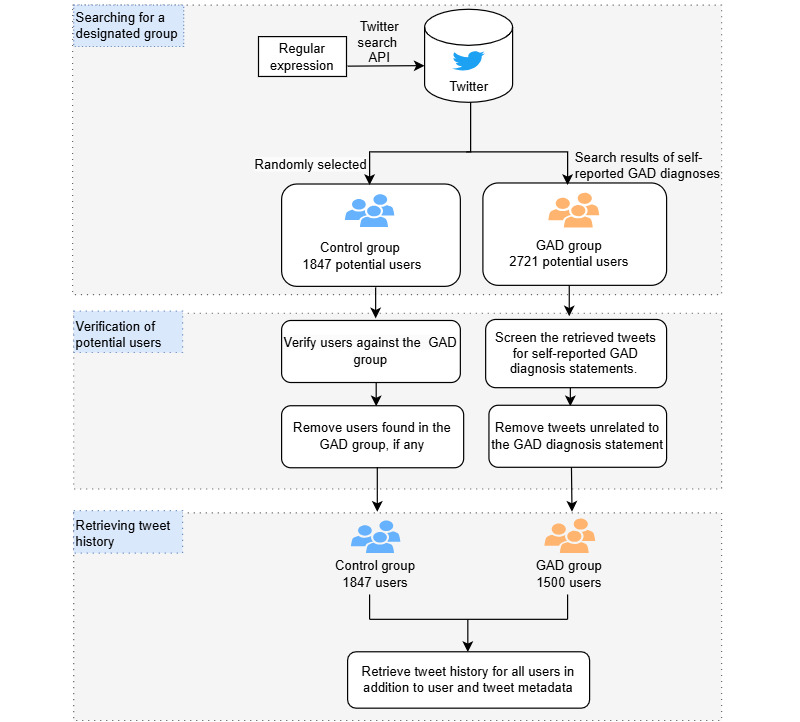
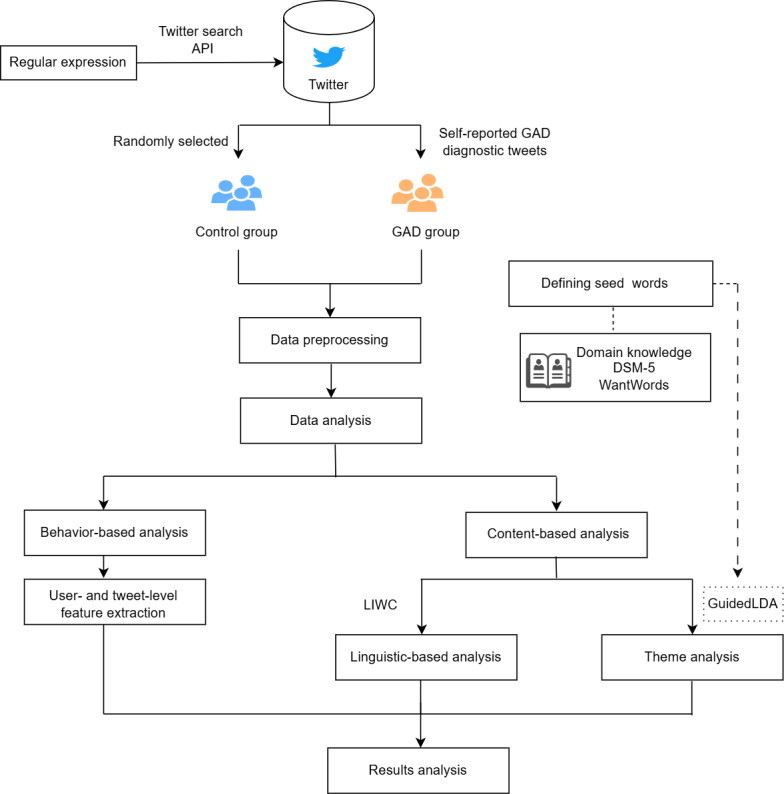
Methods: Data were first collected from Twitter (subsequently rebranded as X) for the GAD and control groups. Several preprocessing steps were performed. Three measurements were defined based on Linguistic Inquiry and Word Count for linguistic analysis. GuidedLDA was also used to identify the themes present in the tweets. Additionally, users' behaviors were analyzed using Twitter metadata. Finally, we studied the correlation between the GuidedLDA-based themes and users' behaviors.
Results: The linguistic analysis indicated differences in cognitive style, personal needs, and emotional expressiveness between people with and without GAD. Regarding cognitive style, there were significant differences (P<.001) for all features, such as insight (Cohen d=1.13), causation (Cohen d=1.03), and discrepancy (Cohen d=1.16). Regarding personal needs, there were significant differences (P<.001) in most personal needs categories, such as curiosity (Cohen d=1.05) and communication (Cohen d=0.64). Regarding emotional expressiveness, there were significant differences (P<.001) for most features, including anxiety (Cohen d=0.62), anger (Cohen d=0.72), sadness (Cohen d=0.48), and swear words (Cohen d=2.61). Additionally, topic modeling identified 4 primary themes (ie, symptoms, relationships, life problems, and feelings). We found that all themes were significantly more prevalent for people with GAD than for those without GAD (P<.001), along with significant effect sizes (Cohen d>0.50; P<.001) for most themes. Moreover, studying users' behaviors, including hashtag participation, volume, interaction pattern, social engagement, and reactive behaviors, revealed some digital markers of GAD, with most behavior-based features, such as the hashtag (Cohen d=0.49) and retweet (Cohen d=0.69) ratios, being statistically significant (P<.001). Furthermore, correlations between the GuidedLDA-based themes and users' behaviors were also identified.
Conclusions: Our findings revealed several digital markers of GAD on social media. These findings are significant and could contribute to developing an assessment tool that clinicians could use for the initial diagnosis of GAD or the detection of an early signal of worsening in people with GAD via social media posts. This tool could provide ongoing support and personalized coping strategies. However, one limitation of using social media for mental health assessment is the lack of a demographic representativeness analysis.
期刊介绍:
The Journal of Medical Internet Research (JMIR) is a highly respected publication in the field of health informatics and health services. With a founding date in 1999, JMIR has been a pioneer in the field for over two decades.
As a leader in the industry, the journal focuses on digital health, data science, health informatics, and emerging technologies for health, medicine, and biomedical research. It is recognized as a top publication in these disciplines, ranking in the first quartile (Q1) by Impact Factor.
Notably, JMIR holds the prestigious position of being ranked #1 on Google Scholar within the "Medical Informatics" discipline.



 京公网安备 11010802042870号
京ICP备2023020795号-1
京公网安备 11010802042870号
京ICP备2023020795号-1

 分享
分享
 求助内容:
求助内容: 应助结果提醒方式:
 扫码关注我们
