Yuan Meng, Xinyi Shu, Jie Yang, Yangyueying Liang, Meiying Zhu, Xuerui Wang, Yue Li, Fanming Kong
{"title":"Lung cancer organoids: a new strategy for precision medicine research.","authors":"Yuan Meng, Xinyi Shu, Jie Yang, Yangyueying Liang, Meiying Zhu, Xuerui Wang, Yue Li, Fanming Kong","doi":"10.21037/tlcr-24-921","DOIUrl":null,"url":null,"abstract":"<p><p>This article discusses new strategies for lung cancer organoids (LCOs) in precision medicine research. Precision medicine aims to identify and develop highly selective drugs targeted at specific disease markers for precise treatment. Given the genetic diversity among lung cancer cells, it is evident that different tumor cells may respond differently to various treatment regimens. LCOs can not only faithfully reproduce the pathological and genomic characteristics of samples, maintaining most variations, including driver gene mutations, but also preserve the cytological features of malignant tumor cells, showing a highly correlated in vitro drug screening response with the mutation spectrum in primary tumors. At this stage, several large-scale LCO biobanks have been established, providing ample sample resources for researchers. Based on this, the development of emerging technologies is expected to overcome limitations in the success rate, accuracy, and stability of the organoid culture process, significantly enhancing the level of precision medicine for lung cancer. This article mainly introduces the applications of LCO models in basic research, including the identification of drug targets, prediction of treatment efficacy, and overcoming drug resistance, assisting in the formulation of personalized treatment plans to improve treatment outcomes. Additionally, the article emphasizes the potential of cancer organoid co-culture models in the field of immunotherapy and their key role in advancing the evolution of precision medicine treatment strategies.</p>","PeriodicalId":23271,"journal":{"name":"Translational lung cancer research","volume":"14 2","pages":"575-590"},"PeriodicalIF":3.5000,"publicationDate":"2025-02-28","publicationTypes":"Journal Article","fieldsOfStudy":null,"isOpenAccess":false,"openAccessPdf":"https://www.ncbi.nlm.nih.gov/pmc/articles/PMC11921219/pdf/","citationCount":"0","resultStr":null,"platform":"Semanticscholar","paperid":null,"PeriodicalName":"Translational lung cancer research","FirstCategoryId":"3","ListUrlMain":"https://doi.org/10.21037/tlcr-24-921","RegionNum":2,"RegionCategory":"医学","ArticlePicture":[],"TitleCN":null,"AbstractTextCN":null,"PMCID":null,"EPubDate":"2025/2/18 0:00:00","PubModel":"Epub","JCR":"Q2","JCRName":"ONCOLOGY","Score":null,"Total":0}
引用次数: 0
Abstract
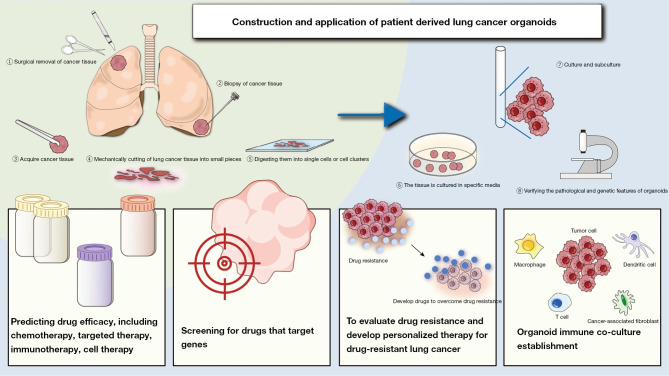
This article discusses new strategies for lung cancer organoids (LCOs) in precision medicine research. Precision medicine aims to identify and develop highly selective drugs targeted at specific disease markers for precise treatment. Given the genetic diversity among lung cancer cells, it is evident that different tumor cells may respond differently to various treatment regimens. LCOs can not only faithfully reproduce the pathological and genomic characteristics of samples, maintaining most variations, including driver gene mutations, but also preserve the cytological features of malignant tumor cells, showing a highly correlated in vitro drug screening response with the mutation spectrum in primary tumors. At this stage, several large-scale LCO biobanks have been established, providing ample sample resources for researchers. Based on this, the development of emerging technologies is expected to overcome limitations in the success rate, accuracy, and stability of the organoid culture process, significantly enhancing the level of precision medicine for lung cancer. This article mainly introduces the applications of LCO models in basic research, including the identification of drug targets, prediction of treatment efficacy, and overcoming drug resistance, assisting in the formulation of personalized treatment plans to improve treatment outcomes. Additionally, the article emphasizes the potential of cancer organoid co-culture models in the field of immunotherapy and their key role in advancing the evolution of precision medicine treatment strategies.
期刊介绍:
Translational Lung Cancer Research(TLCR, Transl Lung Cancer Res, Print ISSN 2218-6751; Online ISSN 2226-4477) is an international, peer-reviewed, open-access journal, which was founded in March 2012. TLCR is indexed by PubMed/PubMed Central and the Chemical Abstracts Service (CAS) Databases. It is published quarterly the first year, and published bimonthly since February 2013. It provides practical up-to-date information on prevention, early detection, diagnosis, and treatment of lung cancer. Specific areas of its interest include, but not limited to, multimodality therapy, markers, imaging, tumor biology, pathology, chemoprevention, and technical advances related to lung cancer.



 京公网安备 11010802042870号
京ICP备2023020795号-1
京公网安备 11010802042870号
京ICP备2023020795号-1

 分享
分享
 求助内容:
求助内容: 应助结果提醒方式:
 扫码关注我们
