{"title":"Genomic regions and candidate genes associated with forehead whorl positioning in Thoroughbred horses.","authors":"Tamu Yokomori, Teruaki Tozaki, Takao Segawa, Takuya Itou","doi":"10.1294/jes.36.11","DOIUrl":null,"url":null,"abstract":"<p><p>Previous studies have examined the relationship between hair characteristics and temperament traits in various animals. A partial genetic association has been suggested in humans because whorl formation and neurological development occur simultaneously during the fetal period. In the horse industry, anecdotal evidence suggests a link between the forehead whorl position and temperament. In our previous study, the heritability of forehead whorl positioning was h<sup>2</sup>=0.653, indicating significant genetic contributions in thoroughbreds. Therefore, in this study, we designed a genome-wide association study using 192 Thoroughbred horses to detect candidate genes associated with forehead whorl positioning. The results revealed 11 suggestive markers on chromosomes 2, 14, 15, 19, and 26, although no significant markers were found. Five genes, namely PTTG1, CCNH, RASA1, COX7C, and CLDN1, located near these markers had functions related to skin cell or hair follicle development and temperament. Therefore, these genes may be involved in the positioning of the forehead whorl in Thoroughbreds. The candidate genes identified in this study are expected to contribute to elucidating the genetic factors behind forehead whorl in horses and to help interpret the common process of whorl and temperament development.</p>","PeriodicalId":35701,"journal":{"name":"Journal of Equine Science","volume":"36 1","pages":"11-18"},"PeriodicalIF":0.0000,"publicationDate":"2025-01-01","publicationTypes":"Journal Article","fieldsOfStudy":null,"isOpenAccess":false,"openAccessPdf":"https://www.ncbi.nlm.nih.gov/pmc/articles/PMC11919545/pdf/","citationCount":"0","resultStr":null,"platform":"Semanticscholar","paperid":null,"PeriodicalName":"Journal of Equine Science","FirstCategoryId":"1085","ListUrlMain":"https://doi.org/10.1294/jes.36.11","RegionNum":0,"RegionCategory":null,"ArticlePicture":[],"TitleCN":null,"AbstractTextCN":null,"PMCID":null,"EPubDate":"2025/3/10 0:00:00","PubModel":"Epub","JCR":"Q3","JCRName":"Veterinary","Score":null,"Total":0}
引用次数: 0
Abstract
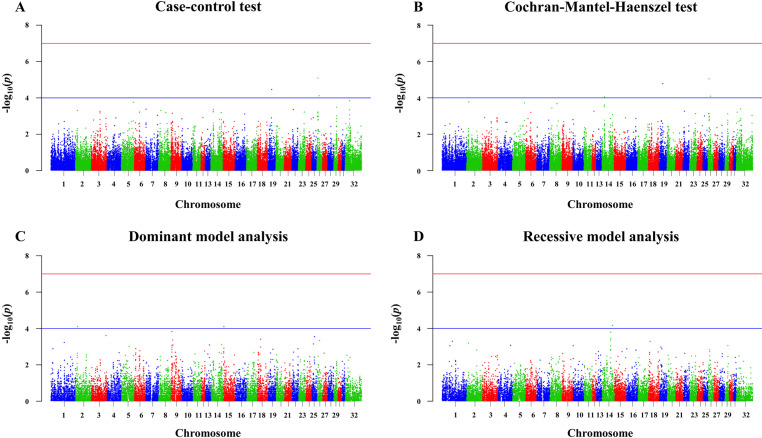
Previous studies have examined the relationship between hair characteristics and temperament traits in various animals. A partial genetic association has been suggested in humans because whorl formation and neurological development occur simultaneously during the fetal period. In the horse industry, anecdotal evidence suggests a link between the forehead whorl position and temperament. In our previous study, the heritability of forehead whorl positioning was h2=0.653, indicating significant genetic contributions in thoroughbreds. Therefore, in this study, we designed a genome-wide association study using 192 Thoroughbred horses to detect candidate genes associated with forehead whorl positioning. The results revealed 11 suggestive markers on chromosomes 2, 14, 15, 19, and 26, although no significant markers were found. Five genes, namely PTTG1, CCNH, RASA1, COX7C, and CLDN1, located near these markers had functions related to skin cell or hair follicle development and temperament. Therefore, these genes may be involved in the positioning of the forehead whorl in Thoroughbreds. The candidate genes identified in this study are expected to contribute to elucidating the genetic factors behind forehead whorl in horses and to help interpret the common process of whorl and temperament development.




 京公网安备 11010802042870号
京ICP备2023020795号-1
京公网安备 11010802042870号
京ICP备2023020795号-1

 分享
分享
 求助内容:
求助内容: 应助结果提醒方式:
 扫码关注我们
