{"title":"Weaning strategies for osmotic laxatives in children with functional constipation: a pilot multicenter randomized controlled trial.","authors":"Yoo Min Lee, Ju Young Kim, Kyung Jae Lee","doi":"10.21037/tp-24-436","DOIUrl":null,"url":null,"abstract":"<p><strong>Background: </strong>Long-term maintenance of laxatives is crucial for treating functional constipation (FC) in children. This study aimed to compare the success rates of discontinuation based on different drug reduction methods, in order to identify the optimal strategy for discontinuing laxative use.</p><p><strong>Methods: </strong>This open-label randomized controlled trial was conducted from September 2020 to September 2021. Children with FC who had been successfully treated with lactulose for more than three months were included. Patients were randomly assigned to one of two groups: dose reduction or frequency reduction over a three-month period. The primary outcome was the weaning success rate at week 12. Participants were divided into two subgroups based on the pre-weaning lactulose dosage: the low-dose group (≤1.5 g/kg/day) and the high-dose group (>1.5 g/kg/day).</p><p><strong>Results: </strong>A total of 16 patients were enrolled, with a median age of 43 months and 11 boys. There were no significant differences in baseline characteristics between the two groups. The primary outcome showed no significant difference: 66.7% for dose reduction <i>vs.</i> 57.1%. for frequency reduction. Weaning success rates decreased at week 16 (33.3% <i>vs.</i> 57.1%) and week 24 (33.3% <i>vs.</i> 42.9%) without significant differences. In the subgroup analysis, the high-dose group showed a significantly higher weaning success rate at 12 weeks compared to the low-dose group (81.8% <i>vs.</i> 20%, P=0.04). Other measures, including median defecation frequency, incontinence episodes, stool consistency, painful defecations, and compliance, were also similar between the groups. Patient satisfaction was 77.8% for dose reduction and 57.1% for frequency reduction, with no significant difference.</p><p><strong>Conclusions: </strong>The method of reducing the dose or frequency of lactulose did not affect the weaning success rate in children with FC. However, a pre-weaning lactulose dose exceeding 1.5 g/kg/day may lead to better outcomes at week 12. Despite gradual reduction over more than 3 months, the weaning success rate remained low, highlighting the importance of careful drug discontinuation and follow-up.</p><p><strong>Trial registration: </strong>The Clinical Research Information Service of the Korea Center for Disease Control and Prevention (https://cris.nih.go.kr/cris, registration No. KCT0006286).</p>","PeriodicalId":23294,"journal":{"name":"Translational pediatrics","volume":"14 2","pages":"252-261"},"PeriodicalIF":1.7000,"publicationDate":"2025-02-28","publicationTypes":"Journal Article","fieldsOfStudy":null,"isOpenAccess":false,"openAccessPdf":"https://www.ncbi.nlm.nih.gov/pmc/articles/PMC11921306/pdf/","citationCount":"0","resultStr":null,"platform":"Semanticscholar","paperid":null,"PeriodicalName":"Translational pediatrics","FirstCategoryId":"3","ListUrlMain":"https://doi.org/10.21037/tp-24-436","RegionNum":4,"RegionCategory":"医学","ArticlePicture":[],"TitleCN":null,"AbstractTextCN":null,"PMCID":null,"EPubDate":"2025/2/25 0:00:00","PubModel":"Epub","JCR":"Q2","JCRName":"PEDIATRICS","Score":null,"Total":0}
引用次数: 0
Abstract
Background: Long-term maintenance of laxatives is crucial for treating functional constipation (FC) in children. This study aimed to compare the success rates of discontinuation based on different drug reduction methods, in order to identify the optimal strategy for discontinuing laxative use.
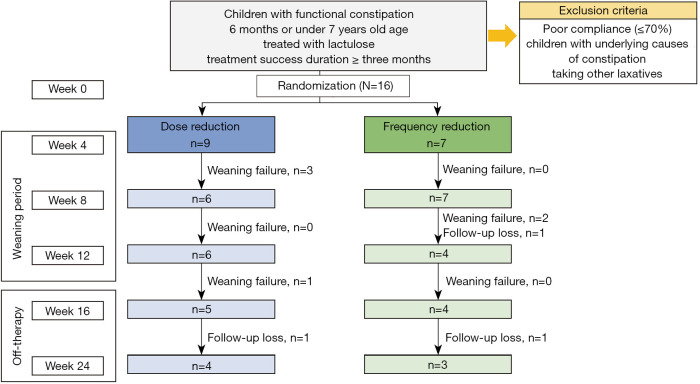
Methods: This open-label randomized controlled trial was conducted from September 2020 to September 2021. Children with FC who had been successfully treated with lactulose for more than three months were included. Patients were randomly assigned to one of two groups: dose reduction or frequency reduction over a three-month period. The primary outcome was the weaning success rate at week 12. Participants were divided into two subgroups based on the pre-weaning lactulose dosage: the low-dose group (≤1.5 g/kg/day) and the high-dose group (>1.5 g/kg/day).
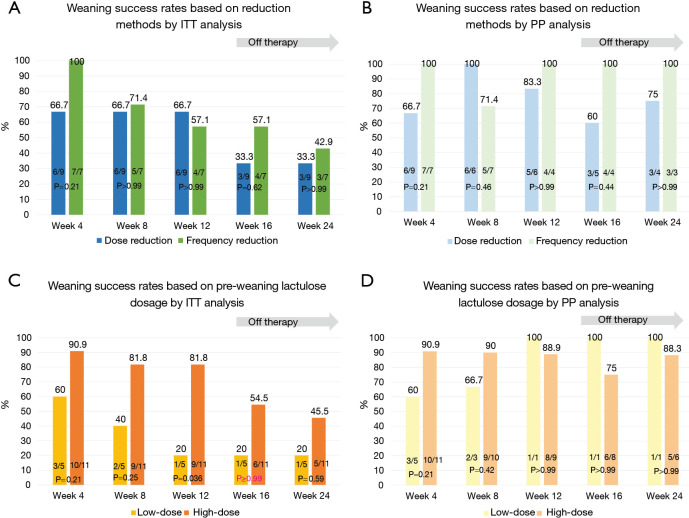
Results: A total of 16 patients were enrolled, with a median age of 43 months and 11 boys. There were no significant differences in baseline characteristics between the two groups. The primary outcome showed no significant difference: 66.7% for dose reduction vs. 57.1%. for frequency reduction. Weaning success rates decreased at week 16 (33.3% vs. 57.1%) and week 24 (33.3% vs. 42.9%) without significant differences. In the subgroup analysis, the high-dose group showed a significantly higher weaning success rate at 12 weeks compared to the low-dose group (81.8% vs. 20%, P=0.04). Other measures, including median defecation frequency, incontinence episodes, stool consistency, painful defecations, and compliance, were also similar between the groups. Patient satisfaction was 77.8% for dose reduction and 57.1% for frequency reduction, with no significant difference.
Conclusions: The method of reducing the dose or frequency of lactulose did not affect the weaning success rate in children with FC. However, a pre-weaning lactulose dose exceeding 1.5 g/kg/day may lead to better outcomes at week 12. Despite gradual reduction over more than 3 months, the weaning success rate remained low, highlighting the importance of careful drug discontinuation and follow-up.
Trial registration: The Clinical Research Information Service of the Korea Center for Disease Control and Prevention (https://cris.nih.go.kr/cris, registration No. KCT0006286).
背景:长期维持泻药是治疗儿童功能性便秘(FC)的关键。本研究旨在比较基于不同减量方法的停药成功率,以确定停药的最佳策略。方法:该开放标签随机对照试验于2020年9月至2021年9月进行。经乳果糖成功治疗3个月以上的FC患儿纳入研究。患者被随机分配到两组中的一组:在三个月内减少剂量或减少频率。主要观察指标为第12周断奶成功率。根据断奶前乳果糖剂量将受试者分为低剂量组(≤1.5 g/kg/day)和高剂量组(>1.5 g/kg/day)。结果:共纳入16例患者,中位年龄为43个月,其中11例为男孩。两组患者的基线特征无显著差异。主要结局无显著差异:剂量减少66.7% vs. 57.1%。为了降低频率。断奶成功率在第16周(33.3% vs. 57.1%)和第24周(33.3% vs. 42.9%)下降,但无显著差异。在亚组分析中,高剂量组在12周断奶成功率显著高于低剂量组(81.8% vs. 20%, P=0.04)。其他指标,包括排便频率中位数、失禁次数、大便一致性、排便疼痛和依从性,在两组之间也相似。减量组患者满意度为77.8%,减频组患者满意度为57.1%,差异无统计学意义。结论:减少乳果糖给药剂量和频率的方法不影响FC患儿的断奶成功率。然而,断奶前乳果糖剂量超过1.5 g/kg/天可能会在第12周产生更好的结果。尽管在3个多月的时间里逐渐减少,但断奶成功率仍然很低,这突出了谨慎停药和随访的重要性。试验注册:韩国疾病管理本部临床研究信息服务中心(https://cris.nih.go.kr/cris,注册号:KCT0006286)。




 京公网安备 11010802042870号
京ICP备2023020795号-1
京公网安备 11010802042870号
京ICP备2023020795号-1

 分享
分享
 求助内容:
求助内容: 应助结果提醒方式:
 扫码关注我们
