{"title":"Impact on bias mitigation algorithms to variations in inferred sensitive attribute uncertainty.","authors":"Yanchen Wang, Lisa Singh","doi":"10.3389/frai.2025.1520330","DOIUrl":null,"url":null,"abstract":"<p><p>Concerns about the trustworthiness, fairness, and privacy of AI systems are growing, and strategies for mitigating these concerns are still in their infancy. One approach to improve trustworthiness and fairness in AI systems is to use bias mitigation algorithms. However, most bias mitigation algorithms require data sets that contain sensitive attribute values to assess the fairness of the algorithm. A growing number of real world data sets do not make sensitive attribute information readily available to researchers. One solution is to infer the missing sensitive attribute information and apply an existing bias mitigation algorithm using this inferred knowledge. While researchers are beginning to explore this question, it is still unclear how robust existing bias mitigation algorithms are to different levels of inference accuracy. This paper explores this question by investigating the impact of different levels of accuracy of the inferred sensitive attribute on the performance of different bias mitigation strategies. We generate variation in sensitive attribute accuracy using both simulation and construction of neural models for the inference task. We then assess the quality of six bias mitigation algorithms that are deployed across different parts of our learning life cycle: pre-processing, in-processing, and post-processing. We find that the disparate impact remover is the least sensitive bias mitigation strategy and that if we apply the bias mitigation algorithms using an inferred sensitive attribute with reasonable accuracy, the fairness scores are higher than the best standard model and the balanced accuracy is similar to that of the standard model. These findings open the door for improving fairness of black box AI systems using some bias mitigation strategies.</p>","PeriodicalId":33315,"journal":{"name":"Frontiers in Artificial Intelligence","volume":"8 ","pages":"1520330"},"PeriodicalIF":4.7000,"publicationDate":"2025-03-06","publicationTypes":"Journal Article","fieldsOfStudy":null,"isOpenAccess":false,"openAccessPdf":"https://www.ncbi.nlm.nih.gov/pmc/articles/PMC11924408/pdf/","citationCount":"0","resultStr":null,"platform":"Semanticscholar","paperid":null,"PeriodicalName":"Frontiers in Artificial Intelligence","FirstCategoryId":"1085","ListUrlMain":"https://doi.org/10.3389/frai.2025.1520330","RegionNum":0,"RegionCategory":null,"ArticlePicture":[],"TitleCN":null,"AbstractTextCN":null,"PMCID":null,"EPubDate":"2025/1/1 0:00:00","PubModel":"eCollection","JCR":"Q2","JCRName":"COMPUTER SCIENCE, ARTIFICIAL INTELLIGENCE","Score":null,"Total":0}
引用次数: 0
Abstract
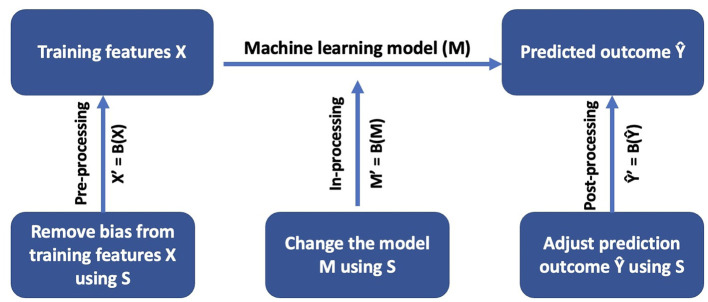
Concerns about the trustworthiness, fairness, and privacy of AI systems are growing, and strategies for mitigating these concerns are still in their infancy. One approach to improve trustworthiness and fairness in AI systems is to use bias mitigation algorithms. However, most bias mitigation algorithms require data sets that contain sensitive attribute values to assess the fairness of the algorithm. A growing number of real world data sets do not make sensitive attribute information readily available to researchers. One solution is to infer the missing sensitive attribute information and apply an existing bias mitigation algorithm using this inferred knowledge. While researchers are beginning to explore this question, it is still unclear how robust existing bias mitigation algorithms are to different levels of inference accuracy. This paper explores this question by investigating the impact of different levels of accuracy of the inferred sensitive attribute on the performance of different bias mitigation strategies. We generate variation in sensitive attribute accuracy using both simulation and construction of neural models for the inference task. We then assess the quality of six bias mitigation algorithms that are deployed across different parts of our learning life cycle: pre-processing, in-processing, and post-processing. We find that the disparate impact remover is the least sensitive bias mitigation strategy and that if we apply the bias mitigation algorithms using an inferred sensitive attribute with reasonable accuracy, the fairness scores are higher than the best standard model and the balanced accuracy is similar to that of the standard model. These findings open the door for improving fairness of black box AI systems using some bias mitigation strategies.






 京公网安备 11010802042870号
京ICP备2023020795号-1
京公网安备 11010802042870号
京ICP备2023020795号-1

 分享
分享
 求助内容:
求助内容: 应助结果提醒方式:
 扫码关注我们
