Problem Solved? An Individual Ratio between Point-of-Care and Venous International Normalized Ratio Values in Two Patients with Antiphospholipid Syndrome: Two Case Reports.
Bettina C Geertsema-Hoeve, Massimo Radin, Savino Sciascia, Rolf T Urbanus, Albert Huisman, Josine Borgsteede-de Wilde, Maarten Limper
{"title":"Problem Solved? An Individual Ratio between Point-of-Care and Venous International Normalized Ratio Values in Two Patients with Antiphospholipid Syndrome: Two Case Reports.","authors":"Bettina C Geertsema-Hoeve, Massimo Radin, Savino Sciascia, Rolf T Urbanus, Albert Huisman, Josine Borgsteede-de Wilde, Maarten Limper","doi":"10.1055/a-2542-5358","DOIUrl":null,"url":null,"abstract":"<p><p>Antiphospholipid syndrome (APS) is a rare autoimmune disorder characterized by thromboembolic and obstetric complications in the presence of persistent antiphospholipid antibodies (aPL). Treatment aims to prevent recurrent thrombosis, primarily using anticoagulation therapy with vitamin K antagonists (VKA). Monitoring of VKA therapy relies on the International Normalized Ratio (INR), which can be assessed using point-of-care testing (POCT). However, in a subset of APS patients with a high-risk aPL profile, the POCT-INR is falsely elevated, which might lead to underdosing of VKA and subsequent high risk of recurrent thrombosis. This case report describes two female patients with triple-positive thrombotic APS receiving VKA therapy. Both patients underwent biweekly paired INR measurements via POCT-INR and venous INR methods. Despite significant discrepancies, a strong individual linear correlation was observed: <i>r</i> = 0.77 (95% confidence interval [CI]: 0.54-0.99, <i>p</i> < 0.001) and <i>r</i> = 0.93 (95% CI: 0.88-0.97, <i>p</i> < 0.001), respectively. These findings suggest that individualized correction factors could be developed to improve the accuracy of POCT-INR measurements, thereby optimizing VKA dosing in these patients.</p>","PeriodicalId":94220,"journal":{"name":"TH open : companion journal to thrombosis and haemostasis","volume":"9 ","pages":"a25425358"},"PeriodicalIF":1.8000,"publicationDate":"2025-03-19","publicationTypes":"Journal Article","fieldsOfStudy":null,"isOpenAccess":false,"openAccessPdf":"https://www.ncbi.nlm.nih.gov/pmc/articles/PMC11924302/pdf/","citationCount":"0","resultStr":null,"platform":"Semanticscholar","paperid":null,"PeriodicalName":"TH open : companion journal to thrombosis and haemostasis","FirstCategoryId":"1085","ListUrlMain":"https://doi.org/10.1055/a-2542-5358","RegionNum":0,"RegionCategory":null,"ArticlePicture":[],"TitleCN":null,"AbstractTextCN":null,"PMCID":null,"EPubDate":"2025/1/1 0:00:00","PubModel":"eCollection","JCR":"","JCRName":"","Score":null,"Total":0}
引用次数: 0
Abstract
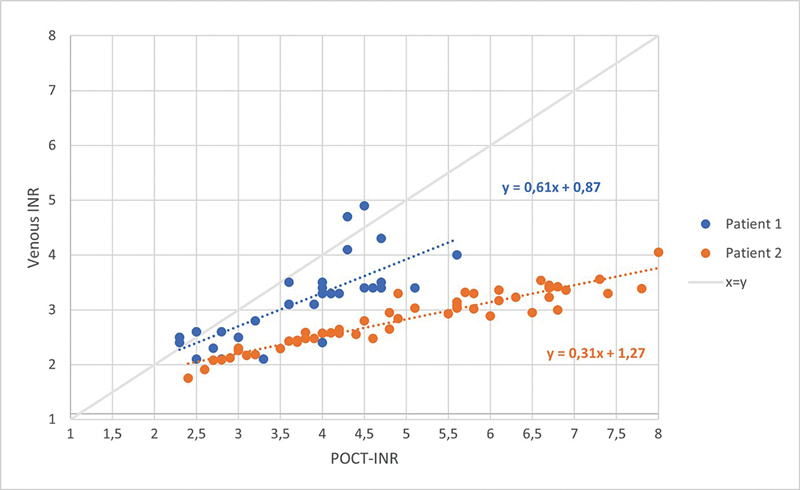
Antiphospholipid syndrome (APS) is a rare autoimmune disorder characterized by thromboembolic and obstetric complications in the presence of persistent antiphospholipid antibodies (aPL). Treatment aims to prevent recurrent thrombosis, primarily using anticoagulation therapy with vitamin K antagonists (VKA). Monitoring of VKA therapy relies on the International Normalized Ratio (INR), which can be assessed using point-of-care testing (POCT). However, in a subset of APS patients with a high-risk aPL profile, the POCT-INR is falsely elevated, which might lead to underdosing of VKA and subsequent high risk of recurrent thrombosis. This case report describes two female patients with triple-positive thrombotic APS receiving VKA therapy. Both patients underwent biweekly paired INR measurements via POCT-INR and venous INR methods. Despite significant discrepancies, a strong individual linear correlation was observed: r = 0.77 (95% confidence interval [CI]: 0.54-0.99, p < 0.001) and r = 0.93 (95% CI: 0.88-0.97, p < 0.001), respectively. These findings suggest that individualized correction factors could be developed to improve the accuracy of POCT-INR measurements, thereby optimizing VKA dosing in these patients.
抗磷脂综合征(APS)是一种罕见的自身免疫性疾病,以持续抗磷脂抗体(aPL)存在的血栓栓塞和产科并发症为特征。治疗的目的是防止血栓复发,主要使用抗凝治疗与维生素K拮抗剂(VKA)。VKA治疗的监测依赖于国际标准化比率(INR),该比率可以使用即时护理测试(POCT)进行评估。然而,在具有高危aPL特征的APS患者中,POCT-INR被错误地升高,这可能导致VKA剂量不足,从而导致血栓复发的高风险。本病例报告描述了两名接受VKA治疗的三阳性血栓性APS女性患者。两名患者均通过POCT-INR和静脉INR方法每两周进行配对INR测量。尽管存在显著差异,但观察到很强的个体线性相关性:r = 0.77(95%置信区间[CI]: 0.54-0.99, p r = 0.93) (95% CI: 0.88-0.97, p



 京公网安备 11010802042870号
京ICP备2023020795号-1
京公网安备 11010802042870号
京ICP备2023020795号-1

 分享
分享

 求助内容:
求助内容: 应助结果提醒方式:
 扫码关注我们
