Alterations in the salivary gland microbiota of Haemaphysalis longicornis during tick-to-host transmission of severe fever with thrombocytopenia syndrome virus.
{"title":"Alterations in the salivary gland microbiota of <i>Haemaphysalis longicornis</i> during tick-to-host transmission of severe fever with thrombocytopenia syndrome virus.","authors":"Jingjing Chen, Chuanfei Yuan, Qiong Xu, Yu Sun, Rui Zheng, Chenghong Zeng, Yan Wu, Zhen Zou, Qianfeng Xia","doi":"10.24272/j.issn.2095-8137.2024.332","DOIUrl":null,"url":null,"abstract":"<p><p><i>Haemaphysalis longicornis</i> serves as the primary tick vector for severe fever with thrombocytopenia syndrome virus (SFTSV), the etiological agent responsible for severe fever with thrombocytopenia syndrome (SFTS). Understanding alterations in tick salivary gland microbiota during SFTSV transmission to vertebrate hosts is essential for developing novel control strategies. However, microbial shifts in tick salivary glands during pathogen transmission to hosts have not been reported for any tick-borne pathogens. In this study, SFTSV transmission from <i>H. longicornis</i> to vertebrate hosts was confirmed using a tick-rabbit transmission model. Salivary gland microbiota profiling via 16S rRNA gene sequencing identified significant changes in bacterial composition associated with viral transmission. The relative abundance of three genera ( <i>Serratia</i>, <i>Bifidobacterium</i>, and <i>Akkermansia</i>) increased, whereas five genera <i>(Flavobacterium</i>, <i>Staphylococcus</i>, <i>Enhydrobacter</i>, <i>Massilia</i>, and <i>Stenotrophomonas</i>) decreased. Correlation network analysis revealed a negative association between <i>Akkermansia</i> and <i>Flavobacterium</i>. These findings demonstrated that SFTSV transmission alters the salivary gland microbiota of <i>H. longicornis</i>, providing insights for future functional studies and the development of targeted strategies for SFTS control.</p>","PeriodicalId":48636,"journal":{"name":"Zoological Research","volume":"46 2","pages":"459-468"},"PeriodicalIF":4.7000,"publicationDate":"2025-03-18","publicationTypes":"Journal Article","fieldsOfStudy":null,"isOpenAccess":false,"openAccessPdf":"https://www.ncbi.nlm.nih.gov/pmc/articles/PMC12000141/pdf/","citationCount":"0","resultStr":null,"platform":"Semanticscholar","paperid":null,"PeriodicalName":"Zoological Research","FirstCategoryId":"99","ListUrlMain":"https://doi.org/10.24272/j.issn.2095-8137.2024.332","RegionNum":1,"RegionCategory":"生物学","ArticlePicture":[],"TitleCN":null,"AbstractTextCN":null,"PMCID":null,"EPubDate":"","PubModel":"","JCR":"Q1","JCRName":"ZOOLOGY","Score":null,"Total":0}
引用次数: 0
Abstract
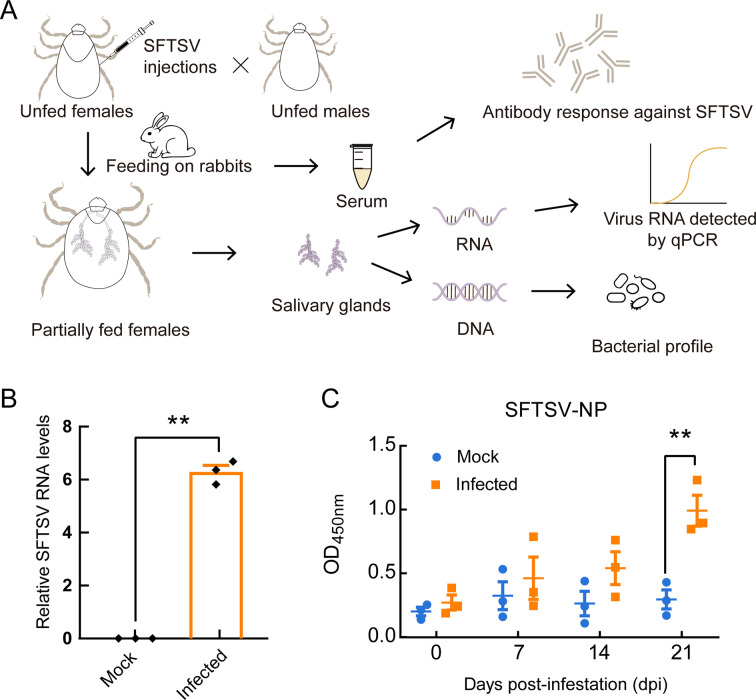
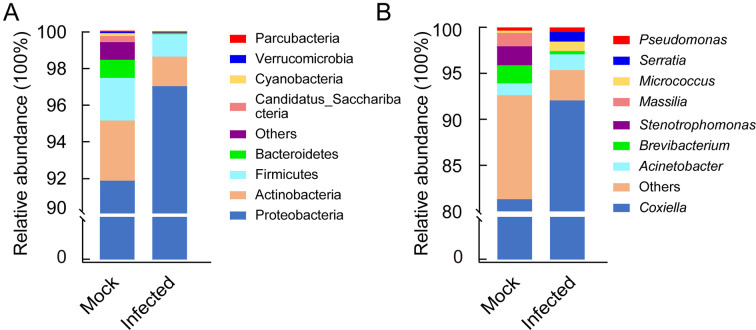
Haemaphysalis longicornis serves as the primary tick vector for severe fever with thrombocytopenia syndrome virus (SFTSV), the etiological agent responsible for severe fever with thrombocytopenia syndrome (SFTS). Understanding alterations in tick salivary gland microbiota during SFTSV transmission to vertebrate hosts is essential for developing novel control strategies. However, microbial shifts in tick salivary glands during pathogen transmission to hosts have not been reported for any tick-borne pathogens. In this study, SFTSV transmission from H. longicornis to vertebrate hosts was confirmed using a tick-rabbit transmission model. Salivary gland microbiota profiling via 16S rRNA gene sequencing identified significant changes in bacterial composition associated with viral transmission. The relative abundance of three genera ( Serratia, Bifidobacterium, and Akkermansia) increased, whereas five genera (Flavobacterium, Staphylococcus, Enhydrobacter, Massilia, and Stenotrophomonas) decreased. Correlation network analysis revealed a negative association between Akkermansia and Flavobacterium. These findings demonstrated that SFTSV transmission alters the salivary gland microbiota of H. longicornis, providing insights for future functional studies and the development of targeted strategies for SFTS control.
期刊介绍:
Established in 1980, Zoological Research (ZR) is a bimonthly publication produced by Kunming Institute of Zoology, the Chinese Academy of Sciences, and the China Zoological Society. It publishes peer-reviewed original research article/review/report/note/letter to the editor/editorial in English on Primates and Animal Models, Conservation and Utilization of Animal Resources, and Animal Diversity and Evolution.




 京公网安备 11010802042870号
京ICP备2023020795号-1
京公网安备 11010802042870号
京ICP备2023020795号-1

 分享
分享
 求助内容:
求助内容: 应助结果提醒方式:
 扫码关注我们
