Josefina Bertoli , Antonio Cleilson Nobre Bandeira , Cíntia de la Rocha Freitas , Ismael Forte Freitas Júnior
{"title":"Can mat Pilates improve quality of life components in breast cancer survivors receiving hormone therapy? A randomized controlled trial","authors":"Josefina Bertoli , Antonio Cleilson Nobre Bandeira , Cíntia de la Rocha Freitas , Ismael Forte Freitas Júnior","doi":"10.1016/j.ctcp.2025.101972","DOIUrl":null,"url":null,"abstract":"<div><h3>Background</h3><div>Short and long-term breast cancer treatment side-effects allied with the increase of sedentary behavior, affect quality of life (QoL). Nonetheless, regular physical exercise appears to ameliorate breast cancer survivor (BCS) QoL components.</div></div><div><h3>Purpose</h3><div>to analyze the effect of 24 weeks of mat Pilates (3 times/week, 60 min session) in BCS receiving hormone therapy on QoL components.</div></div><div><h3>Materials and methods</h3><div>43 participants were randomized according to hormone therapy (Tamoxifen (TMX) or Aromatase Inhibitors (AIs)) in the Pilates group (PG) and control group (CG). The QoL data was collected through SF-36, EORT-30, and 23 questionnaires. The evaluations occurred at baseline (T1), at week 12 (T2), and week 24 (T3) of the intervention. The generalized estimating equations model was used with the Bonferroni post hoc test (p < 0.05).</div></div><div><h3>Results</h3><div>The SF-36 showed that CG improved physical limitations at T2 compared to T1 (p = 0.032). The Pilates group enhanced emotional aspects compared to CG at T3 (0.009), social aspects at T3 compared to its baseline (p = 0.023), and mental health at T3 compared to CG (p = 0.026). The specific breast cancer questionnaires (EORT-30 and 23) did not show differences throughout the intervention.</div></div><div><h3>Conclusions</h3><div>Only the SF-36 showed enhancement for PG QoL components. The EORT-30 and 23 domains are directly related to the side effect treatments, which could influence the outcomes.</div></div>","PeriodicalId":48752,"journal":{"name":"Complementary Therapies in Clinical Practice","volume":"59 ","pages":"Article 101972"},"PeriodicalIF":3.0000,"publicationDate":"2025-03-17","publicationTypes":"Journal Article","fieldsOfStudy":null,"isOpenAccess":false,"openAccessPdf":"","citationCount":"0","resultStr":null,"platform":"Semanticscholar","paperid":null,"PeriodicalName":"Complementary Therapies in Clinical Practice","FirstCategoryId":"3","ListUrlMain":"https://www.sciencedirect.com/science/article/pii/S1744388125000374","RegionNum":3,"RegionCategory":"医学","ArticlePicture":[],"TitleCN":null,"AbstractTextCN":null,"PMCID":null,"EPubDate":"","PubModel":"","JCR":"Q2","JCRName":"INTEGRATIVE & COMPLEMENTARY MEDICINE","Score":null,"Total":0}
引用次数: 0
Abstract
Background
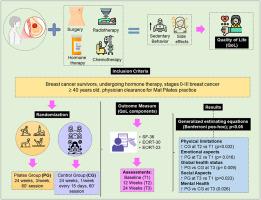
Short and long-term breast cancer treatment side-effects allied with the increase of sedentary behavior, affect quality of life (QoL). Nonetheless, regular physical exercise appears to ameliorate breast cancer survivor (BCS) QoL components.
Purpose
to analyze the effect of 24 weeks of mat Pilates (3 times/week, 60 min session) in BCS receiving hormone therapy on QoL components.
Materials and methods
43 participants were randomized according to hormone therapy (Tamoxifen (TMX) or Aromatase Inhibitors (AIs)) in the Pilates group (PG) and control group (CG). The QoL data was collected through SF-36, EORT-30, and 23 questionnaires. The evaluations occurred at baseline (T1), at week 12 (T2), and week 24 (T3) of the intervention. The generalized estimating equations model was used with the Bonferroni post hoc test (p < 0.05).
Results
The SF-36 showed that CG improved physical limitations at T2 compared to T1 (p = 0.032). The Pilates group enhanced emotional aspects compared to CG at T3 (0.009), social aspects at T3 compared to its baseline (p = 0.023), and mental health at T3 compared to CG (p = 0.026). The specific breast cancer questionnaires (EORT-30 and 23) did not show differences throughout the intervention.
Conclusions
Only the SF-36 showed enhancement for PG QoL components. The EORT-30 and 23 domains are directly related to the side effect treatments, which could influence the outcomes.
期刊介绍:
Complementary Therapies in Clinical Practice is an internationally refereed journal published to meet the broad ranging needs of the healthcare profession in the effective and professional integration of complementary therapies within clinical practice.
Complementary Therapies in Clinical Practice aims to provide rigorous peer reviewed papers addressing research, implementation of complementary therapies (CTs) in the clinical setting, legal and ethical concerns, evaluative accounts of therapy in practice, philosophical analysis of emergent social trends in CTs, excellence in clinical judgement, best practice, problem management, therapy information, policy development and management of change in order to promote safe and efficacious clinical practice.
Complementary Therapies in Clinical Practice welcomes and considers accounts of reflective practice.



 京公网安备 11010802042870号
京ICP备2023020795号-1
京公网安备 11010802042870号
京ICP备2023020795号-1

 分享
分享
 求助内容:
求助内容: 应助结果提醒方式:
 扫码关注我们
