Ming-Yue Gao, Meng Wang, Yong-Tao Wang and Zhi-Ling Zhang
{"title":"Enhanced catalytic efficiency of nanozymes with a V-structured chip for microfluidic biosensing of S. typhimurium†","authors":"Ming-Yue Gao, Meng Wang, Yong-Tao Wang and Zhi-Ling Zhang","doi":"10.1039/D5TB00172B","DOIUrl":null,"url":null,"abstract":"<p >Nanozymes, nanomaterials with enzyme-like characteristics which exhibit lower cost, easier synthesis and functionalization, and better stability compared with natural enzymes, have been widely developed for biosensing, disease therapy and environmental governance. However, the lack of catalytic efficiency of nanozymes compared to natural enzymes makes it difficult for them to completely replace natural enzymes to achieve higher sensitivity and lower detection limits in biosensing. Herein, magnetism-controlled technology was used to form a nanozyme array consisting of stacked Fe<small><sub>3</sub></small>O<small><sub>4</sub></small>/Au NPs at the bottom of the microchannel as a spatially confined microreactor for the catalytic reaction. By enhancing the mass transfer process of the substrate towards nanozymes mediated by the corresponding V-structure, a higher local concentration of the substrate and more efficient utilization of active sites of nanozymes were achieved to increase the catalytic efficiency (<em>k</em><small><sub>cat</sub></small>/<em>K</em><small><sub>M</sub></small>) of the nanozyme array consisting of Fe<small><sub>3</sub></small>O<small><sub>4</sub></small>/Au NPs by 95.2%, which was two orders of magnitude higher than that of the open reactor. Based on this, a colorimetric method on an integrated microfluidic platform was proposed for sensitive biosensing of <em>Salmonella typhimurium.</em> The entire detection could be completed within 30 minutes, yielding a linear range from 10<small><sup>2</sup></small> to 10<small><sup>7</sup></small> CFU mL<small><sup>−1</sup></small> and a detection limit as low as 5.6 CFU mL<small><sup>−1</sup></small>.</p>","PeriodicalId":83,"journal":{"name":"Journal of Materials Chemistry B","volume":" 14","pages":" 4471-4483"},"PeriodicalIF":6.1000,"publicationDate":"2025-03-11","publicationTypes":"Journal Article","fieldsOfStudy":null,"isOpenAccess":false,"openAccessPdf":"https://pubs.rsc.org/en/content/articlepdf/2025/tb/d5tb00172b?page=search","citationCount":"0","resultStr":null,"platform":"Semanticscholar","paperid":null,"PeriodicalName":"Journal of Materials Chemistry B","FirstCategoryId":"1","ListUrlMain":"https://pubs.rsc.org/en/content/articlelanding/2025/tb/d5tb00172b","RegionNum":3,"RegionCategory":"医学","ArticlePicture":[],"TitleCN":null,"AbstractTextCN":null,"PMCID":null,"EPubDate":"","PubModel":"","JCR":"Q1","JCRName":"MATERIALS SCIENCE, BIOMATERIALS","Score":null,"Total":0}
引用次数: 0
Abstract
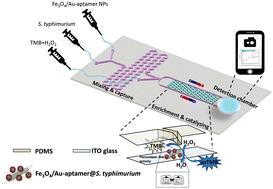
Nanozymes, nanomaterials with enzyme-like characteristics which exhibit lower cost, easier synthesis and functionalization, and better stability compared with natural enzymes, have been widely developed for biosensing, disease therapy and environmental governance. However, the lack of catalytic efficiency of nanozymes compared to natural enzymes makes it difficult for them to completely replace natural enzymes to achieve higher sensitivity and lower detection limits in biosensing. Herein, magnetism-controlled technology was used to form a nanozyme array consisting of stacked Fe3O4/Au NPs at the bottom of the microchannel as a spatially confined microreactor for the catalytic reaction. By enhancing the mass transfer process of the substrate towards nanozymes mediated by the corresponding V-structure, a higher local concentration of the substrate and more efficient utilization of active sites of nanozymes were achieved to increase the catalytic efficiency (kcat/KM) of the nanozyme array consisting of Fe3O4/Au NPs by 95.2%, which was two orders of magnitude higher than that of the open reactor. Based on this, a colorimetric method on an integrated microfluidic platform was proposed for sensitive biosensing of Salmonella typhimurium. The entire detection could be completed within 30 minutes, yielding a linear range from 102 to 107 CFU mL−1 and a detection limit as low as 5.6 CFU mL−1.
期刊介绍:
Journal of Materials Chemistry A, B & C cover high quality studies across all fields of materials chemistry. The journals focus on those theoretical or experimental studies that report new understanding, applications, properties and synthesis of materials. Journal of Materials Chemistry A, B & C are separated by the intended application of the material studied. Broadly, applications in energy and sustainability are of interest to Journal of Materials Chemistry A, applications in biology and medicine are of interest to Journal of Materials Chemistry B, and applications in optical, magnetic and electronic devices are of interest to Journal of Materials Chemistry C.Journal of Materials Chemistry B is a Transformative Journal and Plan S compliant. Example topic areas within the scope of Journal of Materials Chemistry B are listed below. This list is neither exhaustive nor exclusive:
Antifouling coatings
Biocompatible materials
Bioelectronics
Bioimaging
Biomimetics
Biomineralisation
Bionics
Biosensors
Diagnostics
Drug delivery
Gene delivery
Immunobiology
Nanomedicine
Regenerative medicine & Tissue engineering
Scaffolds
Soft robotics
Stem cells
Therapeutic devices



 京公网安备 11010802042870号
京ICP备2023020795号-1
京公网安备 11010802042870号
京ICP备2023020795号-1

 分享
分享
 求助内容:
求助内容: 应助结果提醒方式:
 扫码关注我们
