Qi Wan, Jie Zhao, Yu Liu, Linshu Li, Juwei Yan, Qiwei Tan, Xun Xu, Qingchun Zhang, Xijun Wei, Ling Ni and Ping Li
{"title":"Amorphous FeP@porous carbon nanofibers with sterically conductive networks for stable potassium-ion storage†","authors":"Qi Wan, Jie Zhao, Yu Liu, Linshu Li, Juwei Yan, Qiwei Tan, Xun Xu, Qingchun Zhang, Xijun Wei, Ling Ni and Ping Li","doi":"10.1039/D5NR00116A","DOIUrl":null,"url":null,"abstract":"<p >Structural instability in electrode materials is a critical barrier to the practical application of potassium-ion batteries (PIBs) in terms of long-term durability. To overcome this, we integrated amorphous FeP within continuous three-dimensional (3D) carbon fiber networks, fabricated through an electrospinning process. The amorphous structure of FeP facilitates isotropic volume expansion, effectively distributing stress uniformly across the electrode and mitigating degradation during cycling. Additionally, the loosely packed atomic arrangement and interconnected 3D conductive framework enable smoother potassium-ion diffusion, thereby enhancing the kinetic performance. Therefore, the well-designed amorphous FeP/porous carbon nanofibers (A-FeP@PCNFs) exhibit a remarkable specific capacity of 358.3 mA h g<small><sup>−1</sup></small> at 0.1 A g<small><sup>−1</sup></small> and demonstrate exceptional cycling durability, retaining a reversible capacity of 152.0 mA h g<small><sup>−1</sup></small> after 2400 cycles at 3 A g<small><sup>−1</sup></small>. This innovative design offers a robust approach for developing excellent electrochemical performance anode materials with superior structural stability and rapid electrochemical response, advancing the potential of PIBs in energy storage applications.</p>","PeriodicalId":92,"journal":{"name":"Nanoscale","volume":" 16","pages":" 10371-10379"},"PeriodicalIF":5.1000,"publicationDate":"2025-03-22","publicationTypes":"Journal Article","fieldsOfStudy":null,"isOpenAccess":false,"openAccessPdf":"","citationCount":"0","resultStr":null,"platform":"Semanticscholar","paperid":null,"PeriodicalName":"Nanoscale","FirstCategoryId":"88","ListUrlMain":"https://pubs.rsc.org/en/content/articlelanding/2025/nr/d5nr00116a","RegionNum":3,"RegionCategory":"材料科学","ArticlePicture":[],"TitleCN":null,"AbstractTextCN":null,"PMCID":null,"EPubDate":"","PubModel":"","JCR":"Q1","JCRName":"CHEMISTRY, MULTIDISCIPLINARY","Score":null,"Total":0}
引用次数: 0
Abstract
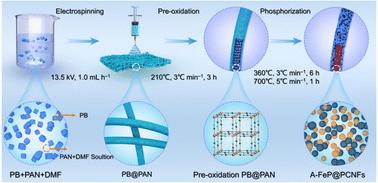
Structural instability in electrode materials is a critical barrier to the practical application of potassium-ion batteries (PIBs) in terms of long-term durability. To overcome this, we integrated amorphous FeP within continuous three-dimensional (3D) carbon fiber networks, fabricated through an electrospinning process. The amorphous structure of FeP facilitates isotropic volume expansion, effectively distributing stress uniformly across the electrode and mitigating degradation during cycling. Additionally, the loosely packed atomic arrangement and interconnected 3D conductive framework enable smoother potassium-ion diffusion, thereby enhancing the kinetic performance. Therefore, the well-designed amorphous FeP/porous carbon nanofibers (A-FeP@PCNFs) exhibit a remarkable specific capacity of 358.3 mA h g−1 at 0.1 A g−1 and demonstrate exceptional cycling durability, retaining a reversible capacity of 152.0 mA h g−1 after 2400 cycles at 3 A g−1. This innovative design offers a robust approach for developing excellent electrochemical performance anode materials with superior structural stability and rapid electrochemical response, advancing the potential of PIBs in energy storage applications.
电极材料的结构不稳定性是钾离子电池长期耐用性实际应用的关键障碍。为了克服这个问题,我们将非晶FeP集成到通过静电纺丝工艺制造的连续三维(3D)碳纤维网络中。FeP的非晶结构有利于各向同性体积膨胀,有效地将应力均匀分布在电极上,减轻循环过程中的降解。此外,松散排列的原子排列和相互连接的3D导电框架使钾离子扩散更顺畅,从而提高动力学性能。因此,精心设计的无定形FeP/多孔碳纳米纤维(A-FeP@PCNFs)在0.1 a g⁻¹下具有358.3 mAh的显著比容量,并表现出特殊的循环耐久性,在3 a g⁻¹的2400次循环后保持152.0 mAh的可逆容量。这种创新的设计为开发具有优异结构稳定性和快速电化学响应的电化学性能优异的阳极材料提供了强有力的方法,提高了PIBs在储能应用中的潜力。
期刊介绍:
Nanoscale is a high-impact international journal, publishing high-quality research across nanoscience and nanotechnology. Nanoscale publishes a full mix of research articles on experimental and theoretical work, including reviews, communications, and full papers.Highly interdisciplinary, this journal appeals to scientists, researchers and professionals interested in nanoscience and nanotechnology, quantum materials and quantum technology, including the areas of physics, chemistry, biology, medicine, materials, energy/environment, information technology, detection science, healthcare and drug discovery, and electronics.



 京公网安备 11010802042870号
京ICP备2023020795号-1
京公网安备 11010802042870号
京ICP备2023020795号-1

 分享
分享
 求助内容:
求助内容: 应助结果提醒方式:
 扫码关注我们
