{"title":"Energy-Efficient Multi-Agent Reinforcement Learning for UAV Trajectory Optimization in Cell-Free Massive MIMO Networks","authors":"Zhilong Liu;Jiayi Zhang;Yong Zeng;Bo Ai","doi":"10.1109/TWC.2025.3550266","DOIUrl":null,"url":null,"abstract":"To enhance global data transmission, uncrewed aerial vehicle (UAV)-aided space-air-ground integrated networks (SAGIN) represent a pivotal direction for future advancements. In this paper, we focus on the trajectory optimization problem with the goal of maximizing the energy efficiency (EE), thereby balancing the system capacity with energy expenditure. To this end, we first introduce a cell-free SAGIN network where UAVs function as flying access points to serve ground user equipment (GUE). Given that the transmission power of satellite direct-to-cell devices typically exceeds that of GUEs, we investigate the interference effect and derive exact closed-form expressions for the uplink spectral efficiency. In order to improve the service access efficiency, a GUE grouping scheme based on density distribution is proposed. Then, an effective EE analysis model is established considering the power consumption of fixed-wing UAVs. To solve the UAV trajectory optimization problem, two algorithms over two timescales are proposed: a successive convex approximation strategy and a multi-agent reinforcement learning (MARL)-based algorithm. In particular, to reduce the algorithmic complexity, we employ a shared Critic network in the proposed MARL algorithm to reduce the training parameters. Importantly, our approach comprehensively optimizes the UAV trajectory, acceleration, and velocity parameters. The results show that the proposed GUE grouping algorithm and the MARL-based optimization algorithm demonstrate adaptability in dynamic time-varying environments.","PeriodicalId":13431,"journal":{"name":"IEEE Transactions on Wireless Communications","volume":"24 7","pages":"5917-5930"},"PeriodicalIF":10.7000,"publicationDate":"2025-03-20","publicationTypes":"Journal Article","fieldsOfStudy":null,"isOpenAccess":false,"openAccessPdf":"","citationCount":"0","resultStr":null,"platform":"Semanticscholar","paperid":null,"PeriodicalName":"IEEE Transactions on Wireless Communications","FirstCategoryId":"94","ListUrlMain":"https://ieeexplore.ieee.org/document/10932660/","RegionNum":1,"RegionCategory":"计算机科学","ArticlePicture":[],"TitleCN":null,"AbstractTextCN":null,"PMCID":null,"EPubDate":"","PubModel":"","JCR":"Q1","JCRName":"ENGINEERING, ELECTRICAL & ELECTRONIC","Score":null,"Total":0}
引用次数: 0
Abstract
To enhance global data transmission, uncrewed aerial vehicle (UAV)-aided space-air-ground integrated networks (SAGIN) represent a pivotal direction for future advancements. In this paper, we focus on the trajectory optimization problem with the goal of maximizing the energy efficiency (EE), thereby balancing the system capacity with energy expenditure. To this end, we first introduce a cell-free SAGIN network where UAVs function as flying access points to serve ground user equipment (GUE). Given that the transmission power of satellite direct-to-cell devices typically exceeds that of GUEs, we investigate the interference effect and derive exact closed-form expressions for the uplink spectral efficiency. In order to improve the service access efficiency, a GUE grouping scheme based on density distribution is proposed. Then, an effective EE analysis model is established considering the power consumption of fixed-wing UAVs. To solve the UAV trajectory optimization problem, two algorithms over two timescales are proposed: a successive convex approximation strategy and a multi-agent reinforcement learning (MARL)-based algorithm. In particular, to reduce the algorithmic complexity, we employ a shared Critic network in the proposed MARL algorithm to reduce the training parameters. Importantly, our approach comprehensively optimizes the UAV trajectory, acceleration, and velocity parameters. The results show that the proposed GUE grouping algorithm and the MARL-based optimization algorithm demonstrate adaptability in dynamic time-varying environments.
期刊介绍:
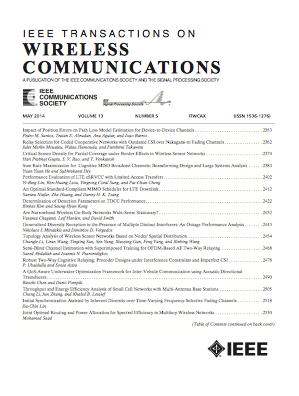
The IEEE Transactions on Wireless Communications is a prestigious publication that showcases cutting-edge advancements in wireless communications. It welcomes both theoretical and practical contributions in various areas. The scope of the Transactions encompasses a wide range of topics, including modulation and coding, detection and estimation, propagation and channel characterization, and diversity techniques. The journal also emphasizes the physical and link layer communication aspects of network architectures and protocols.
The journal is open to papers on specific topics or non-traditional topics related to specific application areas. This includes simulation tools and methodologies, orthogonal frequency division multiplexing, MIMO systems, and wireless over optical technologies.
Overall, the IEEE Transactions on Wireless Communications serves as a platform for high-quality manuscripts that push the boundaries of wireless communications and contribute to advancements in the field.



 京公网安备 11010802042870号
京ICP备2023020795号-1
京公网安备 11010802042870号
京ICP备2023020795号-1

 分享
分享
 求助内容:
求助内容: 应助结果提醒方式:
 扫码关注我们
