Franziska Hoeser, Patricia Saura, Caroline Harter, Ville R. I. Kaila and Thorsten Friedrich
{"title":"A leigh syndrome mutation perturbs long-range energy coupling in respiratory complex I†","authors":"Franziska Hoeser, Patricia Saura, Caroline Harter, Ville R. I. Kaila and Thorsten Friedrich","doi":"10.1039/D4SC04036H","DOIUrl":null,"url":null,"abstract":"<p >Respiratory complex I is a central enzyme of cellular energy metabolism that couples electron transfer with proton translocation across a biological membrane. In doing so, it powers oxidative phosphorylation that drives energy consuming processes. Mutations in complex I lead to severe neurodegenerative diseases in humans. However, the biochemical consequences of these mutations remain largely unknown. Here, we use the <em>Escherichia coli</em> complex I as a model to biochemically characterize the F124L<small><sup>MT-ND5</sup></small> mutation found in patients suffering from Leigh syndrome. We show that the mutation drastically perturbs proton translocation and electron transfer activities to the same extent, despite the remarkable 140 Å distance between the mutated position and the electron transfer domain. Our molecular dynamics simulations suggest that the disease-causing mutation induces conformational changes that hamper the propagation of an electric wave through an ion-paired network essential for proton translocation. Our findings imply that malfunction of the proton translocation domain is entirely transmitted to the electron transfer domain underlining the action-at-a-distance coupling in the proton-coupled electron transfer of respiratory complex I.</p>","PeriodicalId":9909,"journal":{"name":"Chemical Science","volume":" 17","pages":" 7374-7386"},"PeriodicalIF":7.4000,"publicationDate":"2025-03-21","publicationTypes":"Journal Article","fieldsOfStudy":null,"isOpenAccess":false,"openAccessPdf":"https://pubs.rsc.org/en/content/articlepdf/2025/sc/d4sc04036h?page=search","citationCount":"0","resultStr":null,"platform":"Semanticscholar","paperid":null,"PeriodicalName":"Chemical Science","FirstCategoryId":"92","ListUrlMain":"https://pubs.rsc.org/en/content/articlelanding/2025/sc/d4sc04036h","RegionNum":1,"RegionCategory":"化学","ArticlePicture":[],"TitleCN":null,"AbstractTextCN":null,"PMCID":null,"EPubDate":"","PubModel":"","JCR":"Q1","JCRName":"CHEMISTRY, MULTIDISCIPLINARY","Score":null,"Total":0}
引用次数: 0
Abstract
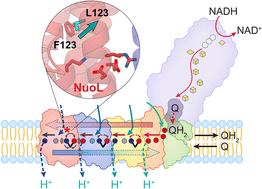
Respiratory complex I is a central enzyme of cellular energy metabolism that couples electron transfer with proton translocation across a biological membrane. In doing so, it powers oxidative phosphorylation that drives energy consuming processes. Mutations in complex I lead to severe neurodegenerative diseases in humans. However, the biochemical consequences of these mutations remain largely unknown. Here, we use the Escherichia coli complex I as a model to biochemically characterize the F124LMT-ND5 mutation found in patients suffering from Leigh syndrome. We show that the mutation drastically perturbs proton translocation and electron transfer activities to the same extent, despite the remarkable 140 Å distance between the mutated position and the electron transfer domain. Our molecular dynamics simulations suggest that the disease-causing mutation induces conformational changes that hamper the propagation of an electric wave through an ion-paired network essential for proton translocation. Our findings imply that malfunction of the proton translocation domain is entirely transmitted to the electron transfer domain underlining the action-at-a-distance coupling in the proton-coupled electron transfer of respiratory complex I.
期刊介绍:
Chemical Science is a journal that encompasses various disciplines within the chemical sciences. Its scope includes publishing ground-breaking research with significant implications for its respective field, as well as appealing to a wider audience in related areas. To be considered for publication, articles must showcase innovative and original advances in their field of study and be presented in a manner that is understandable to scientists from diverse backgrounds. However, the journal generally does not publish highly specialized research.




 京公网安备 11010802042870号
京ICP备2023020795号-1
京公网安备 11010802042870号
京ICP备2023020795号-1

 分享
分享
 求助内容:
求助内容: 应助结果提醒方式:
 扫码关注我们
