Jie Zhou, Guangyang Liu, Ying Zhang, Zhihao Lin, Miao Wang, Bining Jiao, Yiming Zhao, Ge Chen, Xin Yang, Jun Lv, Donghui Xu
{"title":"Tannic Acid-Fe3+ Network-Coated Defective Bimetallic ZnM-ZIF (M = Cu and Ni) for Enhanced Pesticide-Loading Capacity and Pest Control","authors":"Jie Zhou, Guangyang Liu, Ying Zhang, Zhihao Lin, Miao Wang, Bining Jiao, Yiming Zhao, Ge Chen, Xin Yang, Jun Lv, Donghui Xu","doi":"10.1021/acssuschemeng.5c00662","DOIUrl":null,"url":null,"abstract":"Zeolite imidazolate frameworks (ZIFs) are ideal candidates for pesticide carriers due to their simple preparation and biocompatibility. However, the reported ZIF carriers generally have low loading capacity with an unclear structure–property relationship. Herein, two novel defective bimetallic ZnM-ZIFs (M = Cu and Ni) based on leafy ZIF-L were prepared as carriers, and the correlation between structural property and loading capacity was studied using gray correlation analysis. The results showed that the second metal created defects in leafy ZnM-ZIFs that increased its mesoporosity and oxygen vacancy, thus improving the pesticide loading rate. Among them, Zn<sub>0.6</sub>Cu<sub>0.4</sub>-ZIF (30.96%) and Zn<sub>0.4</sub>Ni<sub>0.6</sub>-ZIF (19.03%) showed the highest loading rate for imidacloprid (IMI), which was 2.31 and 1.42 times higher than that of ZIF-L, respectively. After coating the metal-phenolic network (MPN) as a blocker, the final ZnM-ZIF@IMI@MPN showed higher insecticidal activity against <i>Bemisia tabaci</i> (1.47–1.98 times) and longer efficacy duration (1.51–1.65 times) than IMI technical (TC). Besides, the ZnM-ZIF@IMI@MPN exhibited higher photostability (2.33–2.97 times that of the TC), good pH-responsive release, stronger foliar adhesion, and favorable safety. This work gives deep insight into the effect of the second metal on the loading performance of ZnM-ZIF and provides a strategy for developing a defective bimetallic ZIF pesticide system.","PeriodicalId":25,"journal":{"name":"ACS Sustainable Chemistry & Engineering","volume":"61 1","pages":""},"PeriodicalIF":7.3000,"publicationDate":"2025-03-21","publicationTypes":"Journal Article","fieldsOfStudy":null,"isOpenAccess":false,"openAccessPdf":"","citationCount":"0","resultStr":null,"platform":"Semanticscholar","paperid":null,"PeriodicalName":"ACS Sustainable Chemistry & Engineering","FirstCategoryId":"92","ListUrlMain":"https://doi.org/10.1021/acssuschemeng.5c00662","RegionNum":1,"RegionCategory":"化学","ArticlePicture":[],"TitleCN":null,"AbstractTextCN":null,"PMCID":null,"EPubDate":"","PubModel":"","JCR":"Q1","JCRName":"CHEMISTRY, MULTIDISCIPLINARY","Score":null,"Total":0}
引用次数: 0
Abstract
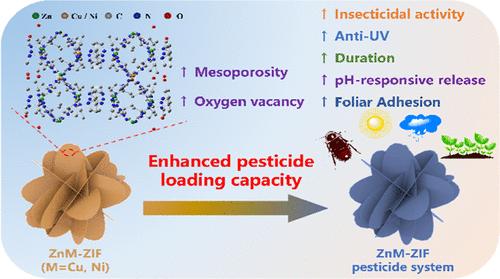
Zeolite imidazolate frameworks (ZIFs) are ideal candidates for pesticide carriers due to their simple preparation and biocompatibility. However, the reported ZIF carriers generally have low loading capacity with an unclear structure–property relationship. Herein, two novel defective bimetallic ZnM-ZIFs (M = Cu and Ni) based on leafy ZIF-L were prepared as carriers, and the correlation between structural property and loading capacity was studied using gray correlation analysis. The results showed that the second metal created defects in leafy ZnM-ZIFs that increased its mesoporosity and oxygen vacancy, thus improving the pesticide loading rate. Among them, Zn0.6Cu0.4-ZIF (30.96%) and Zn0.4Ni0.6-ZIF (19.03%) showed the highest loading rate for imidacloprid (IMI), which was 2.31 and 1.42 times higher than that of ZIF-L, respectively. After coating the metal-phenolic network (MPN) as a blocker, the final ZnM-ZIF@IMI@MPN showed higher insecticidal activity against Bemisia tabaci (1.47–1.98 times) and longer efficacy duration (1.51–1.65 times) than IMI technical (TC). Besides, the ZnM-ZIF@IMI@MPN exhibited higher photostability (2.33–2.97 times that of the TC), good pH-responsive release, stronger foliar adhesion, and favorable safety. This work gives deep insight into the effect of the second metal on the loading performance of ZnM-ZIF and provides a strategy for developing a defective bimetallic ZIF pesticide system.
期刊介绍:
ACS Sustainable Chemistry & Engineering is a prestigious weekly peer-reviewed scientific journal published by the American Chemical Society. Dedicated to advancing the principles of green chemistry and green engineering, it covers a wide array of research topics including green chemistry, green engineering, biomass, alternative energy, and life cycle assessment.
The journal welcomes submissions in various formats, including Letters, Articles, Features, and Perspectives (Reviews), that address the challenges of sustainability in the chemical enterprise and contribute to the advancement of sustainable practices. Join us in shaping the future of sustainable chemistry and engineering.



 京公网安备 11010802042870号
京ICP备2023020795号-1
京公网安备 11010802042870号
京ICP备2023020795号-1

 分享
分享
 求助内容:
求助内容: 应助结果提醒方式:
 扫码关注我们
