Changchun Ai, Yilei Shu, Ziheng Zhao, Huijuan Guo, Shangqing Chen and Qun Yi
{"title":"Advances in the application of ionic liquids in PEO-based lithium-ion solid-state electrolytes: from the perspective of fillers","authors":"Changchun Ai, Yilei Shu, Ziheng Zhao, Huijuan Guo, Shangqing Chen and Qun Yi","doi":"10.1039/D4TA09243K","DOIUrl":null,"url":null,"abstract":"<p >Poly(ethylene oxide) (PEO) composite solid-state electrolytes have been considered promising candidates as electrolytes for all-solid-state lithium batteries with high safety and excellent mechanical properties. However, the ionic conductivity of PEO-based electrolytes is usually low at room temperature, which limits their performances in practical applications. Moreover, their interfacial incompatibility with high-voltage cathode materials remains a challenge despite their better compatibility with lithium-metal anodes. The inevitable problem of lithium dendrite growth also affects the safety performance of these batteries. Ionic liquids (ILs) with high conductivity and ionic mobility are capable of enabling batteries to achieve a higher electrochemical window, offering a new platform for developing more environmentally friendly and sustainable all-solid-state lithium batteries. Considering that there has been a surge in research activities in the field of PEO/ILs systems, this review summarizes the mechanisms of different kinds of ILs in PEO-based solid polymer electrolytes and provides a comprehensive overview of the application of ILs in all-solid-state lithium batteries from the perspective of fillers. Ultimately, this review is expected to guide the design and optimization of novel PEO/ILs systems with enhanced properties for real-world applications.</p>","PeriodicalId":82,"journal":{"name":"Journal of Materials Chemistry A","volume":" 19","pages":" 13632-13656"},"PeriodicalIF":9.5000,"publicationDate":"2025-03-22","publicationTypes":"Journal Article","fieldsOfStudy":null,"isOpenAccess":false,"openAccessPdf":"","citationCount":"0","resultStr":null,"platform":"Semanticscholar","paperid":null,"PeriodicalName":"Journal of Materials Chemistry A","FirstCategoryId":"88","ListUrlMain":"https://pubs.rsc.org/en/content/articlelanding/2025/ta/d4ta09243k","RegionNum":2,"RegionCategory":"材料科学","ArticlePicture":[],"TitleCN":null,"AbstractTextCN":null,"PMCID":null,"EPubDate":"","PubModel":"","JCR":"Q1","JCRName":"CHEMISTRY, PHYSICAL","Score":null,"Total":0}
引用次数: 0
Abstract
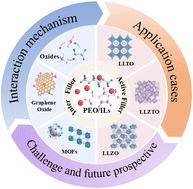
Poly(ethylene oxide) (PEO) composite solid-state electrolytes have been considered promising candidates as electrolytes for all-solid-state lithium batteries with high safety and excellent mechanical properties. However, the ionic conductivity of PEO-based electrolytes is usually low at room temperature, which limits their performances in practical applications. Moreover, their interfacial incompatibility with high-voltage cathode materials remains a challenge despite their better compatibility with lithium-metal anodes. The inevitable problem of lithium dendrite growth also affects the safety performance of these batteries. Ionic liquids (ILs) with high conductivity and ionic mobility are capable of enabling batteries to achieve a higher electrochemical window, offering a new platform for developing more environmentally friendly and sustainable all-solid-state lithium batteries. Considering that there has been a surge in research activities in the field of PEO/ILs systems, this review summarizes the mechanisms of different kinds of ILs in PEO-based solid polymer electrolytes and provides a comprehensive overview of the application of ILs in all-solid-state lithium batteries from the perspective of fillers. Ultimately, this review is expected to guide the design and optimization of novel PEO/ILs systems with enhanced properties for real-world applications.
期刊介绍:
The Journal of Materials Chemistry A, B & C covers a wide range of high-quality studies in the field of materials chemistry, with each section focusing on specific applications of the materials studied. Journal of Materials Chemistry A emphasizes applications in energy and sustainability, including topics such as artificial photosynthesis, batteries, and fuel cells. Journal of Materials Chemistry B focuses on applications in biology and medicine, while Journal of Materials Chemistry C covers applications in optical, magnetic, and electronic devices. Example topic areas within the scope of Journal of Materials Chemistry A include catalysis, green/sustainable materials, sensors, and water treatment, among others.



 京公网安备 11010802042870号
京ICP备2023020795号-1
京公网安备 11010802042870号
京ICP备2023020795号-1

 分享
分享
 求助内容:
求助内容: 应助结果提醒方式:
 扫码关注我们
